How Much Does It Cost to Start an MVNO in 2026? A Complete Breakdown
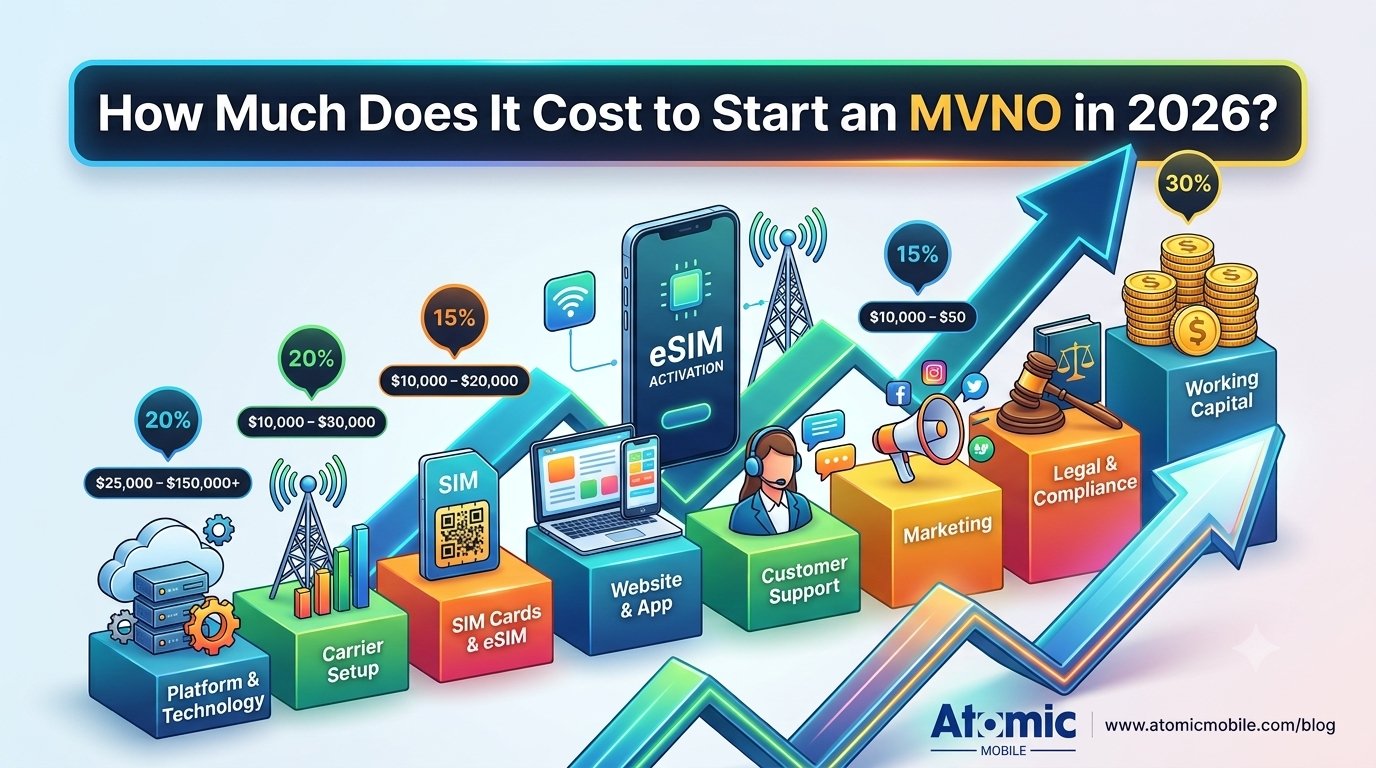
How Much Does It Cost to Start an MVNO in 2026?
One of the first questions every prospective MVNO asks is simple:
"How much does it cost to start an MVNO?"
Unfortunately, there isn't a single answer.
The cost depends on your business model, target market, number of subscribers, technology requirements, and whether you're building a consumer wireless brand, an enterprise mobility solution, or an IoT offering.
The good news is that launching an MVNO has become significantly more accessible over the last decade. Modern MVNE platforms, cloud infrastructure, and eSIM technology have reduced many of the barriers that once required millions of dollars in upfront investment.
This guide breaks down the major expenses involved in launching an MVNO in 2026 and highlights where companies often underestimate their budget.
Quick Answer
Most new MVNOs should expect to invest somewhere between $50,000 and $100,000 before achieving meaningful customer growth.
Some niche MVNOs can launch for less by using an established MVNE platform, while larger enterprise-focused providers may invest well beyond that range depending on integrations, staffing, compliance, and customer acquisition goals.
The largest mistake isn't overspending.
It's underestimating the amount of working capital needed after launch.
Typical MVNO Startup Costs
Category Estimated Cost
Platform & Technology $25,000 – $150,000+
Carrier & Wholesale Setup $10,000 – $100,000+
SIM Cards & eSIM Inventory $5,000 – $50,000+
Website, App & Customer Portal $5,000 – $75,000+
Customer Support $5,000 – $50,000+
Marketing & Customer Acquisition $10,000 – $250,000+
Legal & Compliance $5,000 – $50,000+
Working Capital $50,000 – $500,000+
- Technology Platform
Your technology stack is the foundation of your MVNO.
A modern platform typically includes:
Billing
Customer management (CRM)
Self-service portal
Mobile application
Number provisioning
Porting
Payment processing
Tax calculation
Usage rating
Reporting
Carrier integrations
APIs
Many startups choose an MVNE, such as Atomic Mobile, rather than building these systems from scratch, reducing both launch time and capital requirements.
- Carrier and Wholesale Costs
Every MVNO purchases network access from a carrier, either directly or through an MVNA or MVNE.
Costs vary depending on:
Subscriber commitments
Expected usage
Network access
Voice, SMS, and data pricing
Roaming requirements
Contract structure
New MVNOs often focus solely on wholesale rates, but the operational support behind those services can have an even greater impact on long-term success.
- SIM Cards and eSIM
Physical SIM cards remain common, but eSIM adoption continues to grow rapidly.
You'll likely need:
Physical SIM inventory
eSIM provisioning
Activation systems
Shipping and fulfillment
Packaging and branding
Businesses targeting enterprise customers may rely heavily on eSIM, while retail providers often support both.
- Website, Mobile App, and Customer Experience
Your digital experience is often your storefront.
Budget should include:
Marketing website
Online checkout
Customer portal
Mobile app (not a must)
Knowledge base
Support chat
Payment processing
Customers increasingly expect to activate service online within minutes.
- Customer Support
Wireless customers contact support more often during activation than almost any other point in the customer lifecycle.
Plan for:
Phone support
Live chat
Porting assistance
Technical troubleshooting
Device compatibility questions
Exceptional support doesn't just improve customer satisfaction—it directly improves retention.
- Marketing and Customer Acquisition
Even the best wireless service won't grow without customers.
Marketing expenses often include:
Google Ads
Meta advertising
SEO
Content marketing
Affiliate programs
Referral incentives
Public relations
Influencer partnerships
Many MVNOs spend more acquiring customers than they initially budgeted.
Customer acquisition cost (CAC) should be monitored alongside customer lifetime value (LTV) to ensure sustainable growth.
- Legal, Compliance, and Regulatory Requirements
Launching a telecommunications company involves more than selling wireless service.
Depending on your business model, you may need to consider:
Terms of service
Privacy policies
CPNI compliance
FCC requirements
Sales tax
Telecommunications taxes
Number portability requirements
Data security
Working with experienced legal and regulatory professionals can prevent costly mistakes later. Atomic Mobile has also launched Atomic Fusion to help with all of this at a fraction of the cost: https://atomicmobile.com/products/fusion
- Working Capital
Working capital is frequently overlooked.
Most MVNOs pay carrier invoices before collecting payment from every customer.
You'll also need cash available for:
Payroll
Marketing
Customer growth
Device purchases
Unexpected operational costs
Many successful MVNOs fail not because their business model is flawed, but because they run out of operating capital before reaching scale.
Can You Launch an MVNO for Less Than $100,000?
Yes.
Companies using an experienced MVNE can often reduce infrastructure costs and shorten implementation timelines.
However, reducing startup costs shouldn't come at the expense of customer experience, billing accuracy, or operational reliability.
Launching quickly is valuable.
Launching correctly is essential.
Beyond Launch: Building a Sustainable MVNO
Launching your network is only the beginning.
Long-term success depends on:
Customer retention
Fast onboarding
Reliable billing
Accurate usage reporting
Automated provisioning
Fraud prevention
Operational efficiency
Strong customer support
The most successful MVNOs continuously improve these areas as they scale.
Final Thoughts
Starting an MVNO in 2026 is more achievable than ever before, but success requires realistic planning and a clear understanding of the investments involved.
Choosing the right partners, implementing a scalable technology platform, and budgeting for ongoing operations can make the difference between a successful launch and an expensive learning experience.
Whether you're building a consumer wireless brand, an enterprise mobility solution, or an IoT offering, understanding your true startup costs is one of the first and most important steps.
Frequently Asked Questions
How much money do you need to start an MVNO?
Most MVNOs should plan for an initial investment between $50,000 and $100,000, depending on scale, technology requirements, and customer acquisition strategy.
Can one person start an MVNO?
Yes. Many MVNOs begin with a small team by partnering with an experienced MVNE that provides billing, provisioning, and operational support.
How long does it take to launch an MVNO?
With the right technology partner, many MVNOs can launch in 30 to 90 days, although more complex deployments may take longer.
What is the biggest expense when starting an MVNO?
While technology is important, ongoing customer acquisition and working capital often become the largest long-term expenses.
Is building your own MVNO platform cheaper?
In most cases, no. Leveraging an established MVNE platform is generally faster, less expensive, and significantly less risky than building and maintaining your own OSS/BSS infrastructure.
Ready to launch? Explore MVNO in a Box — Atomic Mobile's turnkey platform with carrier connectivity, billing, eSIM, APIs, and compliance in one place.
Brian Latchford
Author