Cellular Connectivity for POS & Payment Systems
Payments can't wait on Wi-Fi. Atomic Mobile connects payment terminals, smart registers, kiosks, and mobile card readers with cellular built for transactions — provisioned at fleet scale and visible in near real time.
Why use cellular connectivity for POS systems?
Cellular gives payment devices a dedicated connection that's independent of store Wi-Fi or wired internet. Terminals work out of the box anywhere — countertop, curbside, pop-up, or vehicle — and keep processing when local networks fail. Atomic Mobile provides the SIM and eSIM provisioning, transaction-class data plans, and management APIs behind cellular POS deployments.
One Network for Every Payment Device
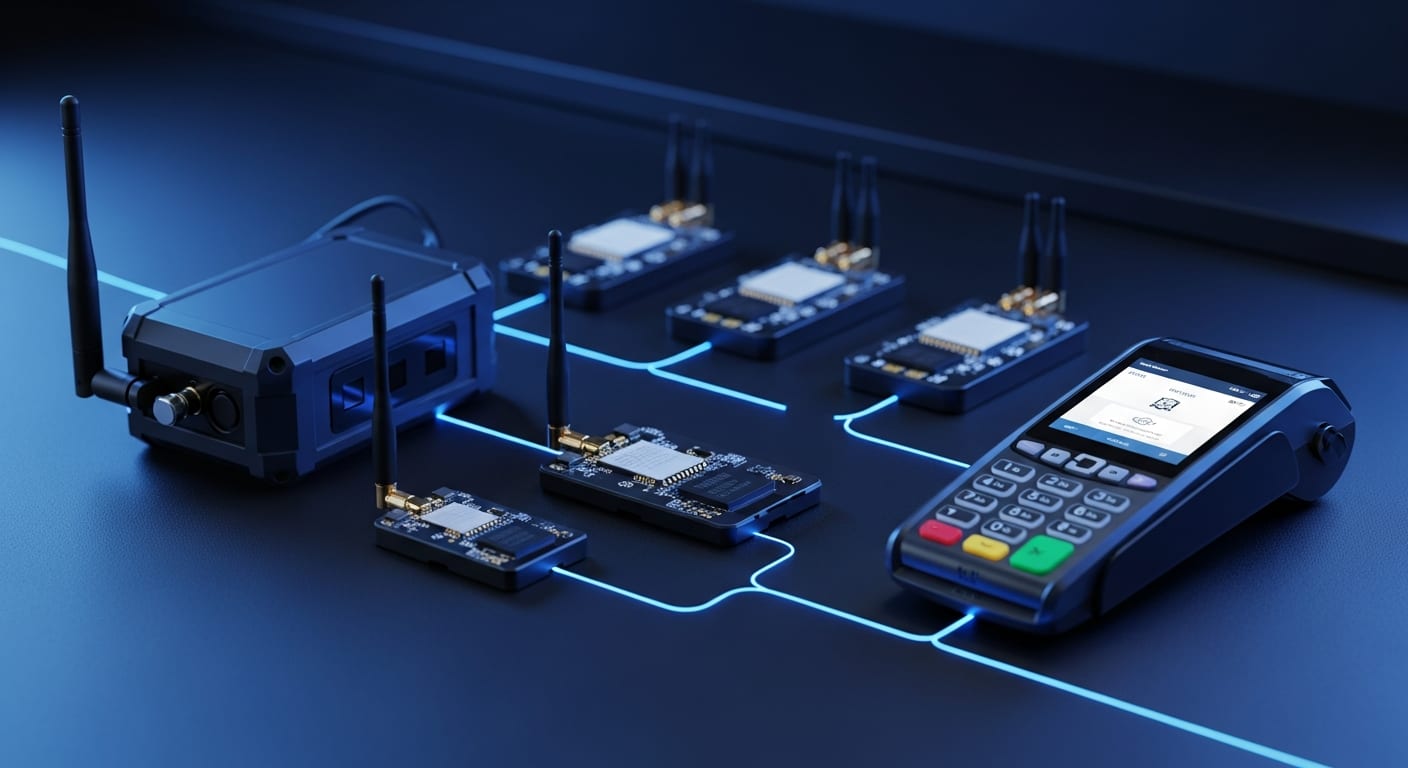
The problem: payments are only as reliable as the network under them
Every declined tap and spinning terminal is revenue walking out the door. Store Wi-Fi gets congested and misconfigured, wired lines fail, and a growing share of payment devices — food trucks, delivery readers, kiosks, vending machines, pop-up retail — never have a fixed line to begin with. Meanwhile, managing thousands of terminal SIMs through consumer carrier tools doesn't scale, and usage problems surface on the invoice instead of in the moment.
Cellular built for payment devices
Atomic Mobile packages POS connectivity end to end: SIMs and SGP.32 eSIM provisioned at manufacture or at deployment, multi-network coverage so terminals connect at any site, data plans sized for transaction-class traffic, and APIs that let your platform activate, suspend, and swap lines across an entire terminal estate programmatically.
- SIM and SGP.32 eSIM form factors for terminals, smart registers, kiosks, and mobile readers
- Multi-network coverage — devices connect at whatever site they're deployed to
- Transaction-class data plans: low, bursty usage priced for payments, not smartphones
- Bulk provisioning and lifecycle APIs: activate, suspend, swap, and retire at estate scale
- UsageIQ near real-time visibility to catch offline terminals and runaway data early
Primary connection, backup — or both
For mobile readers, kiosks, vending, and unattended retail, cellular is the primary and often only connection. For countertop POS in stores and restaurants, cellular is the failover layer that keeps payments processing through ISP outages. Atomic Mobile serves both patterns from one platform — the same SIMs, plans, APIs, and visibility, whether cellular is the lifeline or the safety net.
Built for high-volume terminal deployments
Rolling out payment hardware at enterprise scale is a logistics operation as much as a connectivity one. Atomic Mobile supports the way large deployments actually happen: staged activations that match your rollout waves, bulk provisioning ahead of hardware shipments, pooled data plans across the estate, device-level usage monitoring, and API-driven lifecycle management — coordinated nationwide, from pilot markets to full deployment. And the same platform connects the entire field ecosystem around payments: merchant tablets, courier handhelds, payment terminals, smart lockers, kiosks, and signage.
- Staged activations matched to deployment waves — pay for lines when devices go live
- Bulk provisioning ahead of hardware shipments, so devices arrive ready to transact
- Pooled data plans across the terminal estate instead of per-device buckets
- Device-level usage monitoring and API-driven lifecycle management at nationwide scale
Key Capabilities
SIM & eSIM for terminals
Form factors and SGP.32 eSIM for payment hardware of every class.
Multi-network coverage
Terminals connect at any site without per-location carrier decisions.
Transaction-class plans
Data pricing sized for payment traffic and batch settlement.
Estate-scale APIs
Provision and manage thousands of terminal lines programmatically.
UsageIQ visibility
Near real-time usage data flags dark terminals and anomalies.
Failover ready
The same platform backs up wired countertop POS at fixed sites.
Who This Is For
Payment processors & ISOs
Embed connectivity into your terminal program with API control.
POS & terminal makers
Ship hardware that processes payments out of the box, anywhere.
Delivery & on-demand platforms
Connect merchant tablets, courier handhelds, and doorstep payment devices nationwide.
Kiosk & vending operators
Keep unattended retail transacting without site networks.
Multi-site retail & restaurants
Standardize payments connectivity — primary or failover — across locations.
Frequently Asked Questions
Why use cellular connectivity for POS systems?
Cellular gives payment devices a connection that's independent of site Wi-Fi and wired internet — so terminals work anywhere and keep processing when local networks fail. It also removes payment traffic from shared store networks, simplifying network segmentation.
Atomic Mobile adds the operational layer that matters at fleet scale: SIM and eSIM provisioning, transaction-class plans, lifecycle APIs, and near real-time usage visibility across the whole terminal estate.
Is cellular secure enough for payment processing?
Yes — payment security is handled by the payment application itself, which encrypts card data end to end before it ever touches the network. Cellular serves as the transport layer, and major processors run production payment traffic over cellular every day. Keeping payment devices off shared store Wi-Fi can also simplify PCI network-segmentation scope.
How much data does a payment terminal use?
Individual transactions are measured in kilobytes, so a typical terminal uses just a few megabytes per month, with batch settlement and software updates adding periodic bursts. Atomic Mobile's transaction-class plans are priced for exactly that profile — with near real-time visibility to catch any device consuming outside it.
Can cellular act as backup for countertop POS?
Yes. A failover-capable router or terminal holds a cellular connection in standby and automatically switches to cellular when the primary connection fails, keeping payments processing through the outage. Atomic Mobile provides both patterns — cellular-primary for mobile and unattended devices, and cellular-failover for fixed sites — from one platform.
How do companies manage SIMs across thousands of terminals?
Through platform APIs rather than carrier portals: bulk activation at rollout, automatic suspension for retired hardware, plan changes by device class, and usage monitoring feeding the same dashboards that track terminal health. Atomic Mobile's lifecycle APIs are built for exactly this estate-scale operation.
Related IoT Connectivity
Related Use Cases
From concept to live mobile service
Wireless as a loyalty & revenue product
Connectivity across the modern enterprise
Connectivity for devices in the field
One platform across markets
Turn belonging into a wireless product
Mobile plans inside the banking app
Sell travel data with instant eSIM delivery
Bundle mobile lines with home internet
Reliable cellular for care beyond the clinic
Fan-base wireless & content bundles
Cellular for AI hardware & smart wearables