Apple vs. Samsung: Nobody Cares Who Built the First Foldable
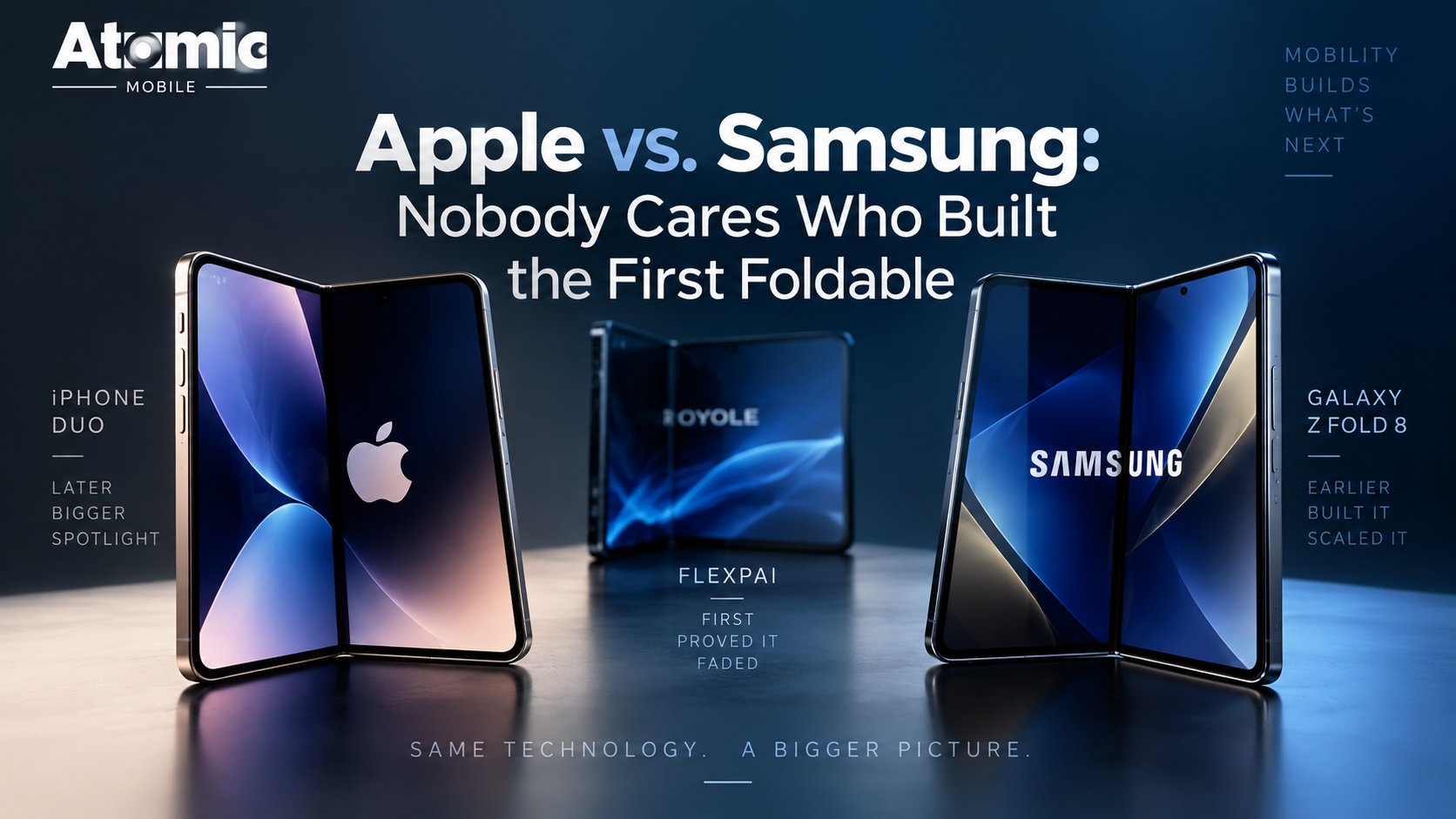
Samsung has a message for Apple: “Welcome to Foldables.”
It is a good line.
It is also a little ironic.
Apple just entered the foldable smartphone market with the iPhone Duo, years after Samsung launched the original Galaxy Fold. Samsung wasted little time reminding everyone who had been building foldable phones while Apple sat on the sidelines.
There is just one problem with the narrative.
Samsung wasn’t first either.
Samsung Wasn't First
Chinese display manufacturer Royole shipped the FlexPai in 2018, before Samsung launched the Galaxy Fold.
If you have never heard of the FlexPai, that is precisely the point.
Royole got there first. Samsung got there later and became synonymous with the category.
Samsung then spent years refining the technology, improving hinges, reducing weight, addressing display durability, and convincing consumers that a phone that folds in half was more than a technology demonstration.
By 2026, Samsung held roughly 40% of the global foldable smartphone market.
Then Apple arrived.
Not first.
Not second.
Not even particularly early.
And suddenly everyone is talking about foldables again.
Being First and Winning Are Two Different Things
Technology has a strange obsession with being first.
First to launch.
First to announce.
First to patent.
First to market.
But customers rarely reward companies simply for arriving before everyone else.
They reward companies that make something useful, accessible, reliable, and desirable.
Royole proved that a foldable smartphone could exist.
Samsung proved that foldable smartphones could become a real product category.
Now Apple is testing whether that category can become significantly larger.
Those are three very different accomplishments.
And they illustrate something that matters far beyond smartphones:
Creating a category and owning a category are not the same thing.
Apple Has Played This Game Before
Apple entering an established category late should surprise almost nobody.
The iPhone wasn't the first smartphone.
The iPad wasn't the first tablet.
The Apple Watch wasn't the first smartwatch.
Apple has repeatedly allowed other companies to establish a market, expose its weaknesses, educate consumers, and improve the underlying technology before entering.
That strategy has risks. Waiting too long can allow a competitor to build an insurmountable advantage.
But entering later has advantages too.
You get to watch everyone else make mistakes.
Foldables are a particularly good example.
Early devices struggled with screen durability, visible creases, awkward dimensions, high prices, software optimization, battery compromises, and questions about whether consumers actually needed them.
Samsung itself famously delayed the original Galaxy Fold after reviewers experienced broken displays.
Seven years later, Apple enters a very different market.
The supply chain is more mature. Displays are better. Hinges are better. Software has had years to adapt. Consumers understand what a foldable phone is.
Apple didn't have to create that market.
Samsung and others did much of that work already.
But Samsung Deserves More Credit Than "First"
This is also why arguing that Samsung wasn't technically first misses part of the story.
Samsung may not have invented the commercial foldable smartphone, but it helped make the category credible.
That is arguably more valuable.
Samsung continued investing after the messy launch of the original Galaxy Fold. It iterated through multiple generations, expanded the form factor, improved the hardware, and built global distribution around foldables.
That persistence matters.
There are thousands of companies that have been first to something.
Far fewer turn that initial innovation into a durable business.
The real competitive advantage isn't saying:
We did it first.
It is being able to say:
We kept making it better until customers cared.
Now Apple Gets Its Turn
The iPhone Duo starts at $1,999, putting it firmly in premium territory.
Foldables also remain a relatively small portion of the overall smartphone market. Despite years of development, they have yet to become the default form factor for most consumers.
That makes Apple's entrance particularly interesting.
Apple doesn't need to prove that foldable phones work.
Samsung already did that.
Apple needs to prove that millions more people should want one.
That is a different challenge entirely.
And if Apple succeeds, there is another irony.
Its success could benefit Samsung too.
Samsung Display is part of the supply chain providing foldable display technology for Apple's new device.
Competitors can fight for customers while simultaneously helping expand the market they both participate in.
There Is a Wireless Lesson Here
This same dynamic happens constantly in wireless.
Companies race to announce the cheapest plan.
The newest feature.
The newest eSIM experience.
The newest AI capability.
The newest pricing model.
The first launch using a particular technology.
Being first makes a great press release.
It doesn't necessarily make a great business.
A competitor can copy a price.
A feature can be replicated.
Technology eventually becomes available to everyone.
What is considerably harder to copy is the infrastructure around the product.
Distribution.
Customer relationships.
Brand trust.
Operational execution.
Billing.
Support.
Integrations.
Data.
The ability to improve a product continuously after launch.
Those are the things that turn an interesting idea into a sustainable business.
The First Mover Doesn't Always Own the Market
There is a natural tendency to think innovation is a race with a starting gun.
Someone crosses the line first and wins.
Real markets rarely work that way.
Sometimes the first mover wins.
Sometimes the second mover learns from the first mover.
Sometimes a company arrives years later and dramatically expands the category.
And sometimes the company that invented the thing disappears while everyone else builds billion dollar businesses around the idea.
The foldable smartphone market now gives us all three stages at once.
Royole was first.
Samsung built the category.
Apple is trying to expand it.
The next few years will tell us what consumers actually want.
But the business lesson is already clear.
Don't confuse being first with building something that lasts.
Brian Latchford
Author