The Hidden Cost of Delayed Usage Data
The Hidden Cost of Delayed Usage Data
For years, mobile virtual network operators (MVNOs) have focused on negotiating better wholesale rates, acquiring subscribers, and designing competitive wireless plans. Yet one of the most significant threats to profitability often receives far less attention: the time it takes to understand how much data customers are actually consuming.
When an MVNO relies on usage records that are 24 to 36 hours old, it is effectively managing today's network expenses with yesterday's information.
In a business where margins can be measured in just a few dollars per subscriber, that delay matters.
The next competitive advantage for MVNOs may not come from purchasing connectivity at a lower price. It may come from managing that connectivity more intelligently.
The Problem With Yesterday's Data
Traditional wholesale wireless reporting often relies on batch processing. Usage records are collected, processed, and delivered to operators hours after the underlying consumption occurs.
For MVNOs, this creates a fundamental disconnect between when network costs are incurred and when operators can respond.
Consider a subscriber consuming significantly more data than expected. Under a traditional reporting model, the MVNO may not identify that behavior until the following day, or even later.
By then, the subscriber may have consumed substantially more data, and the associated wholesale costs may already be unavoidable.
This is particularly challenging for operators offering unlimited plans, where profitability often depends on managing the difference between average subscriber consumption and the behavior of a smaller population of heavy users.
The problem is not necessarily that customers are using too much data. It is that operators lack the timely information needed to manage their economics effectively.
Small Delays Can Create Significant Costs
Consider a hypothetical MVNO with 10,000 subscribers.
Assume that 2% of those subscribers, or 200 lines, experience periods of unusually heavy consumption. During one such period, each of those subscribers consumes an additional 5GB per day beyond the operator's expected usage assumptions.
At an illustrative wholesale cost of $0.50 per GB, the financial exposure looks like this:
- 200 subscribers consuming an additional 5GB daily
- 1,000GB of additional daily consumption
- $500 in additional wholesale expense per day
- $15,000 in additional expense if that pattern continues for 30 days
That represents $1.50 per subscriber per month across the entire 10,000-line base.
For an operator generating $8 in monthly gross margin per subscriber before this additional consumption, that expense would consume nearly 19% of its expected gross margin.
These figures are illustrative, not actual Atomic Mobile customer results. They also assume the additional usage represents an incremental wholesale cost and is not offset by other revenue or contractual arrangements.
The example demonstrates an important principle: a relatively small population of subscribers can materially influence the economics of an entire wireless business.
Faster usage reporting does not automatically eliminate those costs. However, it creates an opportunity to identify abnormal consumption earlier and take appropriate action before the exposure grows.
Usage Intelligence Is a Financial Tool
Most operators understand the importance of subscriber growth, average revenue per user (ARPU), churn, and customer acquisition costs.
Usage intelligence deserves a place alongside those metrics.
Two subscribers paying the same monthly price may have dramatically different consumption patterns. One may generate an attractive margin, while the other may consume nearly all the revenue associated with the plan.
Without timely, line-level usage information, those differences can remain hidden until the operator reviews its wholesale invoice.
Near real-time usage intelligence changes the operating model.
Instead of relying primarily on retrospective reporting, MVNOs can identify emerging consumption patterns, evaluate subscriber-level economics, and make more informed decisions throughout the billing cycle.
This is especially important as MVNOs experiment with customized unlimited plans, shared data allowances, family plans, and usage-based offerings.
As we explored in How Do MVNOs Make Money?, subscriber growth alone does not determine profitability. The relationship between revenue, consumption, and operating expenses ultimately determines whether a wireless business can scale sustainably.
Usage visibility is an essential part of understanding that relationship.
Automation Requires Timely Information
Visibility is only the beginning.
The greater opportunity comes when usage intelligence supports automated operational decisions.
An MVNO might establish thresholds that trigger customer notifications, apply appropriate speed controls, or flag unusual consumption for further investigation.
For example, an operator could design a plan that provides full-speed access through a defined usage threshold before transitioning the subscriber to a different speed tier, consistent with the plan's disclosed terms.
With timely usage information and integrated network controls, those policies can operate much closer to the point of consumption.
With delayed reporting, the same policies may become reactive rather than preventive.
This distinction matters because the effectiveness of automation depends on the quality and timeliness of the information driving it.
An automated system working with yesterday's usage records may execute its rules perfectly while still producing an undesirable financial outcome.
Automation is not inherently intelligent. Its value depends on having the right information at the right time.
Better Visibility Can Improve Customer Experience
Usage intelligence is not exclusively about protecting margins.
It can also improve the relationship between an MVNO and its subscribers.
Customers increasingly expect transparency around how their wireless plans work, particularly when plans include data thresholds, speed reductions, or other usage-based conditions.
When operators rely on delayed reporting, subscribers may receive notifications after crossing a threshold or encounter unexpected changes in service performance.
More timely visibility creates opportunities for clearer communication.
Customers can receive usage notifications earlier, better understand their consumption, and make informed decisions about their plans.
For operators, this can reduce confusion, prevent avoidable support interactions, and strengthen trust.
There is an important distinction between managing consumption and frustrating customers. A successful usage strategy should accomplish the former without creating the latter.
The goal should not be to restrict subscribers unnecessarily. It should be to design sustainable plans with clear expectations and consistent execution.
From Reporting to Operational Intelligence
The industry is moving toward a model in which usage data becomes an active component of wireless operations rather than simply a historical record.
That transition requires more than a dashboard.
Operators need reliable network-sourced records, line-level visibility, integration with operational systems, and the ability to apply appropriate controls.
This is the challenge Atomic Mobile developed Atomic UsageIQ to address.
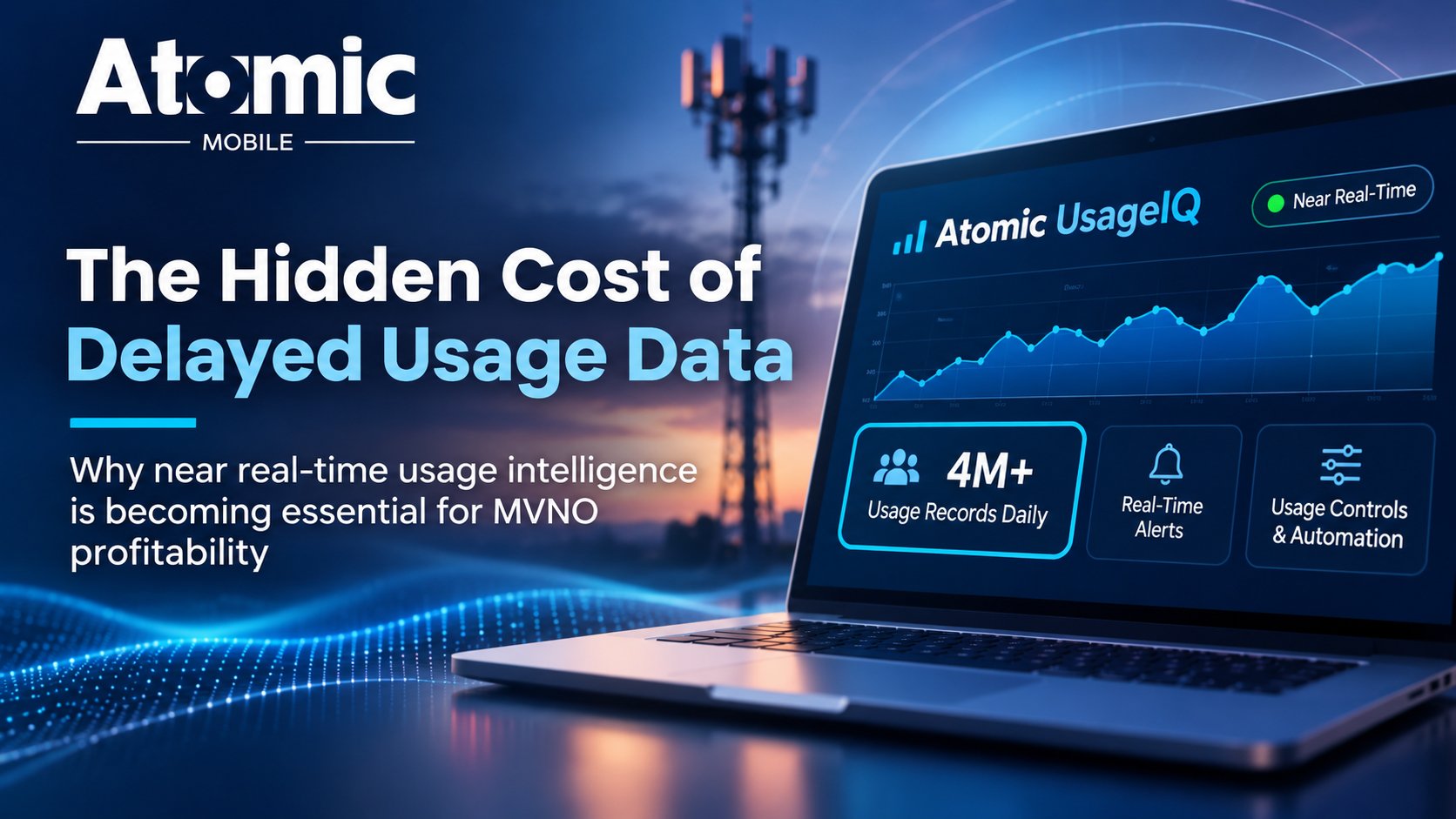
Introduced in 2026, UsageIQ provides near real-time visibility into mobile data consumption, reducing dependence on the traditional 24-to-36-hour reporting cycle.
Today, the platform processes more than 4 million usage records daily.
That volume reflects the scale at which usage intelligence is now operating across the MVNOs Atomic supports.
UsageIQ enables operators to monitor consumption at the subscriber level, identify heavy usage patterns, establish alerts, and implement appropriate throttling or blocking policies through supported network controls.
It also supports more flexible plan design, allowing MVNOs to develop offerings that better align customer expectations with underlying wholesale economics.
Combined with operational capabilities such as Atomic Fusion, which addresses billing, taxation, compliance, and support, usage intelligence becomes part of a broader strategy for reducing operational complexity.
The objective is not simply to provide operators with more data.
It is to make that data useful.
The Next Competitive Advantage
Wholesale network pricing will always matter to MVNO profitability. Even modest improvements in per-gigabyte economics can create meaningful financial benefits at scale.
But pricing is only one side of the equation.
An operator with excellent wholesale rates and poor consumption visibility may struggle to protect its margins. Conversely, an operator with disciplined usage management can make better decisions about plan design, pricing, and customer experience.
As the MVNO market becomes more competitive, operators will need to look beyond subscriber acquisition and headline plan prices.
They will need to understand their economics at the individual subscriber level and respond to changing consumption patterns before those patterns become financial problems.
Near real-time usage intelligence is increasingly becoming a foundational capability rather than an optional enhancement.
The future of MVNO profitability will not be determined solely by who buys connectivity at the lowest price.
It will also be determined by who understands, manages, and monetizes that connectivity most effectively.
Brian Latchford
Author