How to Choose an MVNO Platform in 2026: The Buyer's Guide
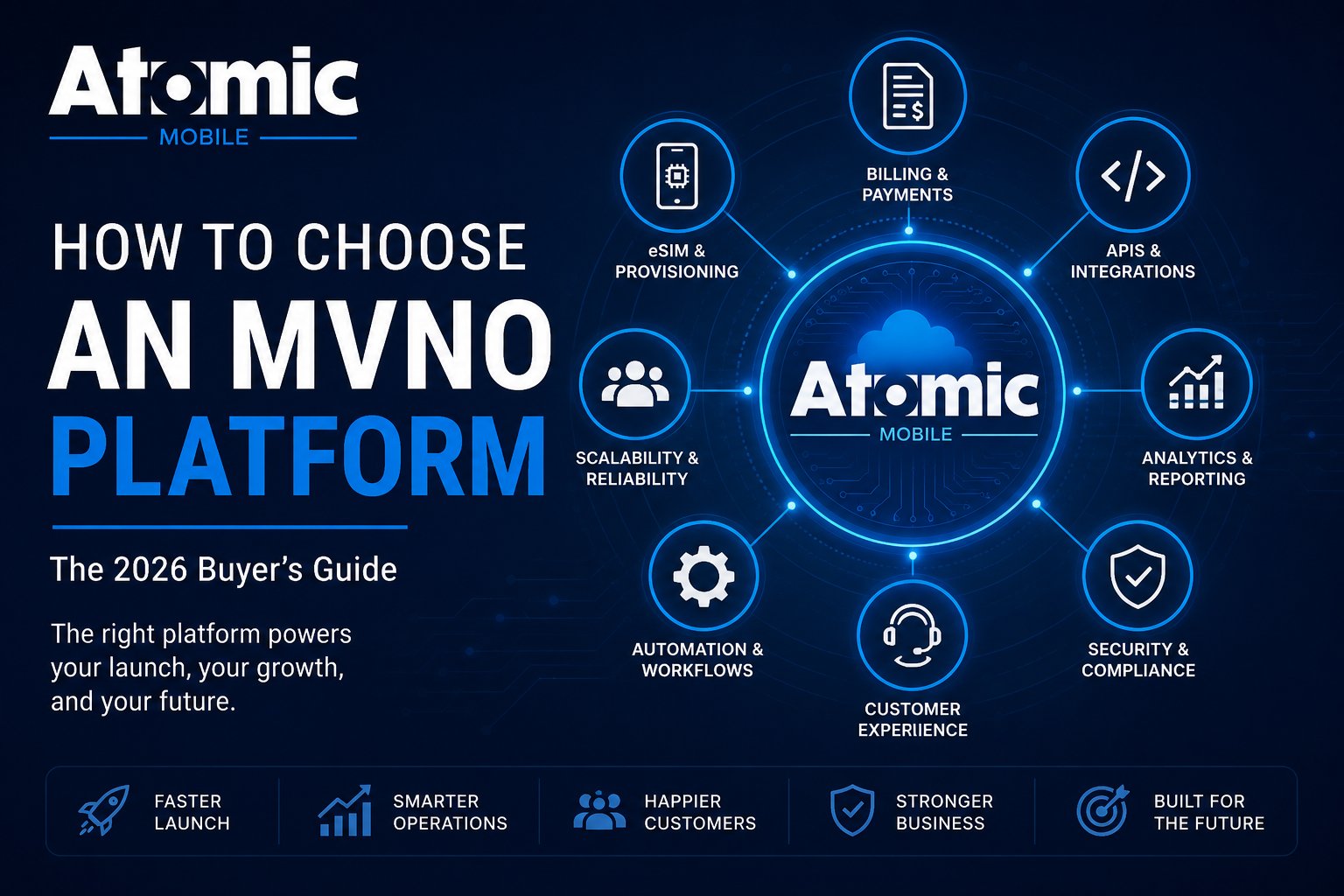
How to Choose an MVNO Platform in 2026
Launching an MVNO has never been more accessible. Modern technology has lowered barriers to entry, giving brands, enterprises, retailers, financial institutions, and entrepreneurs new opportunities to offer wireless services.
But launching successfully depends on far more than obtaining access to a carrier network.
The technology platform behind your MVNO will influence nearly every aspect of your business, including customer experience, operational efficiency, scalability, profitability, and your ability to introduce new services in the future.
Many companies compare platforms primarily on price. While cost is certainly important, choosing an MVNO platform based solely on the lowest proposal often leads to expensive limitations later.
Here are the areas every organization should evaluate before making a decision.
- Billing Should Be More Than Sending Invoices
Billing is the operational backbone of every MVNO.
A modern platform should handle:
Real-time rating
Recurring billing
Proration
Taxes and regulatory fees
Payment processing
Usage rating
Discounts and promotions
Enterprise invoicing
Revenue reporting
Ask whether the platform can support your business five years from now, not just on launch day.
If adding a new rate plan or promotion requires custom development every time, growth becomes increasingly difficult.
- APIs Matter More Than Ever
Today's wireless businesses don't operate in isolation.
They integrate with:
CRMs
Accounting systems
Customer support platforms
Marketing automation
Business intelligence tools
AI solutions
Mobile applications
An MVNO platform should offer modern, well-documented APIs that allow these systems to communicate seamlessly.
Closed systems create operational bottlenecks that become more costly as your business grows.
- eSIM Should Be a Core Capability
eSIM adoption continues to accelerate across consumer, enterprise, and IoT markets.
Your platform should support:
Digital activation
QR code provisioning
Remote provisioning
Multi-device management
Enterprise deployments
Future eSIM standards
If eSIM feels like an add-on rather than a native capability, it's worth asking how much investment the platform is making in future technologies.
- Automation Should Reduce Operational Work
Every manual process increases cost.
Look for automation in:
Customer onboarding
Activations
Suspensions
Payment collections
Notifications
Number portability
SIM fulfillment
Usage alerts
Fraud monitoring
The most successful MVNOs automate routine tasks so their teams can focus on growth instead of administration.
- Reporting Should Drive Better Decisions
Good reporting tells you what happened.
Great reporting helps you decide what to do next.
Evaluate whether the platform provides visibility into:
Subscriber growth
Churn
ARPU
Revenue
Usage patterns
Support metrics
Activation trends
Profitability by plan
Customer lifetime value
Actionable analytics become even more valuable as AI-powered decision making continues to evolve.
- Security and Compliance Cannot Be an Afterthought
Wireless providers manage sensitive customer information and financial data.
Ask potential partners about:
Security certifications
Data encryption
Role-based permissions
Audit logging
Backup strategies
Disaster recovery
Regulatory compliance
A mature platform should treat security as a core design principle rather than a feature added later.
- Can the Platform Scale With Your Business?
Launching with 500 subscribers is very different from supporting 500,000.
Ask questions such as:
How many active subscribers does the platform currently support?
How are large-scale billing events handled?
Can enterprise customers have custom workflows?
How frequently are updates released?
What happens during periods of rapid growth?
A platform should make expansion easier, not require a major migration every time your business reaches a new milestone.
- Evaluate the Team Behind the Technology
Technology matters.
Experience matters just as much.
Ask:
How many MVNOs has the team launched?
Have they worked directly with mobile network operators?
Do they understand regulatory requirements?
Can they support enterprise deployments?
How quickly do they respond to operational issues?
A knowledgeable partner often solves problems before they become visible to customers.
- Look Beyond Launch Day
Launching an MVNO is the beginning of the journey, not the finish line.
Your platform partner should continue helping you:
Introduce new products
Expand internationally
Launch IoT services
Improve customer retention
Increase automation
Adopt emerging technologies
Optimize operational costs
The right platform evolves alongside your business.
Questions Every Buyer Should Ask
Before selecting an MVNO platform, ask every vendor:
What differentiates your platform from competitors?
Which capabilities are native versus custom development?
How frequently is the platform updated?
What APIs are available?
What is included in implementation?
How do you support eSIM?
How do you handle taxes and compliance?
What reporting is available?
How do you help customers scale?
Can you provide customer references?
The quality of these answers often reveals more than a feature checklist.
Final Thoughts
Choosing an MVNO platform is one of the most consequential technology decisions your organization will make.
While pricing and timelines are important, long-term success depends on selecting a platform that is secure, scalable, well integrated, and supported by a team with deep operational expertise.
The wireless industry continues to evolve rapidly through automation, AI, digital customer experiences, and enterprise mobility. Organizations that invest in a modern technology foundation today will be better positioned to adapt to tomorrow's opportunities.
At Atomic Mobile, we've spent decades building and operating wireless platforms, launching MVNOs, and helping organizations navigate the complexities of telecom. Our perspective is shaped by real-world operational experience, not just software development.
Whether you're evaluating your first MVNO platform or considering a migration from an existing provider, taking the time to ask the right questions today can save significant cost, complexity, and disruption in the future.
Ready to launch? Explore MVNO in a Box — Atomic Mobile's turnkey platform with carrier connectivity, billing, eSIM, APIs, and compliance in one place.
Brian Latchford
Author