MNO vs. MVNA vs. MVNE vs. MVNO: Understanding the U.S. Wireless Ecosystem
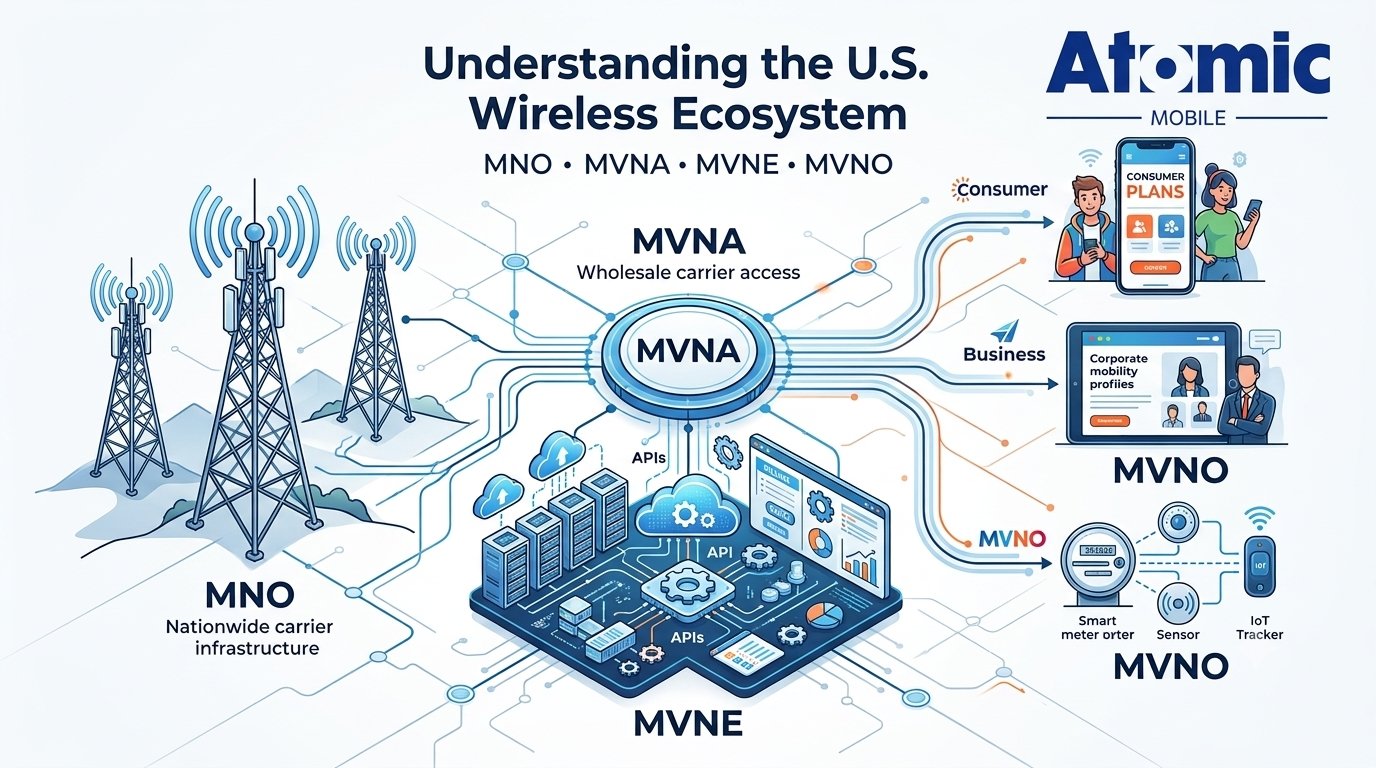
The wireless industry is filled with acronyms that can quickly become confusing. Whether you're considering launching your own wireless brand or simply trying to understand how mobile service providers operate, you'll likely encounter four important terms:
- MNO
- MVNA
- MVNE
- MVNO
While these companies all play a role in delivering wireless service, they each serve a very different purpose. Understanding the differences can help businesses make better decisions when entering the U.S. mobile market.
MNO (Mobile Network Operator)
An MNO owns and operates the physical wireless network.
This includes:
- Cell towers
- Radio spectrum
- Core network infrastructure
- Billing and authentication systems
- Network engineering
In the United States, the three nationwide MNOs are:
- AT&T
- Verizon
- T-Mobile
Building an MNO requires tens of billions of dollars in infrastructure, spectrum licenses, and ongoing maintenance. Because of this, very few companies ever become MNOs.
Think of the MNO as the company that owns the highways.
MVNA (Mobile Virtual Network Aggregator)
An MVNA purchases wireless capacity from an MNO and makes that capacity available to multiple MVNOs.
Rather than every new wireless company negotiating directly with a major carrier, the MVNA provides:
- Wholesale wireless access
- Commercial agreements
- SIM management
- Pricing programs
- Carrier relationships
This dramatically lowers the barrier to entry for companies looking to launch wireless services.
Think of an MVNA as a wholesale distributor.
Instead of buying directly from the manufacturer, businesses purchase through the distributor that already has volume pricing and established relationships.
MVNE (Mobile Virtual Network Enabler)
While an MVNA provides network access, an MVNE provides the technology required to operate a wireless company.
Typical MVNE services include:
- OSS/BSS platforms
- Customer provisioning
- Activations
- Number portability
- Billing systems
- APIs
- Customer care tools
- Reporting
- Compliance
- Usage monitoring
Without an MVNE, an MVNO would need to build millions of dollars worth of software before signing its first customer.
Think of the MVNE as the operating system behind the business.
MVNO (Mobile Virtual Network Operator)
The MVNO is the customer-facing wireless brand.
This is the company consumers or businesses actually recognize.
Examples include companies that sell:
- Consumer wireless plans
- Business mobility
- IoT connectivity
- Private labeled wireless services
- Industry specific mobile solutions
The MVNO focuses on:
- Marketing
- Sales
- Customer acquisition
- Customer support
- Brand development
Unlike an MNO, the MVNO does not own wireless towers or spectrum.
Instead, it leverages the infrastructure and technology provided by its partners.
Think of the MVNO as the retail store.
How They All Work Together
The relationship is actually very straightforward.
MNO
↓ Provides the wireless network
MVNA
↓ Provides wholesale carrier access
MVNE
↓ Provides the software and operational platform
MVNO
↓ Sells wireless service to customers
Each layer specializes in what it does best, creating an efficient ecosystem that allows new wireless companies to launch much faster than building everything from scratch.
Where Does Atomic Mobile Fit?
Atomic Mobile is unique because we serve as both an MVNA and an MVNE.
That means our partners receive both:
- Direct wholesale wireless access
- The technology platform needed to launch and operate their business
Instead of coordinating multiple vendors, businesses can work with a single partner that provides carrier connectivity, operational systems, onboarding, compliance, billing, customer provisioning, analytics, and ongoing support.
For entrepreneurs, enterprises, and organizations looking to launch an MVNO in the United States, this significantly simplifies the process while reducing deployment time and operational complexity.
Final Thoughts
Launching a wireless company no longer requires owning towers or investing billions in network infrastructure.
Today's wireless ecosystem allows businesses to focus on building their brand while experienced partners handle the network, technology, and operations behind the scenes.
Understanding the difference between an MNO, MVNA, MVNE, and MVNO is the first step toward choosing the right launch strategy. For a deeper side-by-side look at the aggregator and enabler roles, see our MVNA vs MVNE comparison. For companies looking to enter the U.S. wireless market, partnering with an experienced MVNA and MVNE can dramatically reduce complexity, accelerate time to market, and position the business for long-term success. We at Atomic Mobile would love to help!
Brian Latchford
Author