Your MVNO Needs Better APIs | Atomic Mobile
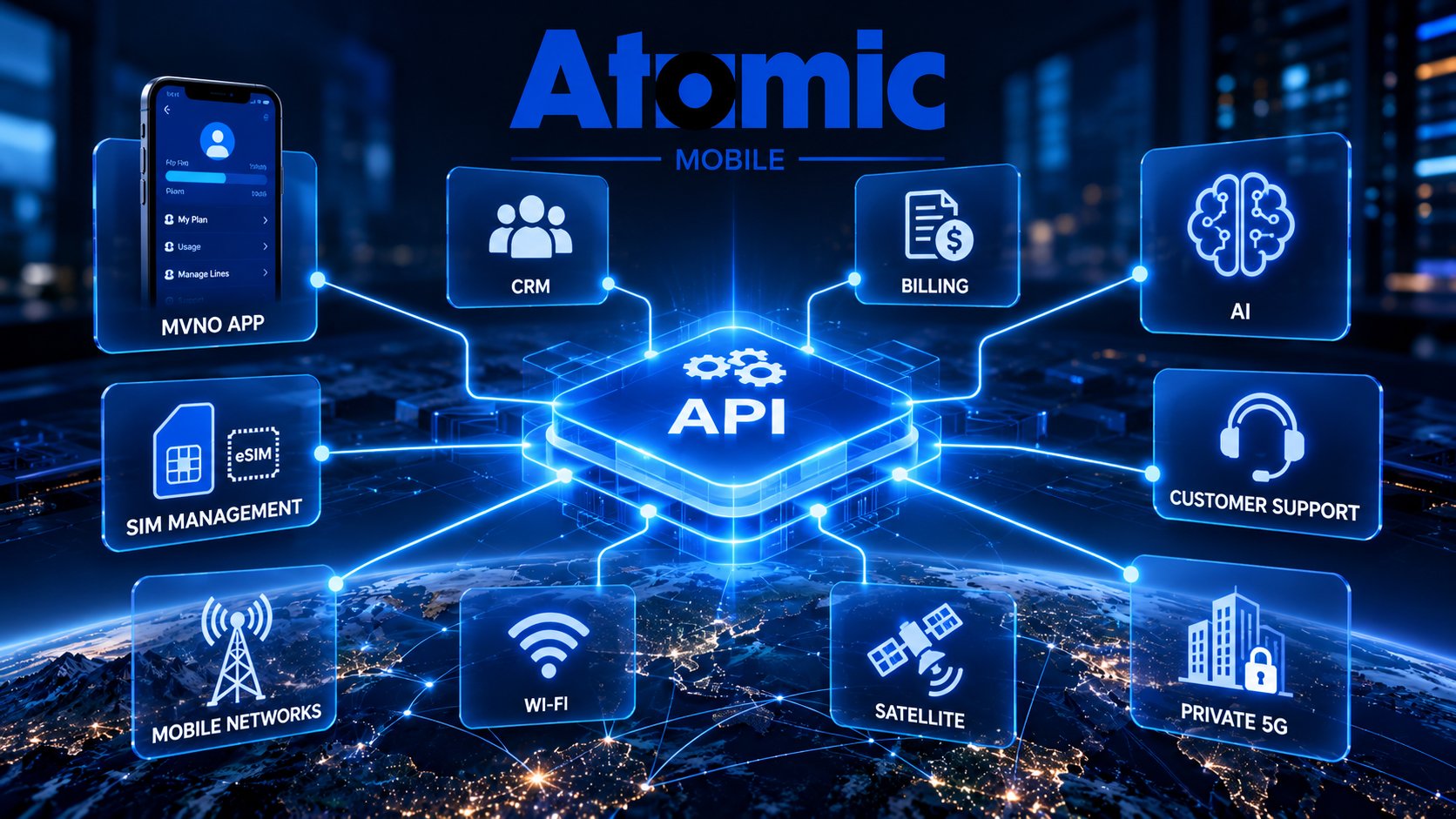
Your MVNO Doesn't Need More Features. It Needs Better APIs.
For years, wireless platforms have competed on features.
A better dashboard.
Another report.
Another billing option.
Another button that lets an operator perform another task.
Those things have value. But they are increasingly becoming table stakes.
The next generation of MVNOs will not differentiate themselves because someone on their operations team can log into a portal and click more buttons.
They will differentiate themselves by what they can build, automate, integrate, and control.
That requires something much more important than another dashboard feature.
It requires better APIs.
The Dashboard Was Built for a Different Era
Most wireless platforms were designed around a fairly simple operating model.
An MVNO needed a place to activate subscribers, manage plans, check usage, suspend lines, replace SIMs, review billing, and perform other routine functions.
So platforms built dashboards.
As MVNOs became more sophisticated, those dashboards became more sophisticated too.
But there is a fundamental limitation to that model.
A dashboard assumes a human is performing the work.
Someone logs in.
Someone finds the subscriber.
Someone changes the plan.
Someone checks the usage.
Someone suspends the line.
Someone reviews the account.
That may work when an MVNO has a few hundred or a few thousand subscribers.
It becomes much less attractive when the business has tens of thousands, hundreds of thousands, or eventually millions of connected devices and subscribers.
At that scale, the question is no longer:
What can my team do inside the dashboard?
The better question is:
What can our systems do without anyone opening the dashboard at all?
APIs Turn Wireless Into Infrastructure
An API allows one system to communicate directly with another.
That sounds technical, but the business impact is straightforward.
Instead of requiring an employee to log into a wireless platform and perform an action, the MVNO's own systems can initiate that action automatically.
A customer signs up.
The line is provisioned.
A customer changes plans.
The wireless service changes.
A device reaches a usage threshold.
The customer receives an alert.
A payment fails.
A predefined workflow begins.
A customer cancels.
The appropriate services are disconnected.
None of those actions necessarily need a person sitting in front of a carrier portal.
That is when wireless starts behaving less like a telecom service and more like infrastructure.
And that distinction matters.
The Best Wireless Platform May Be the One You Rarely Log Into
This sounds counterintuitive for companies that have spent years improving dashboards.
But a successful technology platform should not measure its value by how much time customers spend inside it.
It should measure its value by how much work it eliminates.
Imagine an MVNO with 100,000 subscribers.
If every routine account change requires someone to interact with a dashboard, operational complexity grows alongside the subscriber base.
More subscribers create more tickets.
More tickets require more employees.
More employees create more overhead.
APIs can change that relationship.
If provisioning, plan changes, usage alerts, SIM management, billing events, and customer support workflows can be automated, subscriber growth does not have to produce the same proportional growth in operational headcount.
That is not simply a technology advantage.
It is an economic advantage.
The API Becomes Part of the Customer Experience
APIs are often discussed as backend technology.
Customers may never see them.
But customers experience their results constantly.
Consider a customer who wants to change their wireless plan.
In a traditional environment, they might submit a request, contact customer support, or wait for someone to make the change.
In an API driven environment, the customer taps a button inside the MVNO's app.
The application sends the request.
The wireless platform processes it.
The account updates.
The customer receives confirmation.
The entire experience can happen in seconds.
The same principle applies to activating an eSIM, checking usage, adding international service, suspending a device, enabling a feature, or managing multiple lines.
The API may be invisible.
The customer experience it enables is not.
Every MVNO Should Be Able to Build Differently
This is where APIs become especially important for differentiation.
If every MVNO operates from the same dashboard with the same available features, there is a natural limit to how different those businesses can become.
APIs change that.
One MVNO may build wireless directly into an existing consumer application.
Another may create a loyalty program where wireless benefits change dynamically based on customer behavior.
A fintech company might connect wireless service to a financial product.
A healthcare company might combine connectivity with connected medical devices.
A logistics company could automatically activate and manage service as devices move through its network.
An enterprise provider might build wireless management directly into the software its customers already use.
An IoT company might manage thousands of devices without exposing its customers to a traditional telecom interface at all.
The underlying connectivity can be similar.
The product built on top of it can be completely different.
That is where the competitive advantage moves.
Wireless Should Fit Into the Business, Not the Other Way Around
Historically, companies entering wireless often had to adapt their businesses to telecom systems.
Their customer experience had to work around the capabilities of the wireless platform.
Their billing systems had to accommodate telecom processes.
Their support teams had to learn another portal.
Their developers had to work around limitations that originated with carrier infrastructure.
That relationship should be reversed.
Wireless should fit into the company's existing technology stack.
If a company already has an application, CRM, billing platform, customer support system, loyalty program, or device management platform, connectivity should integrate with those systems.
The company should not have to rebuild its business around wireless.
This becomes particularly important as more nontraditional companies explore launching an MVNO.
Retailers, fintech companies, membership organizations, enterprises, IoT providers, and established consumer brands are not trying to become traditional telecom companies.
They want to add connectivity to something they already do well.
The easier wireless is to integrate into that existing ecosystem, the more valuable it becomes.
Real Time Data Matters Just as Much as Real Time Control
Good APIs are not only about performing actions.
They are also about receiving information.
Wireless generates enormous amounts of operational data.
Usage.
Device status.
Activation events.
Network events.
Billing events.
Plan information.
SIM status.
Customer behavior.
Historically, much of that information has been trapped inside reports, portals, or delayed systems.
That limits what an MVNO can do with it.
If data becomes available through APIs and near real time systems, the MVNO can respond while the information is still useful.
A customer approaching a data threshold can receive an alert before reaching it.
A device behaving unexpectedly can trigger an automated workflow.
A support system can display current usage without requiring an agent to open another platform.
A billing system can react to account changes immediately.
A business intelligence platform can incorporate wireless data alongside the rest of the company's information.
At Atomic Mobile, this is one of the reasons we built Atomic UsageIQ.
Knowing what happened last month is useful for a report.
Knowing what is happening now can change what you do next.
AI Makes APIs Even More Important
Artificial intelligence adds another dimension to this shift.
AI agents can answer questions, analyze customer behavior, identify anomalies, recommend actions, and increasingly execute workflows.
But an AI system is only as useful as the systems it can interact with.
An AI agent might determine that a subscriber needs a different plan.
Without an API, it can recommend the change.
With the right API access, it can potentially execute an approved workflow.
An AI support agent might recognize that a customer's device needs to be suspended.
Without integration, it creates a ticket for someone else.
With integration, the appropriate action can happen immediately within defined permissions and business rules.
This is why the API layer becomes increasingly strategic.
The interface of the future may not always be a dashboard.
It may be software talking directly to software.
And increasingly, it may be AI talking to software on behalf of the business or customer.
APIs Can Change the Economics of an MVNO
There is another reason this matters.
Automation affects margins.
MVNO economics are not determined only by the wholesale cost of data, voice, and messaging.
Operational efficiency matters too.
How many employees are required to support 10,000 subscribers?
What about 100,000?
What about one million?
If subscriber growth requires a nearly proportional increase in operational headcount, scale becomes expensive.
If software can handle an increasing percentage of routine processes, the economics change.
This is why API architecture should not be treated purely as a developer feature.
It can influence customer acquisition, support costs, retention, speed to market, product development, and ultimately profitability.
The API is part of the business model.
APIs Also Reduce Dependency
There is another advantage that gets less attention.
APIs can reduce how tightly an MVNO is coupled to a particular operating model.
A company that builds its entire business around manually using someone else's portal becomes dependent on that portal.
A company that builds its own workflows, customer experiences, and automation around documented APIs owns more of its operating experience.
That does not eliminate dependencies on carriers, MVNEs, MVNAs, billing providers, or other partners.
But it changes where the intelligence resides.
More of it can live inside the MVNO's own systems.
That creates flexibility.
And flexibility becomes increasingly important as wireless businesses grow.
The Next Generation of MVNOs Will Be Built, Not Configured
There will always be a need for dashboards.
Operators need visibility.
Support teams need tools.
Administrators need controls.
But the dashboard should not define what an MVNO can become.
The platform underneath it should.
The most interesting wireless businesses over the next several years may not look like traditional MVNOs at all.
Wireless could simply exist inside another product.
A banking app.
A loyalty program.
A connected vehicle.
A healthcare platform.
A security service.
A wearable.
An enterprise application.
A device that a customer never even realizes contains a SIM.
That future requires connectivity platforms capable of becoming part of something larger.
And that means APIs cannot be an afterthought.
They have to be part of the foundation.
Stop Asking What the Dashboard Can Do
When evaluating an MVNO platform, it is easy to compare feature lists.
Does it have this report?
Does it have this button?
Can the portal perform this function?
Those are reasonable questions.
But there is a more important one:
Can we build what we want on top of it?
Because the next generation of MVNOs will not differentiate themselves by having access to a different button.
They will differentiate themselves by what they can build on top of the network.
At Atomic Mobile, we believe wireless infrastructure should give businesses the tools to create their own experience, automate their own operations, and integrate connectivity directly into the products they are already building.
Your MVNO may not need another feature.
It may just need better APIs.
Brian Latchford
Author