The Future of Connectivity Is Network-Agnostic | Atomic Mobile
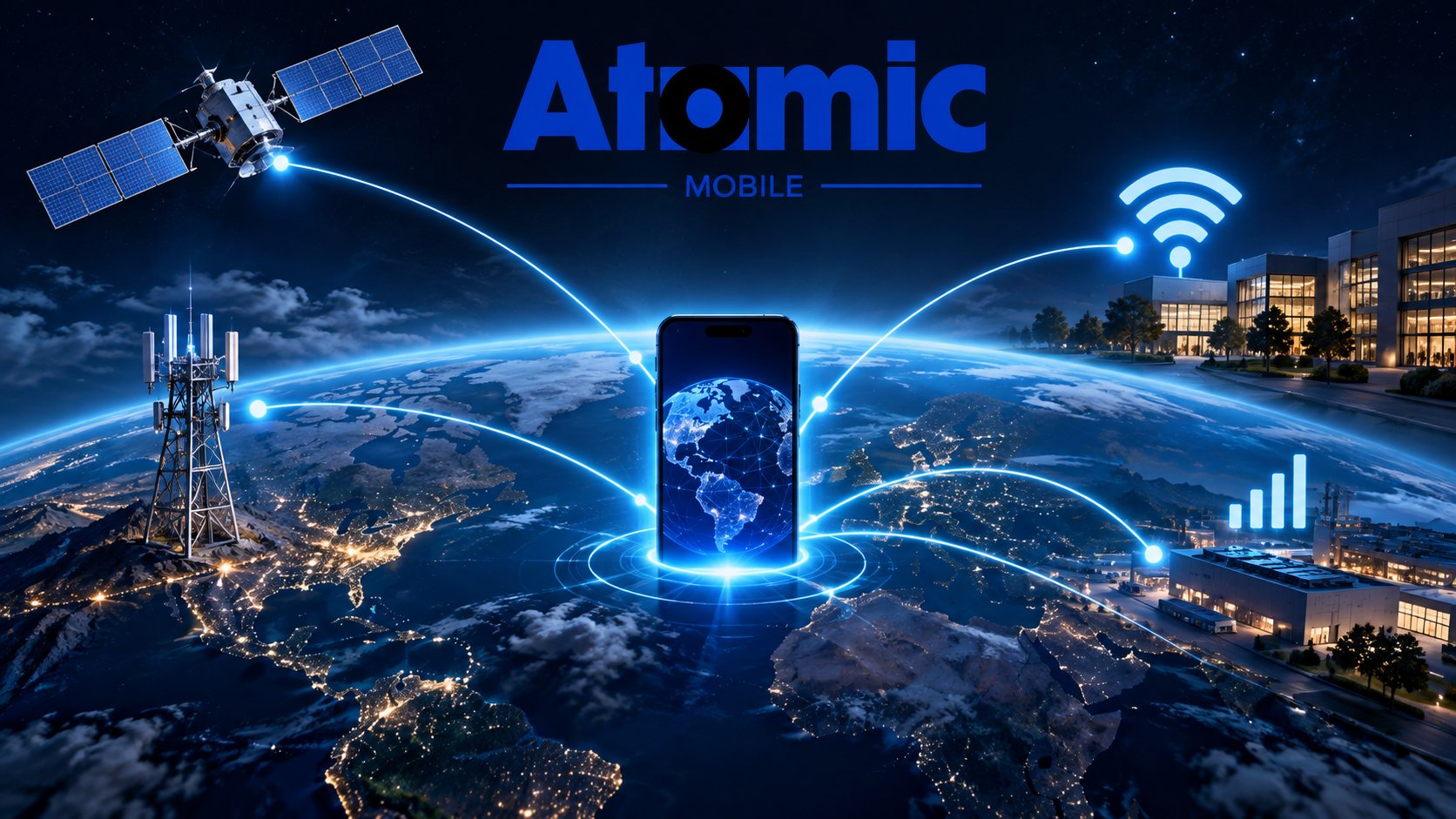
The Best SIM Is the One That Doesn't Care Which Network You Use
For most of mobile history, connectivity has started with a simple decision:
Which network do you want?
Choose a carrier. Get its SIM. Connect to its network. If coverage is poor somewhere, live with it or switch carriers.
That model made sense when the SIM card was effectively a physical key to a single network.
It makes less sense every year.
eSIM has already changed how connectivity can be provisioned. Multi-network arrangements are becoming more common. Private 5G is creating another connectivity layer for enterprises. Wi-Fi remains critical. Satellite connectivity is moving closer to mainstream devices and IoT deployments.
The interesting question is no longer:
Which network should this device use?
The better question is:
Why should the device care?
The future of connectivity is not simply multi-network.
It is network-agnostic.
Connectivity Should Be a Decision, Not a Contract
Consider how most connected devices operate today.
A device has a primary connectivity path. There may be roaming agreements or backup options, but there is usually still an underlying hierarchy.
Network A is preferred.
If Network A fails, try Network B.
If Network B is unavailable, perhaps try something else.
That is better than having only one option, but it is still built around the idea that connectivity should follow a predetermined order.
What if there were no predetermined order?
Instead, the device or connectivity platform could evaluate the available options and determine which connection makes the most sense at that moment.
That decision could consider:
- Signal quality
- Network availability
- Latency
- Cost
- Geography
- Application requirements
- Security policies
- Data usage
- Congestion
- Customer-defined rules
The result might be one mobile network at 9:00 a.m., another network at 10:00 a.m., Wi-Fi inside a facility, private 5G on a manufacturing floor, and satellite when the device moves outside terrestrial coverage.
And when circumstances change, the connectivity path changes with them.
The customer shouldn't have to think about any of it.
We Are Moving Beyond the SIM Card
The physical SIM was revolutionary because it separated subscriber identity from the device.
eSIM took the next step by making that identity programmable.
Now IoT eSIM standards such as SGP.32 are making remote profile provisioning and management more practical for large fleets of connected devices.
That matters.
Imagine deploying 50,000 devices across multiple countries.
With traditional physical SIM architecture, changing connectivity providers could require replacing SIM cards in the field. That means shipping cards, scheduling technicians, physically accessing devices, and potentially interrupting service.
At scale, connectivity becomes a logistics problem.
Remote SIM provisioning changes that equation.
A device can be deployed today while its connectivity options evolve tomorrow.
But even that is only part of the story.
The bigger shift happens when we stop thinking about the SIM as the connectivity product.
The SIM becomes an enabling component. The real product becomes connectivity orchestration.
The Network Should Become Invisible
Think about electricity.
Most people don't think about which generating facility produced the electricity powering their laptop.
They plug it in.
The complexity exists behind the outlet.
Connectivity should increasingly work the same way.
A business deploying a connected device shouldn't necessarily have to design its product around one carrier's footprint.
A consumer shouldn't need to understand which network is strongest in every location.
An IoT company shouldn't have to redesign its connectivity strategy every time it enters another country.
The connectivity layer should handle that complexity.
The device asks for connectivity.
The platform determines the best available way to provide it.
That distinction sounds small.
It isn't.
Cellular Is Only One Part of the Connectivity Stack
For decades, wireless connectivity largely meant cellular.
That definition is expanding.
A modern connected device may encounter several different types of networks.
Public cellular
Traditional mobile networks remain the backbone of wide-area wireless connectivity.
Wi-Fi
For many devices, Wi-Fi offers inexpensive, high-capacity connectivity whenever a trusted network is available.
Private 5G
Enterprises are increasingly deploying private cellular networks for factories, campuses, warehouses, ports, healthcare environments, and other controlled locations.
Satellite
Non-terrestrial networks are adding another connectivity layer, particularly in areas where traditional terrestrial coverage is unavailable or impractical.
These technologies shouldn't necessarily compete for ownership of the device.
They can complement one another.
The question becomes which network is best suited to the device's requirements right now.
"Best Network" Doesn't Always Mean Strongest Signal
This is where connectivity gets more interesting.
The strongest signal isn't always the best connection.
Imagine a logistics company tracking thousands of high-value assets.
For a routine location update, the company might prioritize cost.
For a critical security alert, reliability and latency might become more important.
At a warehouse, private 5G may be preferred.
At a customer's facility, trusted Wi-Fi could make more sense.
On a highway, public cellular might be the obvious choice.
In a remote area, satellite could become the only viable path.
The definition of "best" changes based on the application.
That means the future connectivity layer needs more than network access.
It needs policy.
Connectivity Becomes Software
This is the transformation we believe matters most.
Historically, connectivity decisions were heavily determined by hardware, SIM cards, carrier contracts, and physical network infrastructure.
Increasingly, those decisions can move into software.
A connectivity platform can apply rules such as:
If Network A meets the performance requirement and costs less, use Network A.
If latency exceeds a defined threshold, evaluate another available network.
If the device enters a private network environment, use private 5G.
If terrestrial connectivity disappears, use an available satellite path.
If the device enters another country, activate an appropriate local or regional profile.
The SIM still matters.
The carrier still matters.
The network absolutely matters.
But the intelligence determining how and when those resources are used becomes increasingly important.
Connectivity begins looking less like a carrier relationship and more like a software-defined resource.
IoT May Get There First
Consumers will benefit from this evolution, but IoT connectivity may be where the model becomes most valuable first.
A smartphone user can troubleshoot connectivity.
A sensor mounted inside industrial equipment cannot.
A person can change a SIM.
A tracking device traveling through five countries cannot.
A consumer can select another Wi-Fi network.
A remote agricultural sensor may operate unattended for years.
IoT exposes the weaknesses of static connectivity architecture very quickly.
Businesses deploying thousands or millions of devices need connectivity that can survive changes in geography, carriers, contracts, coverage, technology, and network economics.
That makes flexibility enormously valuable.
A device deployed in 2026 may still be operating in 2031 or 2036.
Nobody can confidently predict what the optimal connectivity provider for that device will be a decade from now.
So why permanently design that decision into the device today?
SGP.32 Is an Important Piece of the Puzzle
SGP.32 is particularly important for this reason.
The standard was designed for IoT remote SIM provisioning and enables network profiles to be managed remotely on devices that may have limited interfaces or no human user available to manage connectivity.
That dramatically changes the operational model for IoT.
Instead of treating the carrier profile as something permanently determined when a device is manufactured or deployed, connectivity profiles can be managed later in the device lifecycle.
That creates more flexibility.
But SGP.32 should not be confused with the entire connectivity orchestration layer.
Remote profile management solves one major problem.
Intelligent connectivity selection is a broader problem involving networks, policies, applications, economics, device capabilities, and software.
The combination is where things become especially interesting.
The Winning Network May Change Every Five Minutes
Telecom has traditionally been built around the idea of network loyalty.
Connectivity doesn't necessarily need to be.
Imagine a device capable of evaluating several available connectivity paths.
At 2:00 p.m., Network A may offer the best combination of performance and cost.
At 2:05 p.m., the device moves into an area where Network B performs better.
At 2:30 p.m., it enters a facility with approved private 5G.
At 3:00 p.m., it moves outside terrestrial coverage and another technology becomes necessary.
Why should the customer care which one is being used?
They probably shouldn't.
What they care about is whether the application works.
That is the fundamental change.
Stop Selling the Network. Start Selling the Outcome.
Telecom has spent decades selling networks.
Coverage maps.
Speeds.
Spectrum.
Bars.
Those things will remain important, but they are infrastructure measurements.
Customers ultimately buy outcomes.
A payment terminal needs to process a transaction.
A security camera needs to transmit video.
A vehicle needs to report telemetry.
A wearable needs to reach a cloud service.
A tracking device needs to report its location.
A person needs their phone to work.
The network is the mechanism that makes the outcome possible.
When multiple connectivity technologies can participate in delivering that outcome, the network itself begins to disappear into the infrastructure.
And that may be exactly where telecom is heading.
The Best Connectivity Is the Connectivity You Don't Think About
The industry will continue talking about 5G, 6G, eSIM, SGP.32, private networks, satellite, Wi-Fi, and whatever technology comes next.
Those technologies matter.
But the end state may be much simpler than the technology underneath it.
A device needs connectivity.
Software evaluates the available options.
Policy determines what matters.
The best connection is selected.
And when a better option becomes available, the device moves.
No truck roll.
No SIM swap.
No customer intervention.
Eventually, perhaps no concept of a "primary network" at all.
At Atomic Mobile, we believe the next generation of wireless will be defined less by which network a device belongs to and more by how intelligently connectivity can be delivered across networks.
Because the best network isn't always one network.
And the best SIM may ultimately be the one that doesn't care which network you use.
Brian
Author