The Ultimate MVNO Launch Checklist: 100 Steps Before Your First Customer
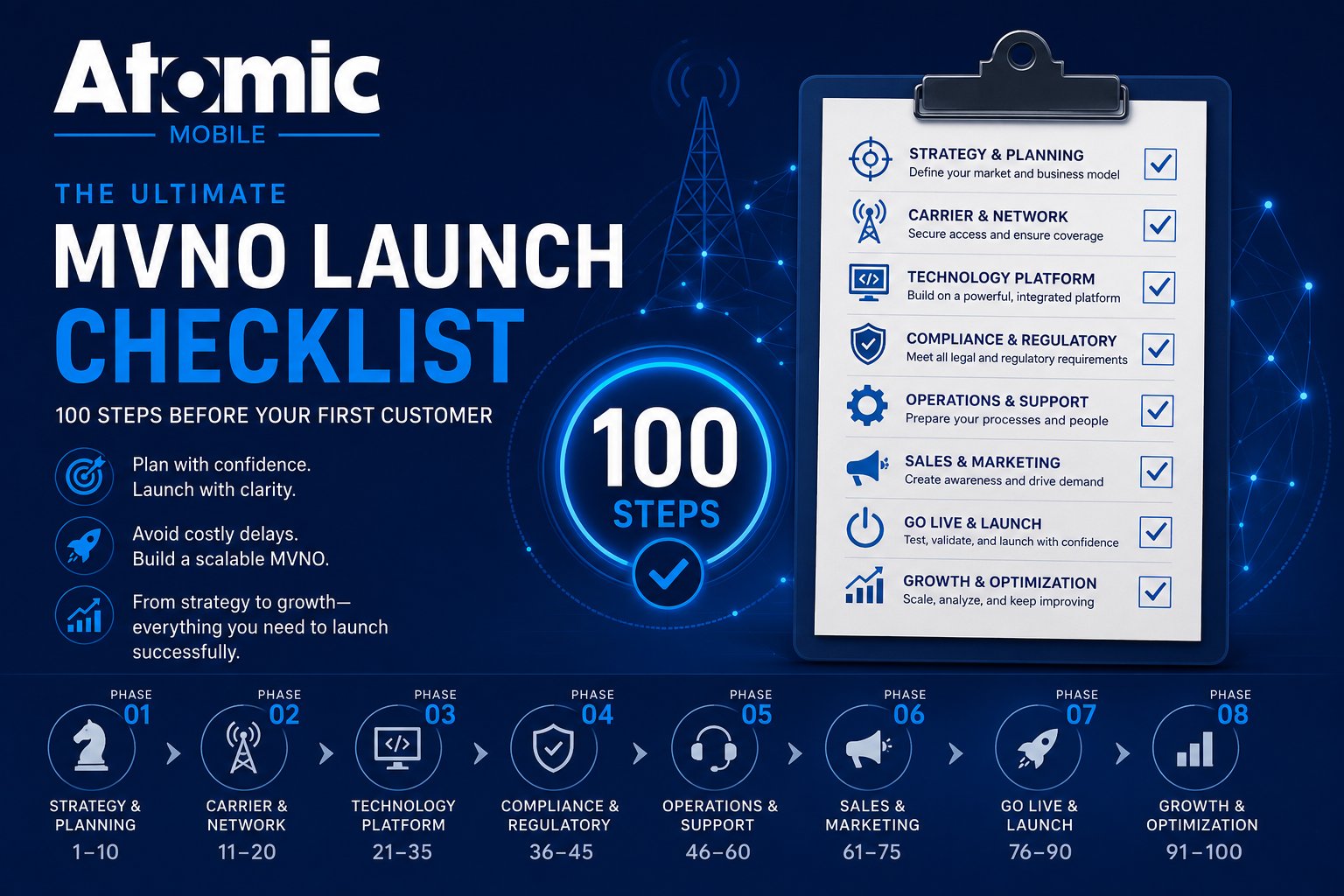
The Ultimate MVNO Launch Checklist: 100 Steps Before Your First Customer
Launching an MVNO is one of the most exciting opportunities in telecommunications today. Whether you're a startup, enterprise, retailer, financial institution, healthcare provider, or technology company, wireless connectivity has become a powerful way to create recurring revenue, strengthen customer relationships, and differentiate your brand.
However, successful MVNOs aren't built by simply signing a carrier agreement and ordering SIM cards.
Behind every successful launch is a carefully planned operation that includes business strategy, network selection, technology, compliance, customer experience, marketing, and ongoing optimization.
At Atomic Mobile, we've spent decades helping organizations launch and operate wireless services. We've seen what creates successful launches and what causes unnecessary delays. This checklist is built from those experiences and is designed to help you avoid common pitfalls while creating a scalable foundation for long-term growth.
Phase 1: Business Strategy (Steps 1–10)
Every successful MVNO starts with a solid business strategy. Before evaluating technology or negotiating with carriers, take the time to define exactly who you're serving and why customers should choose your service over existing providers.
Ask yourself:
- Who is my ideal customer?
- What problem am I solving?
- Why will customers switch?
- How will I make money?
- What does success look like after one year?
Checklist
- Define your target audience.
- Validate market demand.
- Choose consumer, enterprise, IoT, or niche markets.
- Develop your unique value proposition.
- Build a financial model.
- Forecast subscriber growth.
- Identify funding requirements.
- Create your pricing strategy.
- Define business KPIs.
- Develop a three-year roadmap.
Without a clear strategy, every decision that follows becomes more difficult.
Phase 2: Carrier & Network Selection (Steps 11–20)
Your network partner affects everything from coverage and customer experience to pricing and long-term scalability.
Don't focus exclusively on wholesale rates. Consider support, onboarding, network capabilities, roaming options, future technologies, and the overall relationship.
Checklist
- Evaluate carrier partners.
- Compare MVNA and MVNE providers.
- Review coverage requirements.
- Understand wholesale pricing.
- Evaluate roaming capabilities.
- Plan your eSIM strategy.
- Plan physical SIM fulfillment.
- Design number portability workflows.
- Verify device compatibility.
- Complete network testing.
Choosing the right network partner today can prevent expensive migrations later.
Phase 3: Technology Platform (Steps 21–35)
Your technology stack becomes the operational backbone of your business.
A modern MVNO platform should automate routine processes, provide meaningful analytics, integrate with your existing systems, and continue evolving as your business grows.
Checklist
- Select your MVNO platform.
- Configure billing.
- Configure taxation.
- Implement payment processing.
- Deploy CRM.
- Enable customer self-service.
- Configure APIs.
- Implement eSIM provisioning.
- Enable usage monitoring.
- Deploy fraud detection.
- Configure analytics.
- Build executive dashboards.
- Automate customer notifications.
- Develop backup procedures.
- Create disaster recovery plans.
Technology should accelerate growth, not create operational bottlenecks.
Phase 4: Compliance & Security (Steps 36–45)
Telecommunications is a regulated industry. Building compliance into your operations from the beginning reduces risk while strengthening customer trust.
Security should never be treated as an afterthought.
Checklist
- Review regulatory requirements.
- Publish privacy policies.
- Publish Terms & Conditions.
- Publish an Acceptable Use Policy.
- Configure E911 support.
- Review CALEA obligations.
- Validate PCI compliance.
- Secure customer information.
- Configure audit logging.
- Review cybersecurity procedures.
Strong security protects both your customers and your reputation.
Phase 5: Operations & Customer Experience (Steps 46–60)
Launching is only the beginning.
Operational excellence determines whether customers stay with your brand long after activation.
Great customer experiences don't happen by accident. They're designed.
Checklist
- Build support processes.
- Train support staff.
- Create a knowledge base.
- Develop escalation procedures.
- Configure billing cycles.
- Define refund policies.
- Build activation workflows.
- Build number porting workflows.
- Manage inventory.
- Monitor service quality.
- Document internal procedures.
- Define service level agreements.
- Establish vendor management.
- Complete quality assurance testing.
- Prepare incident response plans.
Customers remember every interaction. Make each one count.
Phase 6: Sales & Marketing (Steps 61–75)
Even the best wireless platform won't generate subscribers without effective marketing.
Before launch, ensure your digital presence is ready to support growth.
Checklist
- Launch your website.
- Optimize for SEO.
- Optimize for AI search.
- Finalize branding.
- Configure analytics.
- Launch email marketing.
- Build referral programs.
- Develop sales collateral.
- Prepare launch announcements.
- Configure CRM automation.
- Create onboarding emails.
- Build landing pages.
- Prepare paid advertising.
- Enable conversion tracking.
- Develop customer education resources.
Marketing should begin well before your first customer signs up.
Phase 7: Go Live (Steps 76–90)
Testing is where successful launches separate themselves from costly mistakes.
Every workflow should be validated before opening your doors to customers.
Checklist
- Test activations.
- Test billing.
- Test payments.
- Test customer support.
- Test emails.
- Test APIs.
- Test number porting.
- Conduct internal beta testing.
- Launch a pilot program.
- Review security.
- Verify reporting.
- Complete executive review.
- Monitor platform performance.
- Prepare rollback procedures.
- Launch your MVNO.
Launch day should feel routine because everything has already been tested.
Phase 8: Growth & Optimization (Steps 91–100)
Launching isn't the finish line.
The most successful MVNOs continuously improve their operations, customer experience, and technology.
Checklist
- Collect customer feedback.
- Monitor churn.
- Review subscriber growth.
- Improve onboarding.
- Expand automation.
- Introduce AI where appropriate.
- Optimize pricing.
- Build strategic partnerships.
- Plan future services.
- Commit to continuous improvement.
Growth comes from consistently improving the experience your customers receive.
Questions Every MVNO Should Answer Before Launch
Before acquiring your first customer, make sure you can confidently answer these questions:
- Is our platform built to scale?
- Can we automate repetitive work?
- Have we fully tested billing?
- Do we understand regulatory requirements?
- Is our customer support ready?
- Have we planned for future growth?
- Can we accurately measure success?
- Is our security enterprise ready?
- Are our APIs prepared for future integrations?
- Would we feel comfortable becoming our own customer?
If any answer is "not yet," now is the time to address it.
The Atomic Take
Launching an MVNO isn't about checking one hundred boxes. It's about making one hundred thoughtful decisions that position your business for long-term success.
The companies that thrive aren't always the ones with the largest budgets or the fastest launches. They're the ones that build a solid foundation before their first customer ever activates service.
At Atomic Mobile, we've worked alongside organizations launching consumer brands, enterprise mobility solutions, wholesale platforms, and IoT services. While every launch is unique, the principles behind successful operators remain remarkably consistent.
Use this checklist as a roadmap, revisit it often, and remember that every improvement you make before launch saves time, money, and complexity after launch.
Wireless technology will continue to evolve. The organizations that succeed will be the ones prepared to evolve with it.
Get the free workbook: Track all 100 steps as you complete them.
Download: The Ultimate MVNO Launch Checklist (PDF)
Ready to launch? Explore MVNO in a Box — Atomic Mobile's turnkey platform with carrier connectivity, billing, eSIM, APIs, and compliance in one place.
Brian Latchford
Author