What Happens When Your Phone Can Use Any Mobile Network?
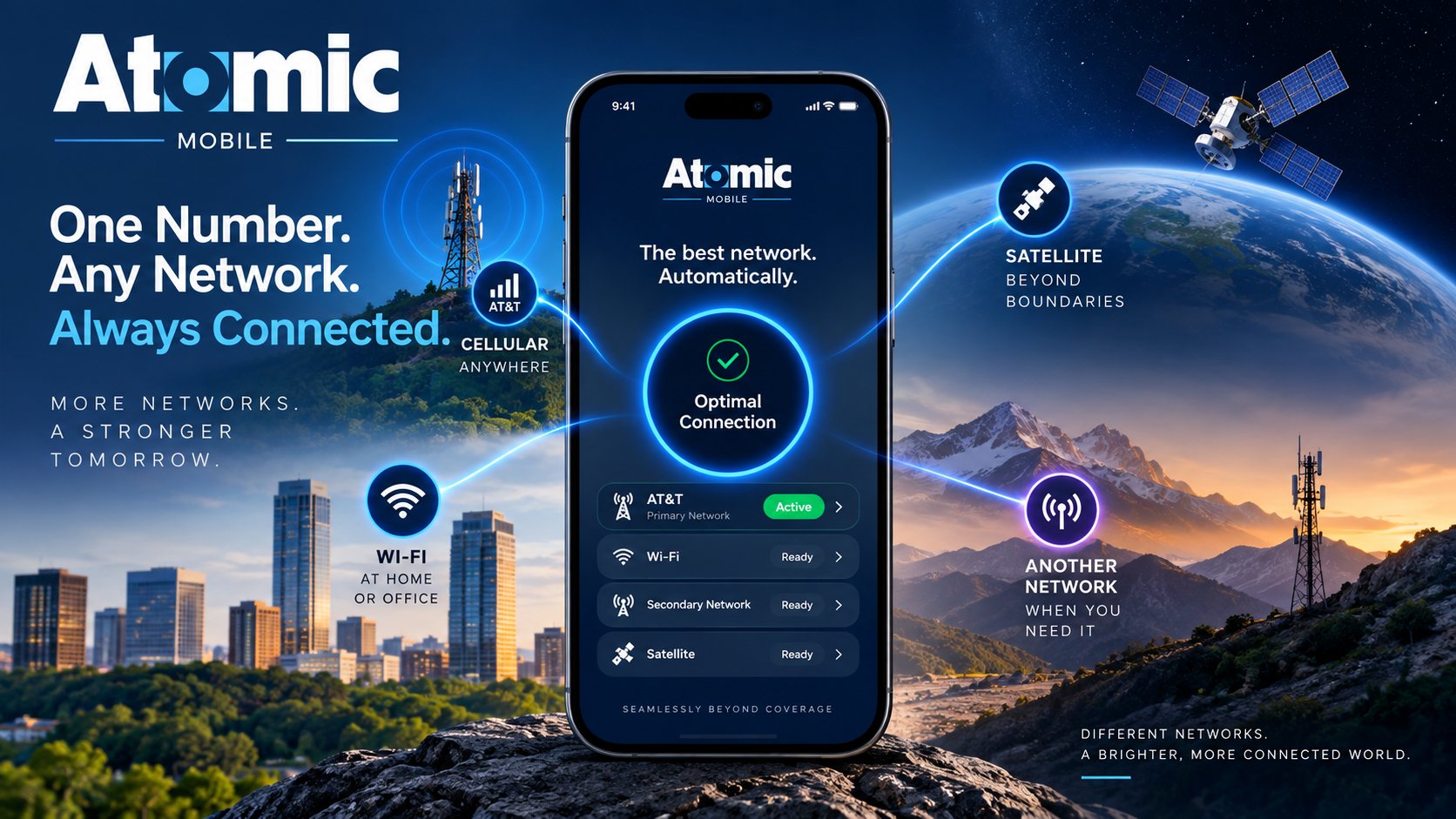
What Happens When Your Mobile Carrier Becomes Just One of Many Networks?
For most of mobile history, choosing a wireless provider meant choosing a network.
Your phone number lived there. Your voice service lived there. Your data traveled through it. And when that network disappeared, so did your connectivity.
I am not convinced that is how mobile communications will work forever.
The future may not be about finding the one network with coverage everywhere.
It may be about making the underlying network increasingly irrelevant to the customer.
Instead of asking:
Which network am I connected to?
The device may eventually ask:
What is the best available way to communicate right now?
That sounds like a subtle difference.
It isn't.
It could fundamentally change what we mean by a mobile network.
Today's Phone Is Still Tied to the Network
Modern smartphones already have access to more connectivity options than most consumers realize.
There is the primary cellular connection.
There is Wi-Fi.
Many devices support multiple SIMs or eSIM profiles.
Some smartphones now have access to satellite connectivity.
International travelers increasingly use secondary eSIMs to access local mobile networks.
The device may therefore have several possible paths to the internet.
But our communications experience is still largely built around one primary mobile carrier.
If that carrier loses coverage, the phone may have another way to reach the internet, but that does not necessarily mean the user's normal mobile service seamlessly follows.
That is the problem I think the industry eventually solves.
Separate the Service From the Transport
Consider a different architecture.
A customer has a normal mobile number and service from their primary wireless provider.
When that network is available, nothing changes.
Calls use the native mobile network.
Messages use the native service.
Data uses the primary cellular connection.
But imagine a software layer continuously evaluating the connectivity available to the device.
If the primary cellular network becomes unavailable, the device could potentially find another path.
Wi-Fi.
A secondary cellular eSIM.
A local network while traveling internationally.
A private network.
Eventually, satellite.
The underlying connection changes.
The customer's communications experience does not.
In that model, cellular is no longer the service.
Cellular is one transport mechanism for the service.
That distinction is important.
We Already Accept This Model in Other Applications
Consumers already use communications platforms that behave this way.
Applications such as WhatsApp, FaceTime and other IP-based communications services generally do not care which company provides the underlying internet connection.
They need connectivity.
If the device moves from cellular data to Wi-Fi, the application continues operating because the application exists above the access network.
Traditional mobile service works differently because the telephone number, network authentication and voice service have historically been tightly connected to the mobile operator.
What happens if those concepts begin to separate?
That is where things become interesting.
The Phone Number Could Become an Identity Layer
A mobile number is increasingly more than a routing destination for telephone calls.
It is an identity.
It is connected to banking accounts, business relationships, authentication systems, messaging platforms and countless other services.
Yet that identity is still closely associated with one carrier relationship.
There may be another model.
The primary carrier could continue providing the number and native mobile service while a software layer extends the communications experience across other available IP connections.
Think of it as communications continuity.
The primary network remains the preferred path.
But it is no longer necessarily the only path.
If the primary network disappears but another data connection exists, the device could potentially maintain communications through that alternate connection.
The user does not need to understand what happened underneath.
They simply remain connected.
The Second Network Doesn't Need to Be Another Full Wireless Plan
This is where the economics become particularly interesting.
Providing resilient connectivity does not necessarily mean consumers need to pay for two complete unlimited wireless subscriptions.
A secondary connection could exist primarily for failover.
Most of the time, it may consume little or no data.
When the primary network becomes unavailable, the secondary connection becomes active and provides enough connectivity to maintain critical communications.
That could be another terrestrial mobile network.
It could be satellite.
It could be an international roaming profile.
Or it could change depending on where the subscriber is located.
Instead of purchasing two wireless plans, the customer is effectively purchasing connectivity resilience.
That is a very different product.
Voice Makes This Harder
Data failover is relatively straightforward.
Voice is where the architecture becomes much more complicated.
If someone calls your normal mobile number, the call is routed through the carrier responsible for that number.
Simply establishing an internet connection through another network does not automatically move that incoming telephone call to the new connection.
The industry therefore has to solve an important question:
How can a subscriber's native communications identity follow them across different connectivity paths?
The answer could involve IMS integration, carrier APIs, IP-based voice, network-level call routing, software-defined communications or technologies that have not yet been widely deployed.
The important point is that the problem is solvable without necessarily requiring every company providing the experience to become a traditional telephone carrier.
The incumbent mobile network can continue doing what it does exceptionally well.
The intelligence can increasingly sit above it.
This Is Bigger Than Satellite
Satellite gets much of the attention because it provides connectivity where terrestrial networks cannot.
But I think focusing exclusively on satellite misses the larger opportunity.
Satellite could simply become another available network.
Imagine a device evaluating:
Primary MNO: available and performing well
Use it.
Primary MNO: unavailable, Wi-Fi available
Use Wi-Fi.
Primary MNO: unavailable, secondary terrestrial network available
Use the secondary network.
No terrestrial network available, satellite available
Use satellite.
The consumer does not select any of this.
Software does.
That is what makes the concept powerful.
The goal isn't satellite connectivity.
The goal is continuous connectivity.
The MVNO Could Become the Orchestration Layer
This is also why I believe the definition of an MVNO will continue changing.
Historically, an MVNO purchased access to an MNO's network and resold that connectivity under its own brand.
But as devices gain access to more networks and connectivity technologies, the opportunity moves higher in the stack.
Someone needs to manage:
Network policies.
SIM and eSIM profiles.
Authentication.
Usage.
Billing.
Failover rules.
Application behavior.
Cost optimization.
Quality of service.
And eventually decisions about which network should carry which traffic.
That is much closer to a connectivity orchestration platform than a traditional MVNO.
Modern MVNE platforms are already moving in this direction.
At Atomic Mobile, we have written previously about how eSIM, NTN and MVNO platforms could help create hybrid networks and why the MVNO platform may ultimately become a connectivity operating system.
The next step is making those underlying networks increasingly invisible.
Cost Could Become Part of the Routing Decision
There is another dimension that rarely gets discussed.
The best network is not necessarily just the network with the strongest signal.
Imagine a connectivity engine evaluating multiple variables simultaneously:
Signal strength.
Latency.
Packet loss.
Application requirements.
Network availability.
Wholesale cost.
Roaming cost.
Satellite cost.
Battery consumption.
Customer policy.
A video download might remain on Wi-Fi.
A voice call might move to a secondary terrestrial network.
An emergency message in a remote location might justify the higher cost of satellite.
An IoT device might wait rather than transmit expensive data immediately.
Connectivity becomes programmable.
And when connectivity becomes programmable, the economics can become programmable too.
That creates an entirely new role for platforms capable of seeing usage and cost close to real time.
The Best Network May Eventually Be No Network at All
Not literally.
The physical networks will become more important, not less.
We will continue to need enormous investment in spectrum, towers, fiber, radio infrastructure, satellites and core networks.
But from the customer's perspective, the individual network may become less visible.
That is what happened with cloud computing.
Most consumers have no idea which data center serves the application they are using.
They don't need to.
The infrastructure matters enormously.
The abstraction is what makes it useful.
Mobile connectivity may eventually follow the same path.
The Next Wireless Experience Could Be Network Agnostic
We have spent decades trying to build networks with coverage everywhere.
Perhaps the next phase is different.
Instead of requiring one network to be everywhere, we build an intelligence layer capable of using whatever network is available.
Terrestrial wireless.
Wi-Fi.
Private networks.
International eSIMs.
Satellite.
And whatever comes next.
The customer keeps the same identity, the same service and the same experience.
The infrastructure underneath changes dynamically.
That would represent a fundamental shift in wireless.
The network would still matter.
You just wouldn't have to think about which one you were using.
At Atomic Mobile, we believe the next generation of wireless platforms will increasingly be defined not simply by the network they provide access to, but by how intelligently they manage connectivity across networks, devices and technologies.
Explore Atomic Mobile's MVNE platform, eSIM enablement, Atomic UsageIQ and Atomic Fusion to see how we are building infrastructure for a more programmable wireless ecosystem.
Brian Latchford
Founder & CEO
Atomic Mobile
Brian Latchford
Author