Wireless failover and business continuity
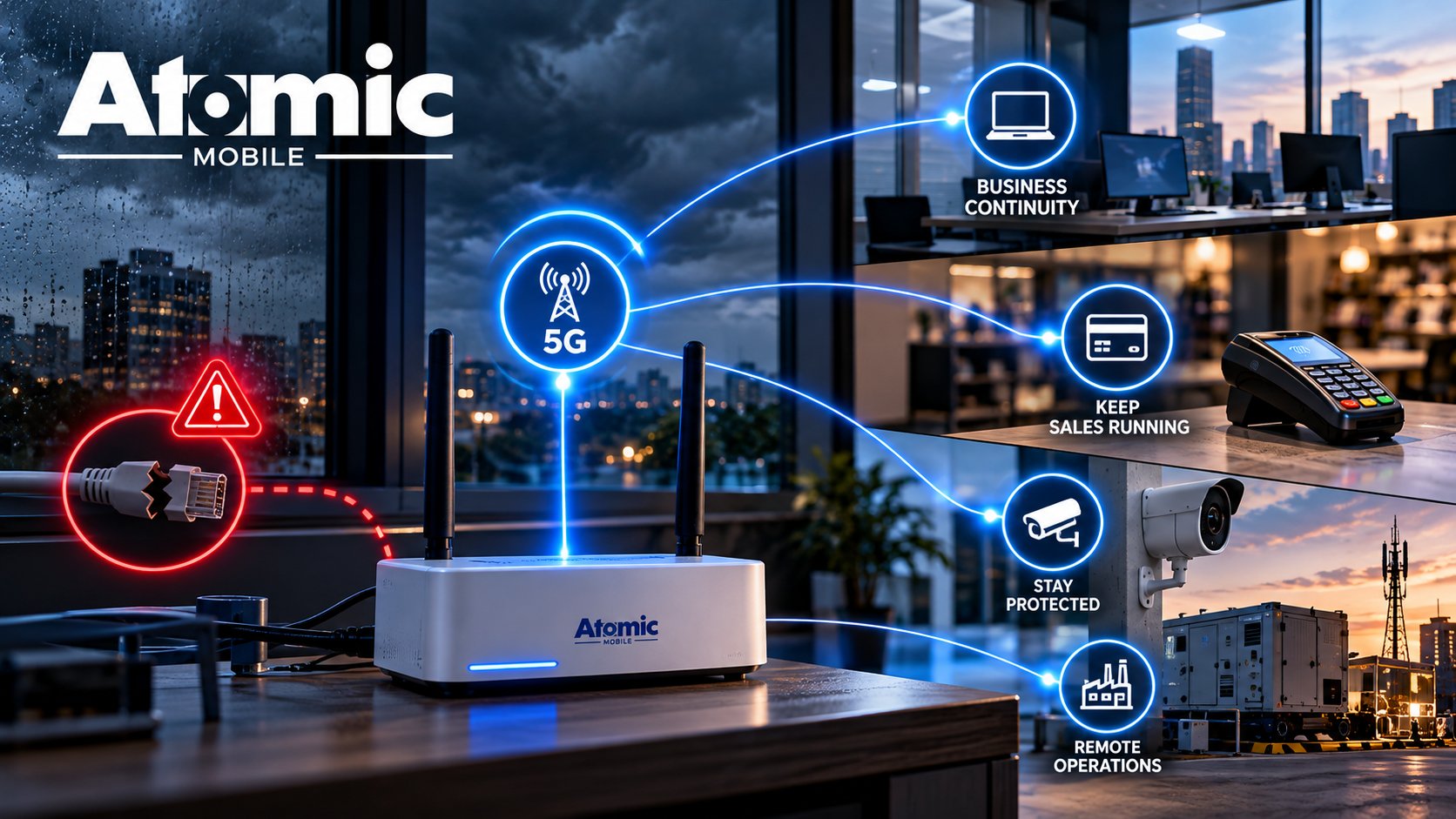
Why Every Business Needs Wireless Failover
Most businesses don't think about their internet connection until it stops working.
It's easy to understand why.
When connectivity works, it's practically invisible. Employees access applications, customers complete transactions, payment terminals communicate with processors, and devices exchange information without anyone giving the underlying network much thought.
But when that connection fails, the impact can be immediate.
A restaurant can't process credit cards. A retail store loses access to its point-of-sale system. A medical office can't reach cloud-based records. A warehouse loses visibility into inventory and shipping systems.
For businesses that rely on cloud applications, digital payments, connected devices, and real-time communications, an internet outage is no longer just an IT problem.
It's a business continuity problem.
And increasingly, wireless connectivity is becoming one of the most practical ways to address it.
The Hidden Cost of Internet Downtime
When businesses evaluate internet service, the conversation usually focuses on speed, reliability, and monthly cost.
Those are important considerations, but they don't tell the entire story.
The real cost of connectivity becomes apparent when it disappears.
Consider a retail location generating $5,000 in sales during a typical eight-hour business day.
That's an average of $625 per hour.
If the location experiences a two-hour internet outage during business hours, approximately $1,250 in sales activity could be exposed to disruption.
Not every transaction would necessarily be lost. Some customers might pay with cash, return later, or complete purchases through another channel.
But the example illustrates an important point.
The financial exposure from a relatively short outage can exceed the monthly cost of maintaining backup connectivity.
And lost sales are only one consideration.
Internet downtime can also create:
- Employee productivity losses.
- Interrupted customer service.
- Failed payment transactions.
- Delayed inventory updates.
- Disrupted communications.
- Inaccessible cloud applications.
- Service-level agreement exposure.
- Reputational damage.
For some businesses, the operational consequences may be even more significant than the immediate revenue impact.
The question shouldn't simply be how much internet service costs.
It should also be how much an internet outage could cost the business.
What Is Wireless Failover?
Wireless failover is a connectivity solution that uses a cellular network as a backup when a primary internet connection becomes unavailable or unusable.
A business might use fiber, cable, or another wired connection for its everyday operations.
A compatible router or gateway monitors that primary connection.
If the primary service fails, the equipment can automatically switch eligible network traffic to a cellular connection, typically using LTE or 5G.
When the primary connection is restored and meets the configured recovery conditions, the system can switch traffic back.
The objective is straightforward.
Keep the business connected even when its primary internet provider experiences an outage.
Wireless failover isn't intended to replace every traditional internet connection.
It's designed to provide an independent connectivity path when the primary one becomes unavailable.
And that distinction is important.
Why a Second Wired Connection Isn't Always Enough
Businesses sometimes assume that purchasing internet service from two different providers automatically gives them full redundancy.
It can improve resilience, but the level of protection depends on the physical infrastructure.
Two providers may use the same underground conduit, utility poles, building entrance, or upstream facilities.
A construction accident, equipment failure, or local infrastructure problem could potentially affect both connections.
That doesn't mean dual wired connections are ineffective.
It means redundancy should be evaluated based on the actual network paths, not simply the number of internet service providers on the invoice.
Cellular failover can provide additional diversity because it uses a different access technology.
Instead of depending on the same local wired infrastructure, the backup connection communicates through a mobile network.
However, cellular service has its own dependencies, including tower availability, signal quality, network congestion, and electrical power.
A resilient design accounts for those limitations rather than assuming any single backup connection is infallible.
For businesses where connectivity is critical, the strongest strategy may combine diverse network paths, properly configured equipment, and backup power.
Why 5G and LTE Make Practical Backup Options
Cellular connectivity has evolved considerably.
Modern LTE networks can support many business applications, while 5G can offer additional capacity and performance where coverage and network conditions permit.
That makes wireless increasingly practical for business continuity.
1. Faster Deployment
Installing a second wired connection can require construction, permitting, equipment installation, and coordination with local service providers.
Cellular connectivity can often be deployed more quickly when suitable coverage and compatible equipment are available.
A cellular gateway or failover router can be installed without extending a new physical circuit into the building.
For multi-location businesses, this can simplify rollout.
2. Automatic Recovery
A properly configured failover solution can detect connectivity problems and redirect traffic without waiting for an employee to troubleshoot the outage.
The speed of the transition depends on the equipment, detection thresholds, network conditions, and application behavior.
Some existing application sessions may still need to reconnect.
But automated failover can substantially reduce the operational burden of responding to an outage.
3. Flexibility Across Locations
Businesses don't always operate in places where multiple wired providers are available.
Some locations may have only one practical broadband option.
Others may operate from temporary facilities, construction sites, kiosks, or mobile environments.
Cellular connectivity can provide an alternative where traditional redundancy is difficult or expensive.
4. More Efficient Backup Economics
A backup connection doesn't necessarily need to carry the same traffic volume as a primary circuit.
During an outage, the objective may be to keep only essential systems online.
That creates opportunities for carefully designed data plans and traffic policies.
A business might prioritize payment processing, critical applications, and essential communications while restricting nonessential traffic.
The right approach depends on the application requirements and the duration of the outage.
Not Every Business Needs the Same Failover Solution
One of the biggest mistakes businesses make is assuming every location requires an identical connectivity package.
A small retail location and a large distribution center have very different requirements.
Retail Stores and Restaurants
For retailers and restaurants, payment processing is often the most immediate concern.
A loss of connectivity can affect point-of-sale systems, cloud-based ordering, inventory management, and customer transactions.
A properly configured cellular backup can help maintain access to critical services.
However, businesses should verify that their payment systems, processors, and network security configurations support operation over the backup connection.
Medical and Healthcare Offices
Healthcare providers increasingly depend on cloud-based applications, scheduling systems, electronic records, and connected equipment.
A backup connection can help maintain access to important administrative and clinical applications during a primary outage.
Because healthcare environments have heightened privacy, security, and operational requirements, connectivity designs should be evaluated accordingly.
Warehouses and Logistics
Warehouses depend on connectivity for inventory systems, shipping platforms, scanners, tracking equipment, and communications.
Even short interruptions can delay operations.
Cellular backup can help maintain essential data exchange and support business continuity across distributed facilities.
Financial Services
Banks, credit unions, financial service providers, and other regulated businesses often have strict expectations around availability, security, and operational resilience.
Wireless failover can form part of a broader continuity strategy, provided the architecture meets applicable security and compliance requirements.
Multi-Location Businesses
Companies operating dozens or hundreds of locations face an additional challenge.
They need consistency.
It's not enough to install backup connectivity at each site.
They also need visibility into which connections are active, how much data is being consumed, and whether the backup infrastructure is functioning correctly.
That turns failover into an ongoing connectivity management responsibility.
The Real Challenge Is Managing Failover at Scale
Providing a cellular connection to one location is relatively straightforward.
Managing cellular backup across 100, 500, or 1,000 locations is a different proposition.
Imagine a retailer with 500 stores.
Each location has a primary broadband connection and a cellular backup.
Most of the time, the cellular connections consume very little data.
But during a regional outage, dozens of stores may switch to cellular simultaneously.
Suddenly, usage patterns change.
Some locations may consume substantially more data than expected.
Others may fail to connect because of equipment issues, expired configurations, poor signal conditions, or inactive service.
Without centralized visibility, the organization may not recognize these problems until an outage occurs.
This is where connectivity management becomes especially important.
Businesses need the ability to monitor usage, identify anomalies, manage service status, and understand the operational health of their cellular connections.
The SIM or eSIM is only one component of the solution.
The real value comes from knowing that backup connectivity is ready when it's needed.
The Economics of Wireless Failover
Wireless failover shouldn't be evaluated solely on the monthly cost of a cellular plan.
It should be evaluated against the financial exposure associated with downtime.
Consider a hypothetical business with 100 locations.
If each location pays $20 per month for cellular connectivity, the base connectivity expense would be:
100 locations × $20 = $2,000 per month.
That's $24,000 annually before hardware, platform fees, taxes, installation, support, overages, and other operating costs.
Now consider what happens if an outage affects 20 locations during business hours.
If each location has $500 per hour in revenue activity exposed to disruption, a two-hour outage could place as much as $20,000 in transaction activity at risk.
Again, that doesn't mean all $20,000 would be permanently lost.
But it illustrates how quickly the potential financial impact can approach the annual cost of a basic backup connectivity deployment.
The calculation becomes even more compelling when businesses account for productivity, customer satisfaction, and operational disruption.
Of course, the economics depend on the specific business.
A location with limited dependence on internet connectivity may not need the same investment as a location where nearly every transaction requires a network connection.
The important thing is to quantify the exposure rather than treating backup connectivity as an unnecessary expense.
Why Data Management Matters
Cellular failover introduces a unique usage challenge.
A backup connection may remain mostly idle for weeks or months.
Then, during an outage, it can suddenly become the primary path for business traffic.
That makes usage visibility and appropriate plan design critical.
A poorly configured network could allow software updates, video streaming, cloud backups, or other nonessential traffic to consume significant cellular data.
Businesses should consider policies that prioritize essential applications and limit unnecessary usage during failover events.
Monitoring and alerting can also help identify unexpected consumption.
For connectivity providers, this creates an opportunity to deliver more than a data plan.
It creates an opportunity to provide ongoing usage intelligence, cost controls, and operational oversight.
At Atomic Mobile, we believe that visibility into connectivity usage is a fundamental part of delivering reliable wireless services at scale.
Failover Should Be Tested Before It's Needed
There's an important distinction between having a backup connection and knowing that it works.
A cellular router may be installed and provisioned, but that doesn't guarantee the entire business environment will operate correctly when traffic switches over.
Businesses should test their failover configuration under realistic conditions.
That includes verifying:
- Whether the router correctly detects primary connection failures.
- Whether essential applications function over cellular.
- Whether payment systems remain accessible.
- Whether security policies continue to operate as intended.
- Whether data usage remains within acceptable limits.
- Whether traffic returns to the primary connection correctly.
- Whether backup power can support the necessary equipment.
Testing also helps identify issues involving VPNs, IP addressing, firewalls, application sessions, and network routing.
For critical environments, failover should be part of a documented continuity plan rather than a feature that's configured once and forgotten.
The Opportunity for Managed Service Providers
Wireless failover isn't just an opportunity for businesses that need connectivity.
It's also an opportunity for the companies that already support them.
Managed service providers, IT consultants, broadband companies, and business technology providers are well positioned to introduce cellular backup as an extension of their existing services.
They already understand their customers' networks.
They often manage routers, firewalls, applications, and infrastructure.
And they already have established service relationships.
Adding wireless failover allows these providers to deliver a more complete connectivity solution.
It may also create recurring revenue opportunities through managed connectivity, monitoring, support, and service administration.
Rather than selling a cellular connection as a standalone product, providers can integrate it into a broader business continuity offering.
That's where the Mobile Virtual Network Operator (MVNO) model and wireless enablement infrastructure can become relevant.
With the right wholesale connectivity arrangements and operational platform, service providers can incorporate cellular services into their existing businesses without building a mobile network.
For companies evaluating this opportunity, Atomic Mobile's MVNO solutions provide a starting point for understanding how wireless services can be integrated into an existing business model.
Reliability Is Becoming a Competitive Advantage
Businesses increasingly compete on the quality and consistency of their customer experience.
Customers expect payment systems to work.
Employees expect access to the applications they need.
Business owners expect connected systems to remain available.
When connectivity fails, those expectations don't disappear.
Wireless failover can't prevent every outage, and it isn't a substitute for sound network architecture.
But it can provide an additional layer of resilience that reduces dependence on a single access connection.
For many businesses, that's becoming increasingly important.
And for the service providers supporting those businesses, it represents an opportunity to move beyond selling connectivity and toward delivering continuity.
The Bottom Line
The question isn't whether a business will ever experience an internet outage.
It's whether the business has a plan for what happens when it does.
A single internet connection may work perfectly well most of the time.
But businesses that depend on continuous access to payments, applications, communications, and connected systems should evaluate what an interruption would mean for their operations.
Wireless failover offers a practical way to add another layer of protection.
When combined with appropriate equipment, monitoring, security, backup power, and regular testing, it can become a valuable component of a broader business continuity strategy.
At Atomic Mobile, we see wireless connectivity as more than a way to connect smartphones.
It's an enabling technology that helps businesses operate, adapt, and grow.
And sometimes, its greatest value becomes apparent when everything else stops working.
Frequently Asked Questions
What is wireless failover?
Wireless failover uses a cellular connection, typically LTE or 5G, as a backup when a business's primary internet connection becomes unavailable or fails configured health checks. Compatible networking equipment can automatically redirect eligible traffic to the cellular connection.
Is 5G better than LTE for business failover?
Not necessarily. The best choice depends on coverage, signal quality, available capacity, hardware, application requirements, and cost. LTE may be sufficient for many business applications, while 5G can offer additional performance where conditions support it.
Does wireless failover switch automatically?
It can. Compatible routers and gateways can monitor the primary connection and automatically switch to cellular when configured failure conditions are met. Transition times vary, and some application sessions may need to reconnect.
Can wireless failover support credit card processing?
Often, yes, provided the payment system supports the cellular connection and the network configuration meets the processor's security and connectivity requirements. Businesses should test their specific equipment and applications before relying on failover.
How much data does wireless failover use?
Usage depends on the number of connected devices, applications, outage duration, and traffic policies. A backup connection may consume little data during normal operations but significantly more during an extended outage.
Can managed service providers offer wireless failover?
Yes. Managed service providers, broadband companies, and IT service providers can incorporate cellular backup into their existing offerings through appropriate wholesale connectivity arrangements and supporting technology platforms.
Is wireless failover enough for business continuity?
Not by itself. A comprehensive continuity plan may also require backup power, application redundancy, network security, diverse connectivity paths, equipment monitoring, and regular testing.
Brian Latchford
Author