Your Brand Already Has Customers. That Changes the Economics of Wireless.
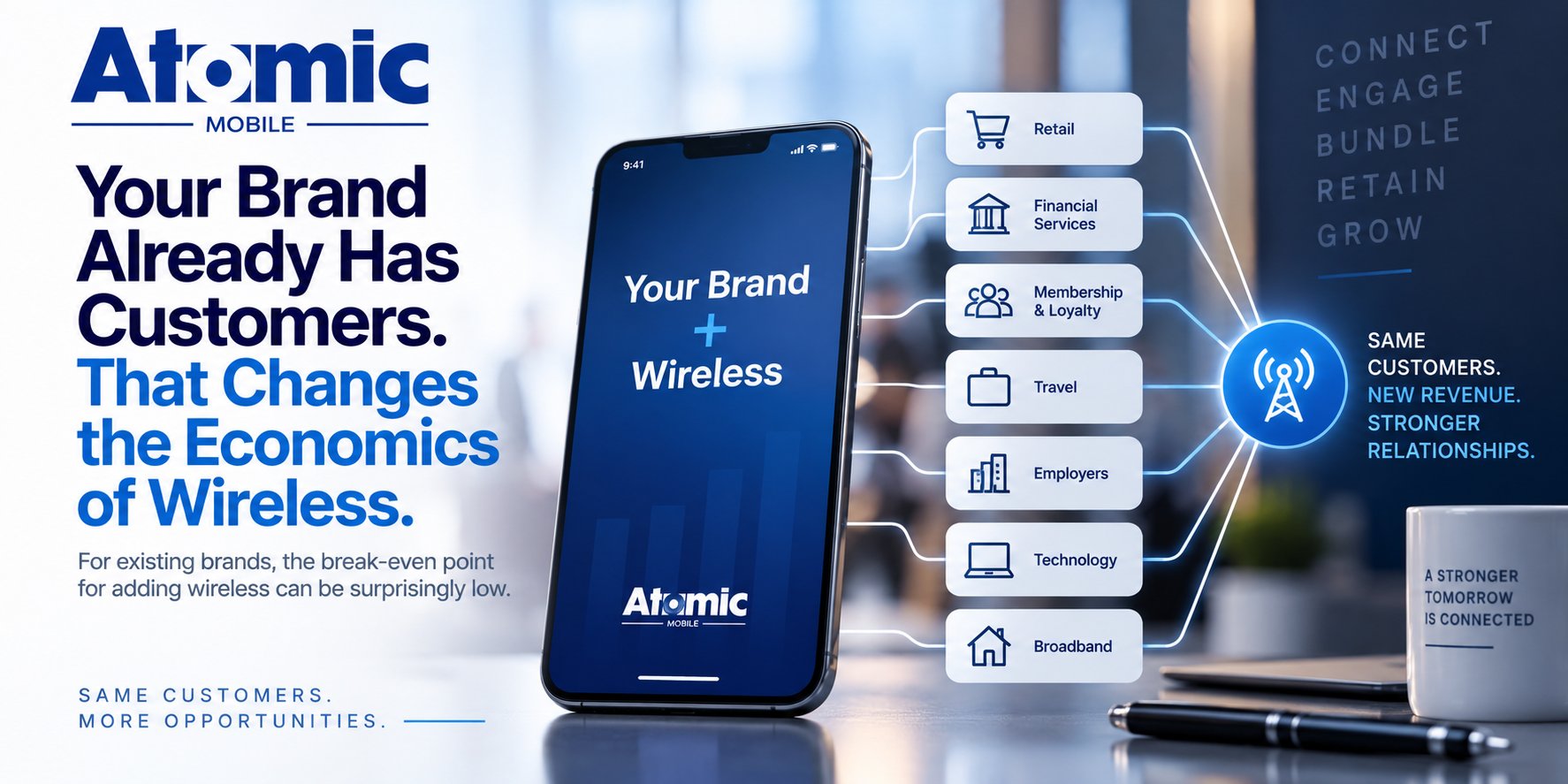
Your Brand Already Has Customers. That Changes the Economics of Wireless.
Starting a wireless company from zero can be expensive.
You need customers. Marketing. Distribution. Billing. Customer support. Technology. Operations. And, of course, connectivity.
But what if your company already has most of those things?
For an established brand with an existing customer base, adding wireless isn't necessarily the same thing as launching a traditional MVNO.
You're not starting at zero.
And that can completely change the economics.
In fact, for the right company, the incremental break-even point for adding wireless can be surprisingly low.
The Biggest Expense May Already Be Paid For
Consider what a traditional wireless startup needs to build.
It needs to acquire customers.
It needs a website and digital acquisition strategy.
It needs payment relationships.
It needs customer service.
It needs marketing channels.
It needs brand awareness.
It needs technology and operational infrastructure.
And it needs enough capital to support the business while the subscriber base grows.
An established company may already have:
100,000 customers.
Or 500,000.
Or several million.
It may already communicate with those customers every week.
It may already have their payment information.
It may already have an app.
It may already operate customer support.
It may already spend millions of dollars maintaining that customer relationship.
Adding wireless to that ecosystem is an entirely different economic proposition.
The question is no longer:
"How much will it cost us to build a wireless company?"
It becomes:
"What is the incremental cost of adding wireless to the business we already have?"
That's a much more interesting question.
The Traditional MVNO Break-Even Equation
In How Many Subscribers Does an MVNO Need to Be Profitable?, we explained the basic break-even formula:
Monthly Fixed Costs ÷ Monthly Contribution Margin Per Subscriber = Break-Even Subscribers
If an MVNO has $100,000 in monthly fixed costs and earns $10 per subscriber:
$100,000 ÷ $10 = 10,000 subscribers
That's straightforward.
But an existing brand may not have $100,000 of incremental wireless overhead.
Many of those costs may already exist inside the broader company.
And that's where the economics start to get interesting.
What If Wireless Only Adds $10,000 in Monthly Fixed Costs?
Let's use a hypothetical brand with 100,000 existing customers.
Assume it launches a wireless offering with:
Retail wireless revenue: $30 per line
Variable wireless cost: $20 per line
Contribution margin: $10 per line
Incremental fixed wireless costs: $10,000 per month
The break-even calculation becomes:
$10,000 ÷ $10 = 1,000 wireless subscribers
That means the company needs to convert only:
1% of its existing customers
to cover those incremental fixed costs.
One percent.
And if the company's incremental fixed costs were $5,000?
Break-even would be approximately:
500 wireless subscribers.
That's just:
0.5% of the existing customer base.
This is why the economics of adding wireless to an established brand can look dramatically different from launching a standalone wireless company.
The New Metric: Break-Even Penetration
For an existing brand, subscriber break-even isn't the only number worth calculating.
We can also calculate what we might call:
Break-Even Penetration
The formula is simple:
Break-Even Wireless Subscribers ÷ Existing Customers = Required Customer Penetration
Suppose the wireless business needs 1,000 subscribers to cover its incremental fixed costs.
Here's what that means for companies with different customer bases:
| Existing Customer Base | Wireless Subscribers Needed | Break-Even Penetration |
| ---------------------: | --------------------------: | ---------------------: |
| 25,000 | 1,000 | 4.0% |
| 50,000 | 1,000 | 2.0% |
| 100,000 | 1,000 | 1.0% |
| 250,000 | 1,000 | 0.4% |
| 500,000 | 1,000 | 0.2% |
| 1,000,000 | 1,000 | 0.1% |
That changes the conversation.
A company with one million customers doesn't necessarily need wireless to become its next billion-dollar business for the initiative to make economic sense.
If just 0.1% of its customers adopt the service in this example, the incremental wireless operation reaches break-even.
Everything beyond that begins contributing additional margin.
Customer Acquisition Cost Changes Everything
This may be the biggest advantage established brands have.
For a standalone wireless startup, customer acquisition can be one of the largest expenses in the entire business.
Suppose a new wireless company spends $150 to acquire a subscriber.
If that subscriber generates $10 per month in contribution margin, it takes:
15 months
just to recover the acquisition cost.
And that's assuming the customer remains active long enough to get there.
Now consider an established brand.
It can potentially market wireless through:
- Its existing app
- Customer emails
- Website traffic
- Monthly statements
- Loyalty programs
- Retail locations
- Customer service interactions
- Push notifications
- Existing sales teams
- Product bundles
The marginal cost of reaching those customers can be dramatically lower.
Instead of paying to find a stranger and convince them to trust a new wireless company, the brand is making an additional offer to someone who already knows the company and already buys from it.
That's a fundamentally different customer acquisition model.
It's also one of the reasons certain businesses may be particularly well positioned to become an MVNO.
Wireless Doesn't Have to Live in Isolation
Here's where the economics become even more compelling.
Suppose wireless generates $10 per month in direct contribution margin.
That's valuable.
But what if customers who add wireless also:
Stay with the company longer?
Buy additional products?
Use the company's app more frequently?
Become more engaged with the brand?
Move into a higher-value membership tier?
Refer more customers?
Become less likely to switch to a competitor?
Now the value of wireless is no longer simply:
Wireless Revenue - Wireless Cost
Wireless becomes part of the economics of the entire customer relationship.
The Retention Effect Can Be Bigger Than the Wireless Margin
Consider a hypothetical membership company.
It earns $40 per month from its core customer relationship.
It adds wireless and generates another $8 per month in contribution from the wireless service.
Looking only at wireless:
$8 per month = $96 per year
Not bad.
But suppose customers who bundle wireless remain customers several months longer than customers who don't.
Suddenly, the economic value of wireless includes:
Wireless contribution + incremental lifetime value of the core customer
That could be significantly more valuable than the direct wireless margin.
This is one reason broadband companies have increasingly bundled mobile service with home internet.
Wireless isn't necessarily just another product.
It can become another reason for the customer to stay.
The Best MVNO Customer May Already Be Your Customer
For decades, the wireless industry largely worked in one direction.
Wireless companies acquired wireless customers.
But the emergence of modern MVNEs, MVNAs, eSIM, APIs, and more flexible wireless infrastructure is creating another model:
Companies that already have customers can add wireless.
Think about the possibilities.
Retailers
A retailer could integrate wireless into its loyalty ecosystem, offer subscriber discounts, and increase customer engagement.
Banks and Fintech Companies
A financial brand could bundle wireless with premium accounts, memberships, or other financial products.
Broadband Providers
A broadband company can combine home internet and mobile connectivity into one customer relationship.
Membership Organizations
Wireless can become another recurring benefit that increases the value of membership.
Travel Companies
Connectivity can become part of the travel experience instead of something customers purchase separately.
Employers
Companies can provide managed employee connectivity without relying entirely on traditional enterprise wireless structures.
Technology Companies
A software or hardware company can embed connectivity directly into its product or service.
These companies don't necessarily need to reinvent themselves as telecom operators.
With the right MVNO infrastructure, wireless can become another service inside the business they already operate.
You Don't Need to Build a Telecom Company
This distinction matters.
A retailer considering wireless shouldn't necessarily be thinking:
"Do we want to become a telecom company?"
Neither should a bank.
Or a travel company.
Or a membership organization.
The better question is:
"Would connectivity make our existing customer relationship more valuable?"
The telecom infrastructure can exist underneath the brand.
An MVNO in a Box model can provide much of the underlying wireless infrastructure while the company focuses on the part it already understands:
Its customers.
That can include network connectivity, provisioning, SIM and eSIM capabilities, billing, taxation, compliance, customer management, and other operational components required to deliver wireless.
Atomic's Fusion platform is designed around this same principle: reduce the complexity associated with operating wireless so brands don't have to assemble every component themselves.
Data Economics Still Matter
Having customers doesn't automatically make wireless profitable.
The underlying unit economics still need to work.
One of the biggest variables is data consumption.
Two subscribers paying the same monthly price may consume dramatically different amounts of data.
If the economics are usage-sensitive, unexpectedly heavy consumption can reduce contribution margin and push break-even higher.
For example:
At $10 contribution per subscriber and $10,000 in incremental fixed costs:
Break-even = 1,000 subscribers
But if higher-than-expected data consumption reduces contribution to $7:
Break-even = approximately 1,429 subscribers
That's a 43% increase in the number of subscribers required.
Understanding subscriber behavior is therefore critical.
Atomic UsageIQ provides near-real-time visibility into wireless data consumption, helping operators better understand usage patterns and protect the economics behind their plans.
What Does "Almost Immediate Break-Even" Actually Mean?
It's important to be precise.
Not every established brand that launches wireless will become profitable immediately.
The economics depend on:
- Existing customer base
- Contribution margin
- Incremental operating expenses
- Customer acquisition costs
- Adoption rate
- Data consumption
- Churn
- Pricing
- Support requirements
- Integration costs
But established brands have one enormous structural advantage:
They don't necessarily need to recreate everything required to acquire and serve a customer.
That's why the incremental break-even point can be dramatically lower.
For some brands, wireless doesn't need 50,000 subscribers to become interesting.
It may not need 10,000.
Depending on the economics, it could require only hundreds or a few thousand existing customers to say yes.
Start With the Customer Base, Not the Wireless Plan
Companies evaluating wireless often start by asking:
What wireless plan should we offer?
I'd start somewhere else.
Look at your existing customer base.
How many customers do you have?
How often do they interact with your brand?
What does it cost to communicate with them?
Do you already have payment relationships?
What percentage would realistically consider buying wireless from you?
How much contribution could wireless generate per customer?
Could wireless increase retention?
Could it increase customer lifetime value?
Could it strengthen a membership or subscription?
Could it differentiate your core product?
Then calculate the penetration required to reach break-even.
You may discover that the hurdle is much lower than expected.
The Bigger Opportunity: Monetizing Distribution
There is a larger strategic idea behind all of this.
Companies spend enormous amounts of money building customer relationships.
They advertise.
They create loyalty programs.
They build apps.
They develop brands.
They operate retail locations.
They build subscriber communities.
They create distribution.
Once that infrastructure exists, adding another recurring service can be extremely powerful.
Wireless is particularly interesting because almost everyone already buys it.
The brand isn't trying to create demand for an entirely new category.
The customer already has a mobile phone bill.
The opportunity is to move some of that existing spend into a relationship the brand already owns.
That's why the future MVNO market may increasingly include companies that don't look like traditional wireless companies at all.
The Bottom Line
Launching a wireless company from scratch and adding wireless to an established brand are not the same economic proposition.
A startup may need to build customers, distribution, technology, operations, support, and brand awareness simultaneously.
An established company may already have most of those assets.
That means the incremental break-even point for wireless can be surprisingly low.
If a brand has 100,000 existing customers and needs 1,000 wireless subscribers to reach break-even, it doesn't need to conquer the wireless industry.
It needs 1% of its customers to say yes.
And if wireless also increases retention, customer lifetime value, engagement, or spending elsewhere in the business, the economics can become even more compelling.
The question for established brands may no longer be:
"Should we become a wireless company?"
It may be:
"We already have the customers. Why aren't we offering them wireless?"
Atomic Mobile helps brands evaluate, launch, operate, and scale wireless offerings without having to build the telecom infrastructure from scratch.
If your company already has a meaningful customer base, talk to Atomic Mobile about what the economics of adding wireless could look like for your business.
Frequently Asked Questions
How quickly can a brand break even after adding wireless?
There is no universal timeline. An established brand may have a significantly lower incremental break-even point because it already has customers, distribution, billing relationships, marketing channels, and operational infrastructure. The actual timeline depends on contribution margin, incremental fixed costs, adoption, usage, and churn.
How do you calculate break-even for a branded wireless offering?
One simple method is:
Incremental Monthly Fixed Costs ÷ Monthly Contribution Margin Per Wireless Subscriber = Break-Even Wireless Subscribers
For an existing brand, you can then divide that subscriber number by the existing customer base to calculate the percentage of customers who need to adopt wireless.
What percentage of existing customers need to buy wireless?
It depends on the economics. For example, if a company has 100,000 customers and needs 1,000 wireless subscribers to cover incremental fixed costs, its break-even penetration rate would be 1%.
Why can adding wireless be cheaper for an existing brand?
Existing brands may already have customer relationships, distribution, marketing channels, payment systems, customer support, digital infrastructure, and brand awareness. That can significantly reduce the incremental cost of launching and acquiring wireless subscribers.
Does a brand need to become a telecom company to offer wireless?
Not necessarily. MVNE, MVNA, and managed wireless platforms can provide much of the underlying telecom infrastructure while the brand controls the customer experience, positioning, and commercial strategy.
Can wireless be valuable even with a small direct margin?
Yes. Wireless can potentially increase customer retention, lifetime value, engagement, cross-selling, and differentiation. For some brands, those indirect economic benefits may be as important as the direct margin generated by the wireless service.
Brian Latchford
Author