Should Your Company Become an MVNO? 10 Businesses That Should Consider It
Should Your Company Become an MVNO? 10 Businesses That Should Consider It
Most companies that should launch an MVNO probably do not think of themselves as telecom companies.
That may actually be their biggest advantage.
For years, launching a wireless company generally meant trying to become the next consumer wireless brand. Build a brand, create some rate plans, acquire customers and compete against companies that already had millions of subscribers and billions of dollars to spend on marketing.
That is still one way to build an MVNO.
But I believe one of the biggest opportunities in wireless today is very different.
There are thousands of companies that already have customers, distribution, brand recognition and an existing relationship with the people they would need to sell wireless to.
They do not need to become telecom companies.
They need to ask whether connectivity can make their existing business more valuable.
Stop Asking Whether You Can Launch an MVNO
The technology required to launch an MVNO has become significantly more accessible.
Modern MVNE platforms can handle provisioning, billing, subscriber management, SIM and eSIM management, usage, compliance and many of the other systems required to operate a wireless business.
That changes the question.
Instead of asking:
Can our company launch an MVNO?
I think companies should be asking:
Does our company have an advantage that makes launching an MVNO worth doing?
That advantage could be millions of existing customers.
It could be a highly engaged membership organization.
It could be hundreds of retail locations.
It could be an app customers already open every day.
It could even be a product that becomes significantly more valuable when connectivity is built directly into it.
Wireless is no longer just something that has to be sold as a standalone product.
It can become a layer inside an existing business.
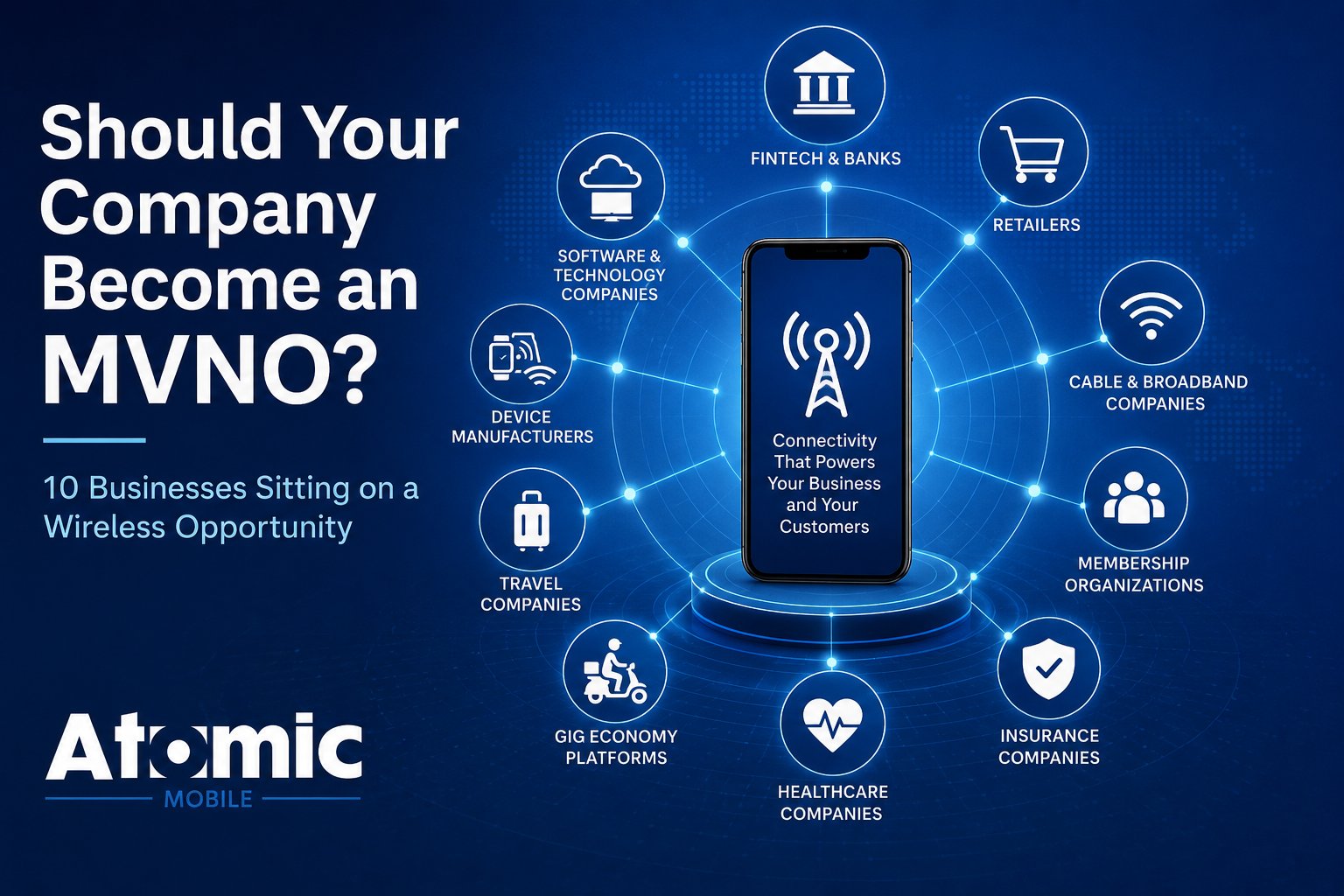
Here are 10 types of companies I believe should be looking closely at that opportunity.
1. Fintech Companies and Banks
Financial institutions have something wireless companies spend enormous amounts of money trying to create: an established financial relationship with the customer.
Customers already trust them with payments, deposits, credit cards and other recurring financial services.
Wireless can become another recurring service inside that ecosystem.
Imagine a fintech offering premium customers a wireless plan as part of a subscription tier. A bank could bundle connectivity with certain accounts or rewards programs. A digital financial platform could integrate wireless activation directly into its existing application.
The opportunity is not simply earning margin on a wireless plan.
It is increasing the value of the overall customer relationship.
That distinction matters.
If wireless reduces churn or increases the adoption of other financial products, its value may extend well beyond the monthly wireless margin.
2. Retailers
Retailers may have one of the most interesting structural advantages in wireless: distribution.
Customer acquisition is one of the largest expenses facing a traditional consumer MVNO.
A retailer may already have stores, websites, loyalty programs, email lists, applications and millions of existing customer relationships.
Instead of paying to find wireless customers, the retailer can introduce wireless to customers it already has.
The offering could also connect directly to the retailer's loyalty ecosystem.
Wireless subscribers could receive store benefits. Loyalty members could receive wireless discounts. Wireless usage could unlock rewards.
Now the wireless plan is not competing solely on price.
It is strengthening the customer's relationship with the retailer.
3. Cable and Broadband Companies
This one is already being proven at scale.
Broadband providers have discovered that mobile can be much more than an additional source of revenue.
It can make the broadband relationship stickier.
When internet, mobile and potentially other services are connected under one customer relationship, leaving becomes more complicated.
That can reduce churn and increase lifetime customer value.
Smaller broadband providers should be paying attention.
You do not necessarily need tens of millions of broadband subscribers to use wireless strategically.
Regional broadband companies, fiber providers and other ISPs may have concentrated customer bases that create natural distribution for mobile services.
4. Membership Organizations
This category is still underdeveloped.
Think about organizations with large groups of members who share an affiliation.
Associations.
Alumni organizations.
Professional groups.
Clubs.
Large nonprofit organizations.
Membership businesses.
These organizations already aggregate customers around something they value.
Wireless can become a tangible membership benefit while creating a new recurring revenue opportunity for the organization.
This is where private label wireless becomes especially interesting.
The member does not need to know or care about the infrastructure operating behind the service.
They see the organization they already trust.
5. Insurance Companies
Insurance and connectivity are becoming increasingly intertwined.
Vehicles are connected.
Homes are connected.
Wearables are connected.
Safety devices are connected.
Telematics increasingly depends on connectivity.
An insurance company does not necessarily need to sell a traditional smartphone plan to participate in wireless.
Connectivity could be incorporated into products involving roadside assistance, vehicle telematics, home monitoring, personal safety or connected devices.
In those situations, the value of connectivity is not necessarily the data itself.
The value is what the data enables.
That is an important distinction for companies evaluating wireless.
6. Healthcare Companies
Healthcare presents a similar opportunity.
Remote patient monitoring, connected medical devices, tablets, wearables and home health applications all depend on reliable connectivity.
Today, connectivity is often treated as a separate component that must be assembled around the healthcare solution.
I think we will increasingly see connectivity disappear into the product itself.
The patient should not need to choose a carrier, configure a device or understand how the network works.
The device should simply connect.
For healthcare companies, becoming an MVNO may therefore have very little to do with selling phone plans.
It may be about controlling the connectivity required to deliver the company's primary service.
7. Gig Economy Platforms
Drivers, delivery workers, contractors and other gig economy participants depend heavily on mobile connectivity.
Their phone is often their office.
Navigation, messaging, payments, customer communication and the actual work platform all depend on it.
That creates an interesting question:
Why should the connectivity required to use the platform always come from someone else?
A gig economy company could potentially offer wireless as a worker benefit, a discounted service or even part of a broader subscription program.
It could also create plans designed specifically around the usage patterns of its workforce.
Again, the value does not necessarily come entirely from wireless margin.
Better connectivity could improve engagement with the underlying platform itself.
8. Travel Companies
Travel and connectivity are rapidly converging.
Airlines, hotel companies, travel platforms and loyalty programs already maintain relationships with people precisely when connectivity becomes especially important.
Travel eSIM has demonstrated that consumers are willing to purchase connectivity from companies other than their traditional mobile carrier.
The next logical question is whether travel companies themselves should own more of that experience.
Imagine booking a trip and having connectivity activated as part of the purchase.
Or receiving international data as a loyalty benefit.
Or having a travel application automatically provision connectivity when you arrive in another country.
The best connectivity experience may eventually be the one the customer barely notices.
9. Device Manufacturers
Every connected product creates the same fundamental question:
Who controls the connection?
Manufacturers of cameras, trackers, tablets, routers, vehicles, wearables, security products and other connected devices increasingly have the ability to incorporate connectivity directly into the product.
This can fundamentally change the business model.
Instead of:
Sell device → customer finds connectivity
the model becomes:
Sell connected service → connectivity is included
That can transform a one time hardware transaction into a recurring relationship.
It also gives the manufacturer greater control over activation, support and the overall customer experience.
10. Software and Technology Companies
This may ultimately become one of the largest categories.
Software increasingly interacts with the physical world.
Point of sale systems, workforce applications, logistics platforms, security platforms, fleet management systems and countless other software products depend on connected devices.
Today, many software companies tell customers to obtain connectivity separately.
That creates friction.
Over time, I expect more software platforms to embed connectivity directly into their offering.
The customer buys the solution.
The solution connects.
The software company manages the entire experience.
Wireless becomes infrastructure inside the product rather than another vendor the customer has to manage.
The MVNO Advantage Test
Before launching an MVNO, I think every company should go through what I call the MVNO Advantage Test.
Ask five questions:
1. Do we already have customers?
An existing customer base can dramatically change the economics of launching wireless.
2. Do we have efficient distribution?
Retail locations, applications, websites, sales teams, membership programs and existing communication channels can reduce customer acquisition costs.
3. Do customers have a reason to buy wireless from us?
Brand recognition alone is not enough. There should be a logical connection between your existing relationship and the wireless offering.
4. Can wireless strengthen our primary business?
Look beyond wireless margin.
Could it improve retention?
Increase subscription value?
Create another customer touchpoint?
Make another product work better?
5. Can we create something the traditional carriers cannot easily replicate?
This may be the most important question.
A carrier can lower its price.
It can add more data.
It can introduce another promotion.
What it cannot easily replicate is the unique relationship another company already has with its customers.
That relationship can become the moat.
You Do Not Have to Build a Telecom Company
There is another reason I believe this market is going to expand.
The infrastructure required to operate wireless no longer has to be built internally.
An MVNE platform can provide the technology required to manage subscribers, provisioning, billing, plans, SIMs, eSIMs and network integrations.
Companies can also use private label wireless when they want the wireless experience to carry their brand while much of the telecom operation remains behind the scenes.
For companies looking for an even more integrated approach, an MVNO in a Box model can combine the infrastructure needed to launch, operate and scale the service.
That means the company launching wireless can remain focused on the thing that made the opportunity attractive in the first place:
Its customers.
The Economics Still Matter
Having a large audience does not automatically make an MVNO a good business.
Companies still need to understand the complete economics.
Wholesale connectivity.
Platform expenses.
Billing.
Taxes.
Compliance.
Support.
Customer acquisition.
Data consumption.
Churn.
Working capital.
Those variables determine whether the business model actually works.
I recently broke down how MVNOs make money and why the spread between the retail plan price and wholesale connectivity cost does not tell the entire story.
Companies considering wireless should model both the direct economics and the indirect value.
A wireless customer generating $10 of monthly contribution margin may be attractive.
But a wireless customer generating $10 of monthly contribution margin while also becoming significantly less likely to leave your primary business may be far more valuable.
That is where some of the most interesting MVNO models will emerge.
Start With the Advantage, Not the Network
If your company is considering wireless, do not begin by asking which network you can access or what an unlimited plan will cost.
Start with the customer.
Why would they buy wireless from you?
What advantage do you already possess?
What becomes more valuable if connectivity is added?
How does wireless strengthen the relationship you already have?
Then determine whether the economics support the idea.
If they do, the actual mechanics of building the business can follow. Our 15 step guide to launching an MVNO covers that process in considerably more detail.
The companies that create some of the most interesting wireless businesses over the next decade may not come from telecom at all.
They may come from banking.
Retail.
Healthcare.
Travel.
Software.
Insurance.
Membership organizations.
Or industries we have not even considered yet.
Because the next generation of MVNOs will not necessarily be companies trying to become wireless carriers.
They will be companies realizing that wireless can make the business they already have more valuable.
Brian Latchford
Author