How to Launch an MVNO in 15 Steps
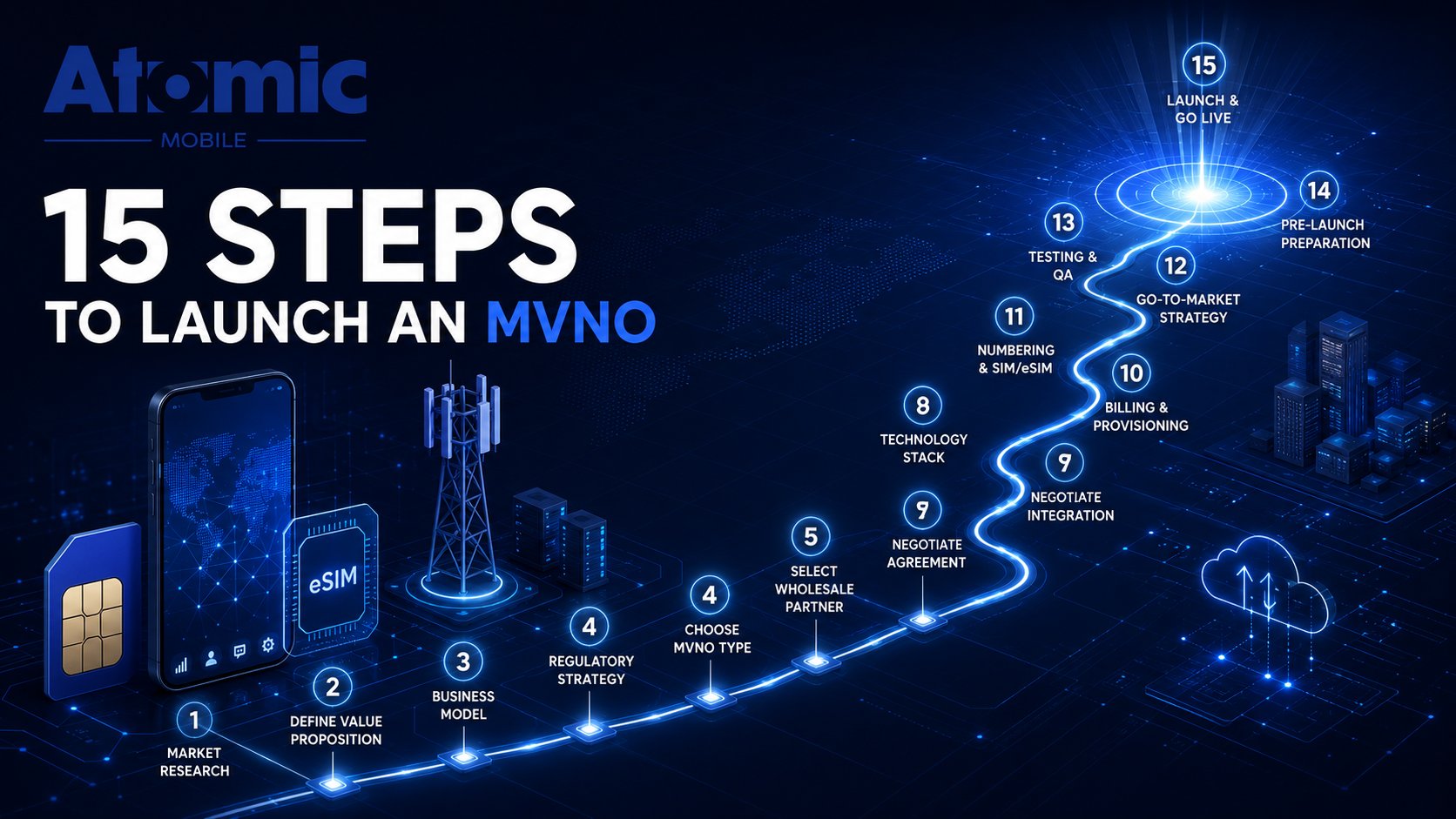
How to Launch an MVNO in 15 Steps
By Brian Latchford, Founder and CEO of Atomic Mobile
I have helped launch and support more than 100 MVNOs throughout my career. One of the most common misconceptions I encounter is that launching an MVNO begins with securing network access and ordering SIM cards.
Those elements are necessary, but they are only a small part of building a successful wireless company.
Launching an MVNO means building a complete telecommunications business. The network, technology, billing, compliance, customer support, pricing, distribution, and customer experience must all work together. A weakness in any one of these areas can affect the entire operation.
The strongest MVNOs are not necessarily the ones with the lowest prices or the most ambitious launch plans. They are the ones that understand exactly whom they serve, why those customers will choose them, and how the business will operate profitably as it grows.
Here are the 15 steps I believe every company should address before launching an MVNO.
- Define Who Your MVNO Will Serve
The first question should not be, “Which network should we use?”
It should be, “Why should this MVNO exist?”
A successful MVNO generally begins with a clearly defined audience and a specific customer problem. That audience might be consumers, businesses, employees, members of an organization, travelers, healthcare providers, financial institutions, connected device manufacturers, or a community that is not being served effectively by traditional wireless carriers.
You need to understand:
Who will purchase the service?
What problem will it solve?
Why will customers choose your brand?
How will you reach those customers?
Will wireless generate direct revenue, strengthen retention, or support another product?
In my experience, distribution is often a greater advantage than network access. If you already have customers, members, employees, retail locations, channel partners, or an engaged community, you may have the foundation for a differentiated wireless offering.
- Choose Your MVNO Business Model
Not every MVNO is a traditional consumer wireless company.
Your business model determines the features, billing structure, integrations, operational processes, and network capabilities you will need.
Common models include:
Consumer MVNOs selling voice, messaging, and data plans
Enterprise MVNOs managing wireless service for businesses or workforces
Embedded MVNOs integrating connectivity into another product or platform
IoT MVNOs connecting equipment, sensors, vehicles, cameras, and other devices
Fixed Wireless Access providers offering primary or backup internet access
Travel eSIM providers delivering international data connectivity
Affinity MVNOs serving members of a specific organization or community
Trying to serve every possible customer usually creates an unfocused product. Choose the model that best matches your existing strengths, customer relationships, and distribution capabilities.
- Build the MVNO Business Case
A compelling brand does not automatically create a viable business.
Before investing heavily in technology or marketing, build a financial model that connects subscriber growth, customer revenue, wholesale network costs, and operating expenses.
The model should account for:
Expected subscriber growth
Monthly revenue per subscriber
Wholesale voice, messaging, and data costs
Platform and service fees
SIM and eSIM expenses
Payment processing
Telecom taxes and regulatory fees
Customer support
Marketing and customer acquisition
Device subsidies or financing
Fraud and nonpayment
Customer churn
Working capital
Do not build the entire model around average usage. Averages can conceal the financial effect of high usage customers, roaming, fraud, payment failures, and poorly structured unlimited plans.
The objective is not simply to determine whether the MVNO can attract subscribers. It is to determine whether it can acquire, serve, and retain those subscribers profitably.
- Select the Right Operating Model
The appropriate operating model depends on how much control, capital, technical ownership, and operational responsibility you want.
A light MVNO relies on an MVNA or MVNE for carrier connectivity and much of the underlying technology. This is generally the most practical model for startups, established brands, and companies entering wireless for the first time.
A full MVNO controls more of the network infrastructure and subscriber environment. That can provide greater flexibility, but it also requires substantially more capital, technical expertise, carrier integration, and regulatory responsibility.
An MVNO in a Box model combines network connectivity, provisioning, billing, SIM and eSIM management, reporting, APIs, and operational support in a unified environment.
More control is not automatically better. The right level of control is the level that supports your business model without creating unnecessary cost and complexity.
- Obtain Wholesale Network Access
An MVNO must have an agreement that permits it to resell or integrate mobile network service.
Negotiating directly with a major carrier can require significant subscriber commitments, financial guarantees, technical resources, and industry experience. Many new MVNOs therefore obtain connectivity through an established Mobile Virtual Network Aggregator, or MVNA.
Wholesale connectivity should be evaluated on more than price.
Important considerations include:
Network coverage and performance
4G LTE and 5G access
Voice and messaging capabilities
Domestic and international roaming
eSIM support
Device compatibility
Usage reporting
Minimum commitments
Contract restrictions
Carrier escalation procedures
Ability to scale
A low wholesale rate will not compensate for an agreement that cannot support the product you intend to offer.
- Choose an MVNE Platform
The MVNE platform is the operating system behind the MVNO.
It manages the subscriber lifecycle, including account creation, activations, number porting, SIM and eSIM management, plan configuration, usage rating, billing, suspensions, cancellations, support workflows, reporting, and API integrations.
Do not evaluate a platform solely by how quickly it can activate your first subscriber. Determine whether it can support the company at 100, 10,000, and 100,000 subscribers.
Migrating a live wireless business from an inadequate platform can be expensive, disruptive, and risky. It is much better to select technology based on where the business intends to go, rather than only what it needs on launch day.
- Design Your Plans and Pricing
Your plans must provide clear customer value while maintaining predictable wholesale economics.
Possible structures include:
Prepaid monthly plans
Postpaid plans
Usage based plans
Shared or pooled data
Unlimited plans
Multi line and family plans
Enterprise account plans
IoT data plans
Fixed Wireless Access plans
Travel eSIM packages
Bundled or membership based plans
You also need to decide how top ups, overages, throttling, roaming, plan changes, and midcycle activations will work.
A pricing idea is not operationally complete until the platform can provision, rate, bill, tax, and support it accurately.
- Build Billing and Payment Operations
MVNO billing is more complex than charging a monthly software subscription.
The billing environment may need to support recurring charges, usage based billing, prorated service, plan changes, promotions, add ons, top ups, multiple lines, enterprise account hierarchies, payment recovery, refunds, credits, invoices, and telecom taxes.
Billing errors quickly become support problems, customer experience problems, and financial problems.
At Atomic Mobile, we developed Atomic Fusion to help qualifying operators manage billing, telecom tax calculation and remittance, regulatory reporting, and customer support operations. This gives an MVNO the ability to manage those functions internally or rely on an experienced operating partner.
- Prepare for Telecom Tax and Compliance
Wireless service is not regulated like an ordinary ecommerce product or software subscription.
Depending on the service, customer type, geography, and operating model, an MVNO may need to address:
Federal, state, and local telecom taxes
Regulatory registrations and reporting
Universal Service Fund obligations
911 requirements
CPNI protections
Number porting regulations
Accessibility requirements
Privacy and security controls
Customer disclosures
Recordkeeping
Fraud prevention
Lawful process procedures
Compliance cannot be treated as something to solve after the service launches. It should be incorporated into the operating model, customer experience, and billing environment from the beginning.
Operators should also work with qualified telecommunications, legal, tax, and regulatory professionals to determine the requirements that apply to their specific offering.
- Implement SIM and eSIM Activation
The activation experience is one of the first moments when the customer discovers whether the MVNO actually works as promised.
An MVNO may support:
Physical SIM cards
Consumer eSIM
QR code activation
App based activation
Bulk enterprise deployment
IoT provisioning
SGP.32 eSIM workflows for compatible IoT use cases
The activation journey may also include device eligibility, identity verification, number selection, number porting, plan selection, payment, SIM assignment, provisioning, and confirmation.
eSIM can remove shipping delays and enable immediate activation, but it does not eliminate the need for device compatibility checks, reliable provisioning, clear instructions, and effective customer support.
- Create the Complete Customer Experience
The customer experience should be designed before the first subscriber is activated.
Map every important journey, including:
Creating an account
Selecting a plan
Activating a SIM or eSIM
Porting a number
Adding another line
Changing a plan
Viewing usage
Updating payment information
Reporting a lost device
Suspending or restoring service
Contacting support
Cancelling service
Customers do not see the separate systems and vendors behind an MVNO. They see one brand. The website, application, customer portal, payment platform, support tools, and network systems must therefore behave like one connected experience.
Near real time usage visibility is also increasingly important. We built UsageIQ to help operators answer customer questions, identify unusual consumption, manage capacity, and reduce unexpected usage problems.
- Establish Customer Support and Operations
Wireless support requires specialized processes.
Support teams may need to handle:
Activation failures
Device compatibility
Number ports
SIM and eSIM issues
Voice and data troubleshooting
Messaging problems
Roaming
Account access
Payment failures
Lost or stolen devices
Fraud
Service suspensions
Carrier escalations
There should be a clear escalation path from frontline support to billing operations, platform support, technical teams, and the underlying carrier.
A customer should never be left bouncing between vendors because the operator has not established ownership of the problem.
- Test the Complete MVNO
Testing an MVNO means much more than confirming that a phone can connect to the network.
Before launch, test:
New activations
Physical SIM and eSIM flows
Number ports
Voice calls
SMS and MMS
Mobile data
Voicemail
Plan changes
Top ups
Usage rating
Recurring billing
Failed payments
Tax calculations
Suspensions and restorations
Cancellations
Refunds and credits
Customer notifications
Portal functions
Support escalations
Test normal transactions, failures, edge cases, and higher volume workflows.
The goal is not to prove that the ideal customer journey works. It is to understand what happens when something does not work and make sure the organization can identify, own, and resolve the problem.
- Prepare Your Go-to-Market Strategy
A technically complete MVNO is not automatically a commercially successful MVNO.
Before launching, define:
Your ideal customer
Brand positioning
Distribution channels
Customer acquisition strategy
Launch offer
Conversion funnel
Retention strategy
Referral program
Partnership opportunities
Support coverage
Subscriber and revenue goals
Whenever possible, validate demand before committing significant capital.
Companies with an existing customer base, membership, retail footprint, enterprise relationship, or distribution network often have a meaningful advantage. Wireless becomes much more compelling when it can be introduced through a trusted relationship rather than purchased through expensive advertising.
- Launch, Measure, and Scale
I generally recommend a controlled launch rather than immediately opening the service to the largest possible audience.
A controlled launch gives the team time to identify technical, billing, support, and customer experience issues before they affect a large subscriber base.
Important performance indicators include:
Number of activations
Activation success rate
Number port completion time
Customer acquisition cost
Revenue per subscriber
Gross margin
Data usage
Support contacts per subscriber
Payment failure rate
Churn
Fraud losses
Network incidents
Customer satisfaction
Scalability should be designed into the company from the beginning. APIs, automation, accurate usage information, billing controls, and documented support processes become more important with every subscriber added.
Four Gates Every MVNO Should Pass
I think about MVNO readiness through four basic gates.
Strategy Gate
Do you have a defined audience, differentiated offering, credible distribution strategy, and viable business case?
Infrastructure Gate
Can the network and platform activate, provision, rate, bill, tax, support, and manage the proposed service?
Readiness Gate
Has the complete customer journey been tested, including failures, exceptions, and escalation procedures?
Commercial Gate
Can the business acquire, serve, retain, and support customers at a sustainable cost?
If the answer to one of these questions is no, the MVNO may not be ready to launch, regardless of whether the SIM card connects to the network.
The Most Important Lesson
Launching an MVNO is not a technology project with a marketing plan attached. It is the creation of a complete telecommunications business.
Network access allows the business to exist. The operating platform, unit economics, compliance framework, distribution strategy, and customer experience determine whether it can grow.
After helping launch more than 100 MVNOs, I believe the best time to address these requirements is before the first subscriber is activated. Every decision becomes more difficult and more expensive once customers depend on the service.
Atomic Mobile brings wholesale carrier connectivity, MVNE technology, billing, provisioning, compliance support, usage intelligence, and operational experience together in one scalable environment.
If you are considering launching an MVNO, start by downloading our free 100-step MVNO launch checklist. It provides a more detailed breakdown of the work required across technology, operations, sales, marketing, and launch readiness.
Download the Free 100-Step MVNO Launch Checklist
When you are ready to turn the plan into a working wireless business, talk with Atomic Mobile about your MVNO launch.
Brian Latchford
Author