The Hybrid Network Era: Why the Future Isn’t Fiber vs. Wireless vs. Satellite
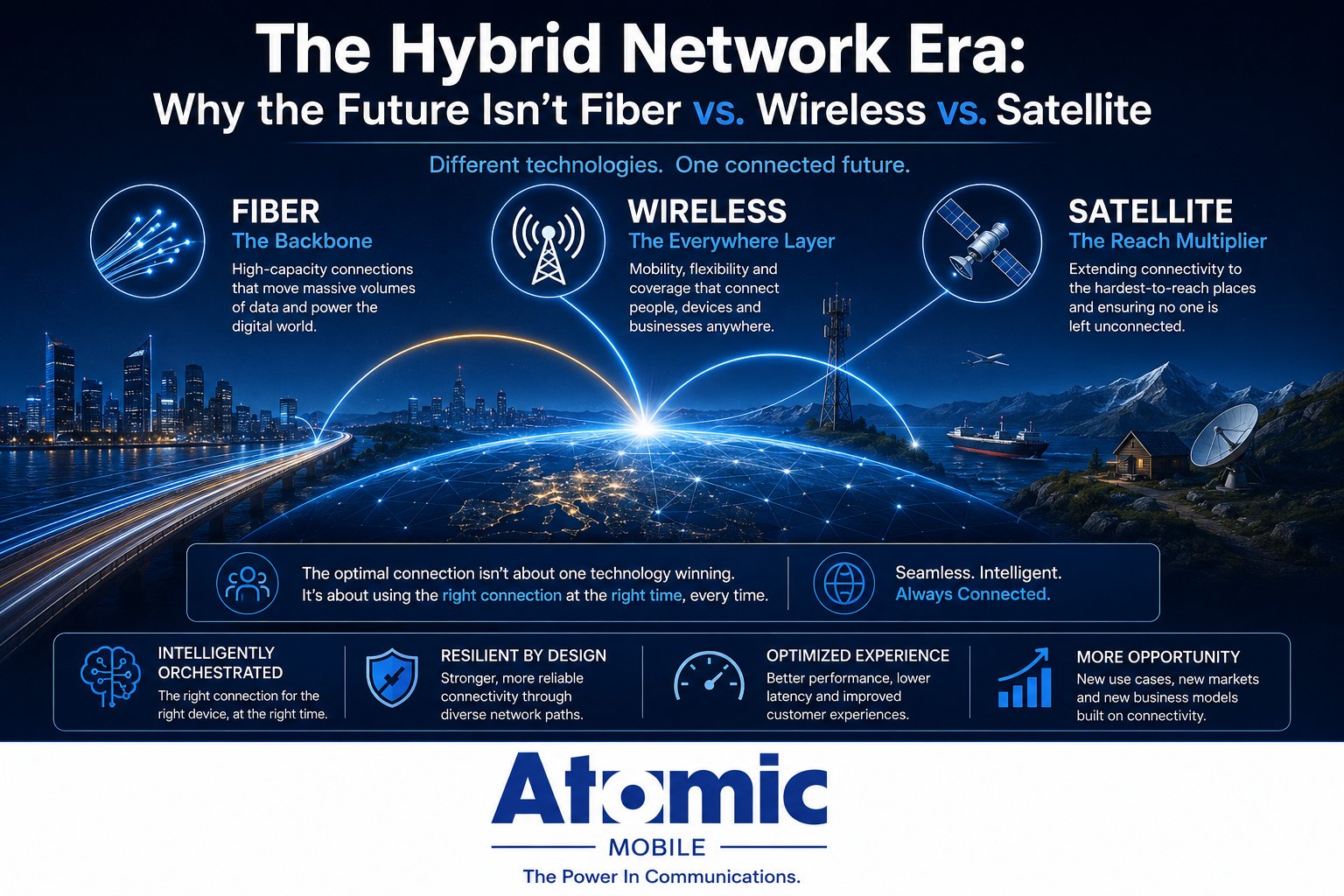
The Hybrid Network Era: Why the Future Isn’t Fiber vs. Wireless vs. Satellite
For years, the connectivity industry has loved a good technology showdown.
Fiber vs. wireless.
5G vs. Wi-Fi.
Fixed wireless vs. cable.
And now, satellite vs. terrestrial networks.
The latest version of that debate has intensified as satellite providers push deeper into traditional telecom territory and direct-to-device connectivity moves from concept toward commercial reality.
But I think the debate itself is increasingly outdated.
The future of connectivity isn't about which network wins. It's about how intelligently we combine them.
We are entering the hybrid network era, where fiber, terrestrial wireless, Wi-Fi, fixed wireless and satellite increasingly operate as parts of the same connectivity ecosystem.
And that shift could create one of the biggest opportunities we've seen in telecom in years.
Fiber Isn't Going Anywhere
Let's start with fiber.
Despite every prediction about the next technology replacing it, fiber remains fundamental to modern communications infrastructure.
Data centers need fiber. Mobile networks need fiber. Cloud platforms need fiber. Enterprises need fiber. Even wireless networks ultimately need high-capacity transport somewhere behind the radio.
As wireless traffic grows, the need for fiber doesn't disappear. In many cases, it grows with it.
That is an important distinction.
Wireless and satellite aren't necessarily substitutes for fiber. They can actually create additional demand for the infrastructure behind them.
Fiber is increasingly the capacity layer of the connectivity ecosystem.
Wireless Remains the Mobility Layer
Fiber may move enormous amounts of data, but you can't drag a fiber connection behind your phone, vehicle or IoT device.
That's where terrestrial wireless remains incredibly difficult to replace.
Modern cellular networks combine broad geographic coverage with capacity, mobility, low latency and an enormous installed base of compatible devices.
And the wireless network itself continues to evolve.
5G Advanced, network APIs, eSIM, private networks and increasingly sophisticated network intelligence are making cellular connectivity more programmable and adaptable.
Wireless isn't simply becoming faster.
It's becoming more flexible.
And that matters because the next generation of connected products won't all look like smartphones.
They'll be vehicles, cameras, payment terminals, sensors, routers, wearables, industrial equipment and devices we haven't even invented yet.
Satellite Solves a Different Problem
Satellite's advantage is obvious: reach.
There are places where building terrestrial infrastructure simply doesn't make economic sense.
Oceans. Remote highways. Agricultural regions. Mountains. Disaster areas. Extremely rural communities.
Satellite changes the economics of reaching those places.
And increasingly, the device on the other end doesn't need to be a giant satellite phone.
3GPP Release 17 was the first release to establish normative requirements for Non-Terrestrial Networks, including requirements designed to support continuity between terrestrial 5G and satellite access.
That is a much bigger development than simply putting another satellite into orbit.
It means the standards themselves are evolving toward terrestrial and non-terrestrial networks working together.
The GSMA describes direct-to-device satellite connectivity in much the same way: as a technology that can supplement terrestrial mobile coverage and improve network resilience, particularly where traditional mobile infrastructure isn't available.
Notice the word supplement.
Not replace.
That's where I believe a lot of the current conversation gets it wrong.
The Real Innovation Happens Between the Networks
Imagine a connected vehicle traveling across the country.
Most of the time, cellular connectivity might provide the best combination of performance, economics and mobility.
But what happens when that vehicle enters an area without terrestrial coverage?
Satellite becomes valuable.
Now imagine the same vehicle parked at a facility with high-capacity Wi-Fi connected to fiber.
The optimal network changes again.
From the customer's perspective, none of that should matter.
They don't want to choose a network.
They want the application to work.
That changes the fundamental question from:
Which network technology is best?
to:
Which network is best right now, for this device, application and location?
That's a dramatically different way of thinking about connectivity.
Connectivity Is Becoming an Abstraction Layer
Cloud computing went through a similar evolution.
Businesses once spent enormous amounts of time thinking about physical servers. Today, developers increasingly think about applications, workloads and services while infrastructure platforms determine where the underlying computing resources live.
Connectivity may be heading in a similar direction.
The application shouldn't necessarily care whether the packet travels over cellular, Wi-Fi, fiber-backed infrastructure or satellite.
It should care about things like availability, latency, cost, security, capacity and reliability.
The network increasingly becomes something that can be orchestrated around those requirements.
That is where hybrid networking becomes particularly interesting.
Instead of forcing a device onto one network architecture, connectivity platforms can increasingly make intelligent decisions about which network should carry the traffic.
The network becomes less visible.
The experience becomes more important.
This Creates a Huge Opportunity for MVNOs
Historically, the MVNO model has largely been defined by one thing:
Buying wireless connectivity from an MNO and reselling it to customers.
That definition is becoming far too narrow.
The next generation of MVNOs may aggregate multiple types of connectivity across multiple networks, technologies and geographies.
The value isn't simply access to a SIM card.
The value becomes orchestration.
Which network should the device use?
How should usage be rated?
Which connectivity option meets the customer's SLA?
Can the device switch networks?
Can connectivity policies change dynamically?
Can cellular, Wi-Fi and satellite usage appear on the same bill?
Can an enterprise manage all of it through one platform?
Those are much more interesting questions than simply asking which carrier has the lowest wholesale rate.
And they create an opportunity for MVNOs, MVNEs and connectivity platforms to move higher in the value chain.
IoT May Be Where This Happens Fastest
Consider an IoT deployment with devices spread across thousands of locations.
Some devices may operate perfectly on terrestrial cellular networks.
Others may sit beyond reliable cellular coverage.
Some may transmit tiny amounts of data from extremely remote locations.
Others may require high-bandwidth connectivity.
Trying to solve every one of those scenarios with a single network architecture doesn't make much sense.
A hybrid model does.
Hybrid terrestrial-satellite connectivity is already emerging as a practical next step for IoT, with devices potentially able to use different network types based on availability and application requirements.
That is where the market starts becoming particularly interesting.
Because once connectivity can move intelligently between networks, the company creating the most value may not necessarily be the company that owns the infrastructure.
It may be the company that orchestrates it.
The Winners May Not Own the Most Infrastructure
Telecom has traditionally rewarded infrastructure ownership.
Spectrum. Towers. Fiber. Data centers. Satellites.
Those assets will remain enormously valuable.
But another layer is emerging above them.
The orchestration layer.
The companies that can combine infrastructure from multiple providers and turn it into a simple, programmable connectivity experience may become increasingly important.
That is particularly relevant for MVNOs and digital-first brands.
You don't necessarily need to own towers, satellites or nationwide fiber networks.
You need access to the right infrastructure, the right economics and a platform capable of making all of it usable.
That dramatically lowers the barrier to creating specialized connectivity businesses.
The Future Isn't Either/Or
Satellite isn't going to eliminate terrestrial wireless.
Wireless isn't going to eliminate fiber.
Fiber isn't going to reach every device.
Each technology solves a different part of the connectivity problem.
And that's exactly why they become more powerful when they work together.
The next era of telecom won't be defined by a single network winning.
It will be defined by networks becoming increasingly invisible to the customer.
The customer won't care how the connection happened.
They'll care that it happened.
Anywhere.
Automatically.
Reliably.
And at the right economics.
That's the hybrid network era.
And we're just getting started.
The Atomic Perspective
At Atomic Mobile, we believe the future of connectivity is about more than providing network access. It's about making connectivity easier to launch, manage, understand and scale across an increasingly complex network ecosystem.
As fiber, wireless, IoT, FWA and satellite continue to converge, the opportunity isn't simply connecting more devices.
It's making all of that connectivity work together.
Atomic Mobile: Small actions. Massive results.
Brian Latchford
Author