The MVNO Is Disappearing. And That’s a Good Thing.
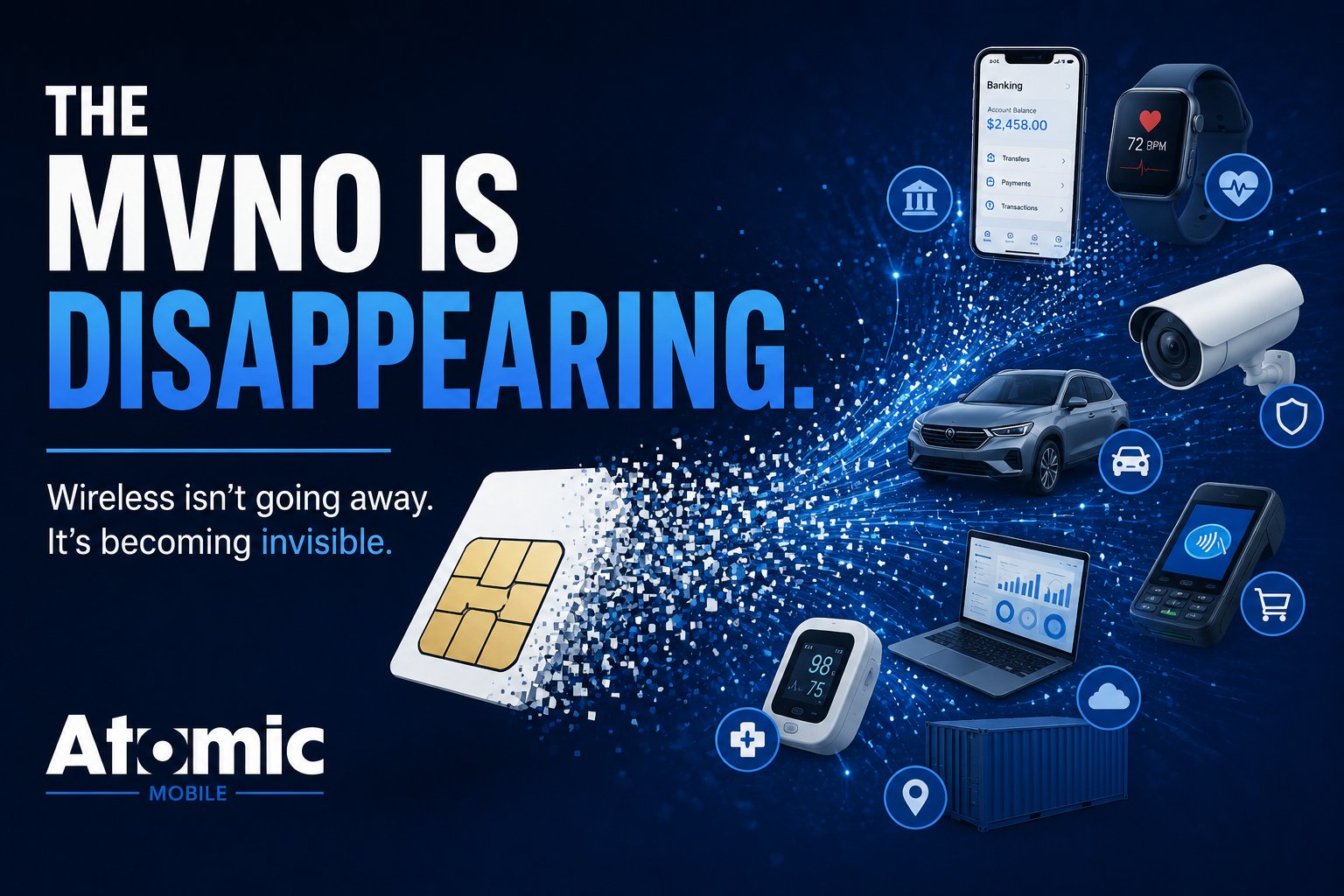
The MVNO Is Disappearing. And That’s a Good Thing.
For most of the wireless industry's history, the MVNO has been easy to recognize.
It has a name.
It has rate plans.
It sells SIM cards.
It advertises unlimited data.
It asks customers to switch from another carrier.
In other words, it looks like a wireless company.
I am increasingly convinced that some of the most successful MVNOs of the next decade will look nothing like that.
In fact, the customer may never even know they are using an MVNO.
And that may be exactly the point.
The Traditional MVNO Model
The basic MVNO model has existed for decades.
An MVNO obtains wholesale network access from a mobile network operator, packages that connectivity into plans and sells those plans to customers under its own brand.
There have been countless variations of the model, but the customer proposition has generally remained recognizable:
Buy your wireless service from us instead of someone else.
That model is not going away.
There will continue to be successful consumer MVNOs serving specific communities, demographics and price segments.
But wireless is becoming easier to integrate into products and services that have nothing to do with traditional telecom.
And that creates a much larger opportunity.
What If Nobody Has to Buy Wireless?
Think about how strange the current connectivity experience can be.
You buy a connected device.
Then you need to figure out how to connect it.
You buy software that requires mobile connectivity.
Then someone has to purchase and manage SIMs separately.
You travel internationally.
Then you need to figure out whether your existing carrier works, purchase an international plan or find another connectivity provider.
We have spent decades making wireless networks incredibly sophisticated while often leaving the customer responsible for assembling the final pieces.
That is starting to change.
The emerging model looks more like this:
Buy the product. The product connects.
No carrier selection.
No separate wireless account.
No SIM card decision.
Potentially no wireless bill at all.
Connectivity simply becomes part of the experience.
Wireless Is Becoming a Feature
We have seen this happen before in technology.
Payments used to require businesses to build complicated relationships with banks and payment processors.
Today, developers can integrate payments into an application through APIs.
Messaging followed a similar path.
Cloud computing did too.
Capabilities that once required specialized infrastructure became services developers could incorporate into other products.
I believe cellular connectivity is moving in the same direction.
With modern APIs, eSIM technology, automated provisioning and flexible billing infrastructure, connectivity can increasingly become something a company integrates rather than something a customer purchases separately.
That is the idea behind embedded connectivity.
The product does not send the customer somewhere else to obtain connectivity.
Connectivity is part of the product.
The Rise of Invisible Wireless
I think we need a better way to describe where this is heading.
I call it Invisible Wireless.
Invisible Wireless is connectivity that exists inside another product, service or customer relationship without requiring the end user to think about the network underneath it.
The customer buys the outcome.
The connectivity simply makes that outcome possible.
Consider a healthcare device used for remote patient monitoring.
The patient does not want a cellular plan.
They want the device to send their health information where it needs to go.
Consider a security camera.
The customer does not necessarily want 5 GB of cellular data.
They want the camera to work.
Consider a travel application.
The traveler does not necessarily want an eSIM.
They want their phone to have data when the plane lands.
Consider a fleet management platform.
The business does not want to manage thousands of individual SIM cards.
It wants to know where its vehicles are.
In each case, wireless is essential.
But wireless is not necessarily the product.
The Best Connectivity Experience May Be No Experience At All
Telecom has traditionally spent enormous amounts of time thinking about the wireless customer experience.
Activation.
Plan selection.
Usage.
Billing.
Support.
Upgrades.
All of those things still matter when someone is purchasing wireless service.
But embedded connectivity introduces another possibility:
What if we eliminate much of the traditional wireless customer experience entirely?
A connected device could arrive already provisioned.
An application could activate connectivity through an API.
A business could manage thousands of endpoints from its existing software platform.
Connectivity could be included in the price of the product or bundled into a recurring subscription.
The customer does not have to become an expert in telecom.
They just use the product.
That may ultimately be a better customer experience than creating a prettier wireless activation flow.
The MVNO Does Not Disappear. It Moves Behind the Product.
This does not mean the infrastructure underneath becomes less important.
Quite the opposite.
Someone still has to manage network connectivity.
Someone still has to provision the subscriber.
Someone still has to manage SIM and eSIM profiles.
Usage still has to be measured.
Billing and rating still have to occur somewhere.
Taxes and regulatory requirements do not disappear because the customer cannot see them.
Network policies still need to be managed.
Support still exists.
The complexity does not disappear.
It moves behind the curtain.
That changes the role of the MVNO and the technology supporting it.
The MVNO increasingly becomes an orchestration layer between network infrastructure and the product the customer actually wants.
APIs Change What an MVNO Can Be
This is where APIs become especially important.
Historically, launching wireless meant building a wireless business and then integrating technology around it.
Increasingly, the relationship can work in reverse.
A company already has a product.
It already has customers.
It already has billing.
It already has an application.
It already has a customer experience.
Wireless gets inserted into that existing environment.
The company's software can tell the connectivity platform:
Activate this device.
Provision this eSIM.
Suspend this line.
Change this service.
Retrieve this usage.
Apply this policy.
The telecom infrastructure becomes programmable.
That is fundamentally different from simply logging into a portal and activating SIM cards.
It allows wireless to become part of another company's software architecture.
eSIM Accelerates the Shift
Physical SIM cards created a natural boundary around wireless.
Someone had to manufacture the SIM.
Ship it.
Receive it.
Insert it.
Activate it.
eSIM begins removing that physical dependency.
And technologies such as SGP.32 can push the model further for connected devices by enabling more flexible remote management of connectivity profiles.
That matters because the easier connectivity becomes to provision programmatically, the easier it becomes to hide the complexity from the end customer.
Eventually, activating cellular connectivity could feel less like opening a wireless account and more like enabling a cloud service.
That is a significant shift.
This Creates Entirely New MVNO Categories
Once wireless becomes infrastructure instead of the primary product, the definition of an MVNO begins expanding.
A fintech company can embed wireless into a premium account.
A retailer can incorporate connectivity into its loyalty ecosystem.
A healthcare company can connect devices automatically.
A software company can bundle cellular connectivity into its platform.
A broadband provider can make mobile part of the household relationship.
A travel company can provide connectivity when a customer arrives in another country.
A hardware manufacturer can sell a connected subscription instead of a disconnected device.
I recently wrote about 10 types of businesses that should consider becoming MVNOs.
But perhaps “becoming an MVNO” is not even the best way to describe what many of them will do.
They are not necessarily entering telecom.
Telecom is entering their product.
That is a very different idea.
The Brand Still Matters. Just Differently.
None of this means brands disappear.
In many cases, the brand becomes even more important.
The difference is which brand the customer sees.
The traditional MVNO tries to build a new wireless relationship with the customer.
Invisible Wireless takes advantage of a relationship that already exists.
A bank already has customers.
A retailer already has customers.
A healthcare company already has patients.
A software platform already has users.
A manufacturer already sells products.
Those companies do not necessarily need to convince someone to trust a new wireless provider.
They can make connectivity part of a relationship the customer already trusts.
That can dramatically change the economics of customer acquisition.
It can also change the reason wireless exists inside the business.
The goal may not be maximizing wireless ARPU.
The goal might be increasing retention, improving the product, creating recurring revenue or making the primary service harder to replace.
Wireless Economics Will Change Too
Invisible Wireless also creates interesting business models.
Connectivity does not necessarily have to appear as a $40 monthly wireless plan.
It could be included in a $199 device.
It could be bundled into a $20 monthly software subscription.
It could be part of a premium banking account.
It could be included with a vehicle.
It could be metered based on actual usage.
It could be subsidized because it increases the value of another product.
That means companies evaluating wireless need to think beyond traditional telecom metrics.
The question is not simply:
How much margin do we make on the wireless plan?
The better question may be:
How much more valuable does our overall customer relationship become when connectivity is included?
That is a much larger strategic question.
The Infrastructure Becomes More Important, Not Less
There is an irony in making wireless invisible.
The easier it looks to the customer, the more sophisticated the infrastructure behind it may need to become.
A traditional MVNO might offer five plans to 20,000 smartphone customers.
An embedded connectivity platform could eventually manage hundreds of thousands or millions of endpoints across different products, usage profiles and commercial models.
Some customers may require smartphone connectivity.
Others may use tiny amounts of IoT data.
Some devices may travel globally.
Some applications may need multiple network options.
Some products may bill monthly.
Others may bundle connectivity into another subscription.
That requires flexible billing, provisioning, usage intelligence, APIs, automation and network management.
The front end becomes simpler because the back end becomes smarter.
That is why the next generation of MVNO platforms cannot simply be billing systems with SIM management attached.
They increasingly need to become connectivity orchestration platforms.
Eventually, We May Stop Calling Some of Them MVNOs
This may be the most interesting part.
If a software company embeds connectivity into its platform, is it really an MVNO?
If an automobile manufacturer provides connectivity inside every vehicle, is it an MVNO?
If a healthcare company manages cellular connections for a million medical devices, is it an MVNO?
Technically, depending on the structure, perhaps.
But the customer probably does not care.
And eventually, the terminology may matter less than the capability.
Companies will not necessarily wake up and decide:
We want to become a telecom company.
They will decide:
Our product should always be connected.
Then they will look for infrastructure that makes that possible.
That is why models such as MVNO in a Box are evolving beyond simply helping entrepreneurs create another wireless brand. The same underlying infrastructure can allow established companies to integrate connectivity into businesses that already exist.
The Future of Wireless May Be Invisible
For decades, wireless has been something customers actively purchased.
They chose a carrier.
Selected a plan.
Received a SIM.
Activated a line.
Paid a wireless bill.
That experience will continue to exist.
But it will no longer be the only model.
Increasingly, connectivity will be embedded inside products, applications and services.
The customer will not always choose the network.
They may not choose a wireless plan.
They may not even know which company is providing the underlying connectivity.
They will simply expect the product to work.
That does not mean the MVNO is actually disappearing.
It means the MVNO is becoming something much more interesting.
Infrastructure.
And if we do this correctly, the best wireless experience of the future may be the one customers never have to think about at all.
Brian Latchford
Author