The Network You Never Have to Choose: How eSIM, NTN and MVNO Platforms Could Power the Hybrid Network
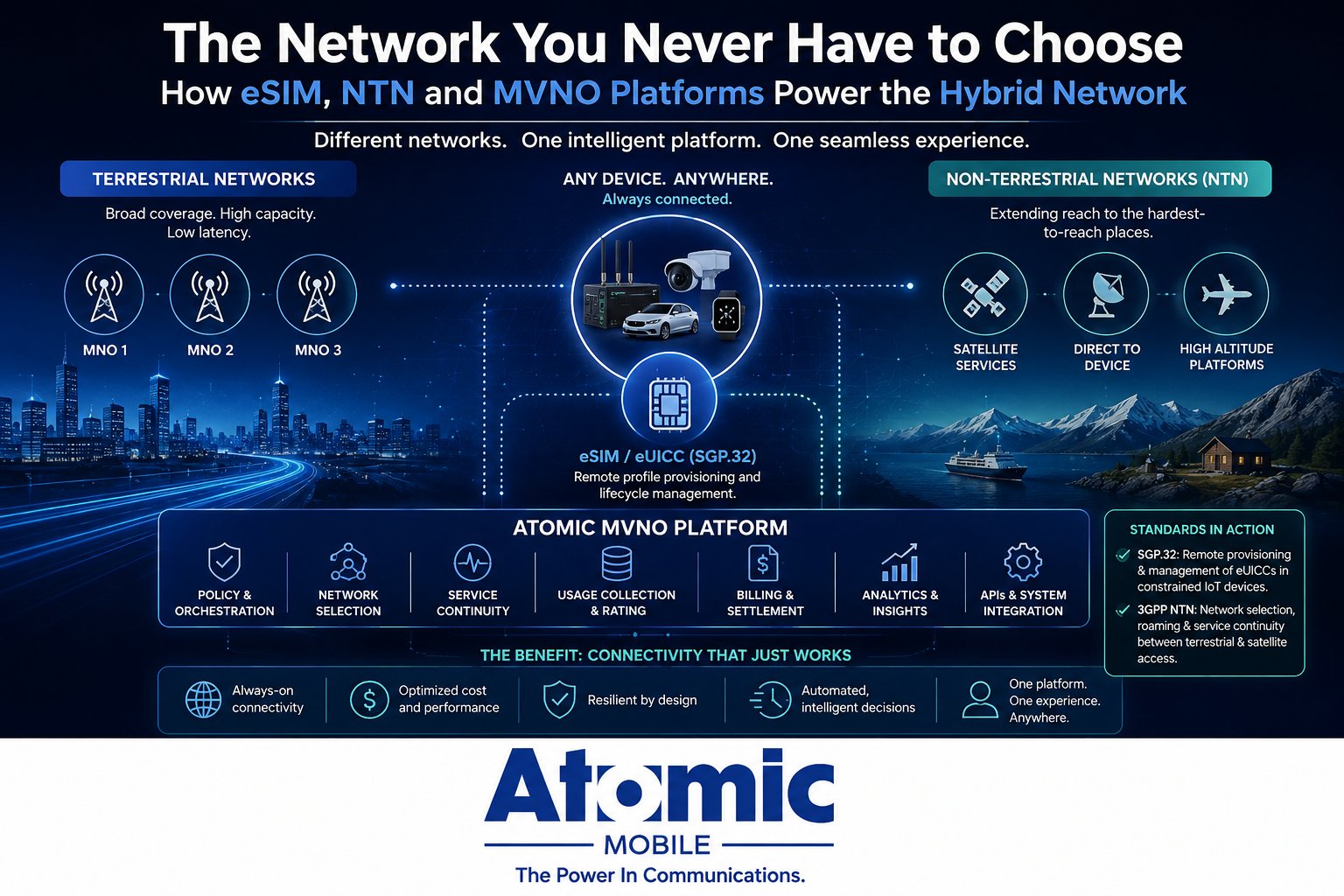
The Network You Never Have to Choose: How eSIM, NTN and MVNO Platforms Could Power the Hybrid Network
Earlier this week, I wrote about what I believe is the beginning of the hybrid network era.
The premise was simple: the future of connectivity isn't fiber vs. wireless vs. satellite.
It's all of them working together.
That raises a much more interesting question:
How does that actually work?
How does a device take advantage of terrestrial mobile networks and Non-Terrestrial Networks? How do you determine which network it should use? How do you maintain service continuity? And perhaps just as importantly, how do you manage and bill for all of it without creating a nightmare for the customer?
Part of the answer may lie in the convergence of three developments already reshaping telecom:
eSIM/eUICC. Non-Terrestrial Networks. And an increasingly intelligent MVNO platform layer.
But there is an important distinction.
eSIM profile management and terrestrial-to-NTN network selection are not the same thing.
Today, you cannot simply assume that an eUICC can switch profiles over an NTN connection. The device, network, standards and service layers all play different roles in making hybrid connectivity possible.
Understanding those differences is exactly what makes the opportunity so interesting.
The SIM Card Is Becoming Software
For most of wireless history, changing operators meant changing something physical.
A SIM card represented your relationship with a particular network.
Want another carrier? Swap the SIM.
That model works reasonably well when you're talking about a person carrying a phone.
It becomes a much bigger problem when you're talking about thousands or millions of connected devices deployed across cities, countries and continents.
You don't want to send someone into the field to replace a SIM card in a vehicle, utility meter, camera, router or piece of industrial equipment.
That's why eSIM and eUICC are so important.
The eUICC allows operator profiles to be provisioned and managed remotely. Instead of treating the operator relationship as something permanently tied to a physical SIM card, that relationship becomes increasingly programmable.
For IoT in particular, GSMA's SGP.32 architecture addresses remote provisioning and management of eUICCs in devices that may have constrained network capabilities, little or no user interface, or both.
That sounds technical.
The business implication is much simpler:
The operator relationship no longer has to be permanently tied to a physical SIM card.
And that's a very big deal.
Now Add Satellite
This gets even more interesting as Non-Terrestrial Networks, or NTN, become part of the cellular ecosystem.
Terrestrial mobile networks are incredibly good at what they do.
They provide capacity, mobility, relatively low latency and broad coverage across populated areas.
But terrestrial networks can't economically cover every square mile of the planet.
Satellite can extend connectivity into some of those gaps.
3GPP has already established standards supporting satellite access as part of the broader cellular ecosystem, including requirements around network selection, roaming and service continuity between terrestrial and satellite access.
So imagine a device designed to support both terrestrial cellular and NTN connectivity.
When terrestrial coverage is available, that may be the preferred connectivity path.
When it isn't, an NTN capable device and network could provide another path.
But here's the important distinction:
Moving between terrestrial and NTN connectivity is not simply an eSIM profile switch.
It requires support across the device, radio, network, operator relationships and service architecture.
eSIM/eUICC plays a different but complementary role: making operator profiles and connectivity relationships remotely manageable.
Those two capabilities can work together.
But they shouldn't be confused with one another.
Network Selection Becomes a Policy Decision
Today, most customers think about connectivity in terms of carriers.
"I'm on Network A."
"I'm on Network B."
In a hybrid environment, that may eventually become less relevant.
The more important question becomes:
What is the best available connectivity path for this device right now?
And "best" doesn't necessarily mean strongest signal.
It could mean:
Lowest cost.
Lowest latency.
Highest reliability.
Best geographic coverage.
Best SLA.
Preferred operator.
Emergency connectivity.
Or some combination of all of them.
As terrestrial and NTN interoperability continues to mature, policy and network intelligence could increasingly help determine which available connectivity path is appropriate based on coverage, economics, application requirements and service capabilities.
For an IoT sensor transmitting a few kilobytes of critical information from a remote location, an NTN connection could make perfect sense.
For a device attempting to download gigabytes of noncritical data, the economics might say otherwise.
The connectivity decision becomes contextual.
That's where orchestration starts becoming more valuable than connectivity alone.
Service Continuity Is the Hard Part
Moving between networks sounds simple when we describe it on a whiteboard.
In practice, the customer doesn't care that the underlying network changed.
They care whether their application stopped working.
That's why service continuity may be one of the most important pieces of the hybrid network.
3GPP has specifically addressed service continuity between terrestrial and satellite access as part of its NTN work, but real-world continuity still depends on the capabilities and configuration of the device, networks and application.
Applications may also need to account for differences in latency, bandwidth, IP behavior, session state and other network characteristics as connectivity changes.
And not every application will require the same level of continuity.
A payment terminal may have one set of requirements.
A connected vehicle may have another.
A security camera may have another.
A low-power IoT sensor transmitting once every hour may barely care at all.
This is another reason I don't think the future is simply about finding the network with the strongest signal.
The application requirement should increasingly influence the connectivity decision.
Profile Orchestration and Network Orchestration Are Different
This distinction is worth emphasizing.
An eUICC can contain and manage operator profiles.
SGP.32 provides an architecture for remotely provisioning and managing those profiles in IoT devices.
That is profile orchestration.
Determining whether a device should connect through a terrestrial network or an NTN, maintaining service as access conditions change, and applying policies to those connectivity paths involves additional capabilities.
That is network orchestration.
The two can complement each other, but one does not automatically provide the other.
And that's where I think the long-term opportunity becomes particularly interesting.
Imagine combining programmable operator relationships with increasingly interoperable terrestrial and non-terrestrial connectivity.
Now add a platform capable of managing policy, usage, economics and customer experience above it.
That's where hybrid connectivity starts becoming much more powerful.
Then Someone Has to Bill for All of It
This may be the least glamorous part of the conversation.
It's also one of the most important.
Imagine a single enterprise with 100,000 connected devices.
Some traffic travels through one terrestrial MNO.
Some may travel through another.
Devices may use different operator profiles in different countries.
And some traffic could eventually travel through an NTN service.
Each connectivity relationship may have different wholesale costs, rating structures, policies and commercial terms.
The customer doesn't want four invoices and a spreadsheet.
They want one answer:
What did my devices use, and what does it cost?
That is where the MVNO and MVNE platform becomes particularly important.
The platform can become an abstraction layer between increasingly complex network infrastructure and a customer who simply wants connectivity to work.
Usage collection.
Rating.
Billing.
Policy.
Profile lifecycle management.
Analytics.
Network preferences.
Customer management.
APIs.
Instead of exposing all of the complexity underneath, the platform can turn multiple connectivity relationships into a manageable service.
This Changes the Role of the MVNO
For years, the simplest definition of an MVNO was a company that bought wholesale mobile service from an MNO and sold it to customers under another brand.
I think that definition is becoming outdated.
The next generation of MVNOs may not simply resell a network.
They may increasingly orchestrate connectivity across networks and technologies.
That's a fundamentally different value proposition.
The underlying infrastructure could include terrestrial MNOs, Wi-Fi, private networks and, where supported, NTN connectivity.
The MVNO doesn't necessarily need to own any of them.
Its value is making the connectivity ecosystem easier for the customer to consume.
This is where the MVNO platform starts looking less like a billing system and more like a connectivity operating system.
SGP.32 Makes This Particularly Interesting for IoT
IoT may be one of the first places where we see this model develop at scale.
A smartphone has a person attached to it.
An IoT device usually doesn't.
There may be no screen.
No settings menu.
No person available to scan a QR code.
And potentially no practical way to physically access the device after deployment.
That's exactly the type of problem SGP.32 is designed to address.
Remote profile provisioning and lifecycle management can allow enterprises and connectivity providers to manage operator relationships without physically touching the device.
But it's important to be precise:
SGP.32 profile management should not be interpreted as meaning that profile switching over NTN is universally available today.
Those are different technical capabilities.
What makes the future interesting is what happens as eSIM, terrestrial connectivity, NTN and the surrounding standards and commercial ecosystems continue to mature together.
A manufacturer could increasingly envision building connected products for multiple markets.
Deploying them globally.
Managing operator profiles remotely.
Changing connectivity relationships when economics, geography or business requirements change.
Creating backup connectivity strategies.
And managing the entire fleet through a common platform.
That's not simply a better SIM card.
That's a different connectivity architecture.
The Customer Shouldn't Have to Know
This may ultimately be the most important part.
The best hybrid network experience is probably one the customer never notices.
They shouldn't need to understand eUICC profiles.
They shouldn't need to understand the difference between terrestrial and non-terrestrial access.
They shouldn't need to reconcile multiple network bills.
They should define the outcome they need.
Keep this device connected.
Prioritize reliability.
Stay below this cost.
Use the appropriate available network based on policy.
Maintain connectivity across these countries.
Then the networks, devices and platform should handle as much of the complexity underneath as possible.
That is where I believe connectivity is ultimately headed.
The Network Becomes Invisible
The evolution from physical SIM to eSIM was important.
The evolution from one connectivity option to multiple connectivity options may be even more important.
But the biggest change may happen when the customer stops thinking about networks altogether.
Fiber provides capacity.
Terrestrial wireless provides mobility.
Satellite extends reach.
eSIM/eUICC makes operator profiles remotely manageable.
NTN extends the cellular ecosystem beyond the traditional terrestrial footprint.
And the platform layer can provide the policy, management, usage, billing and commercial abstraction that helps bring those pieces together.
That's when the hybrid network becomes more than a collection of technologies.
It becomes an experience.
The best network may ultimately be the network you never have to choose.
The Atomic Perspective
At Atomic Mobile, we believe the next generation of wireless platforms will need to do much more than activate SIMs and generate bills.
As connectivity expands across terrestrial networks, IoT, eSIM, SGP.32, FWA and NTN, the platform layer becomes increasingly important.
The opportunity is to take an incredibly complex connectivity ecosystem and make it feel simple to the customer.
Because customers shouldn't have to manage networks.
They should manage their business.
Brian Latchford
Author