The Next Generation of MVNOs Won’t Start With Wireless
The Next Generation of MVNOs Won’t Start With Wireless
For most of the history of the MVNO industry, the process started with a fairly simple idea:
Let's start a wireless company.
From there came the network agreement, billing platform, SIM cards, plans, website, marketing strategy and eventually, hopefully, customers.
I think the next generation of MVNOs is going to look very different.
Many of them won't start with wireless at all.
They will start with customers.
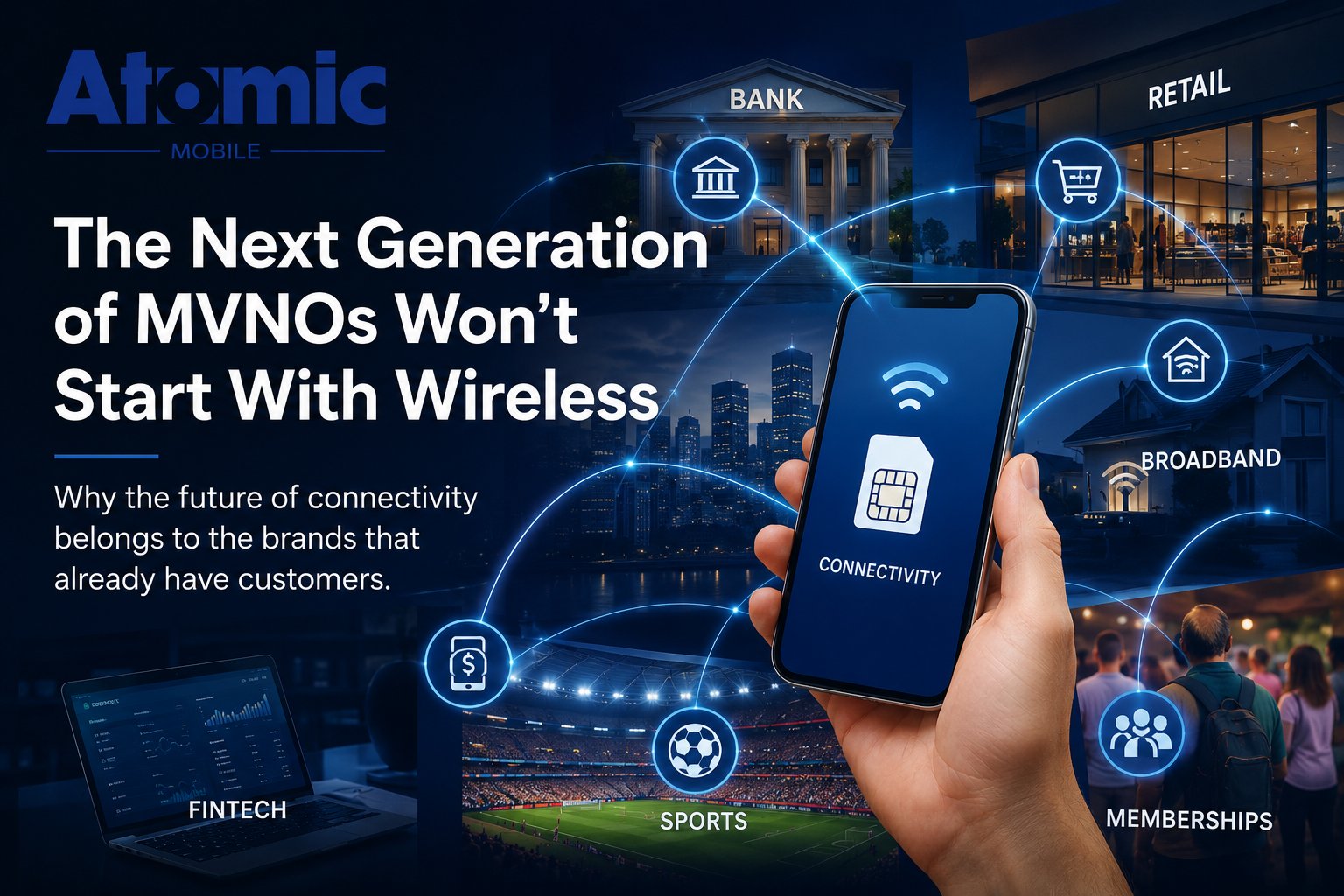
Banks. Retailers. Broadband providers. Membership organizations. sports organizations. fintech companies. software platforms. media companies. travel brands. employers. Communities built around a shared interest or identity.
These companies already have something that traditional wireless startups spend enormous amounts of time and money trying to create.
They have a relationship with the customer.
Wireless can become another product inside that relationship.
And that changes the economics of the MVNO model considerably.
The Traditional MVNO Model
Historically, launching an MVNO meant building a wireless business and then figuring out how to acquire subscribers.
That model can absolutely work. Some very successful wireless brands have been built this way.
But customer acquisition is difficult.
A new wireless company has to convince someone to leave a carrier they already know, trust a company they may have never heard of, move their phone number, potentially change their SIM or eSIM and begin paying a new company every month.
Then the MVNO has to spend enough money on advertising, retail distribution, affiliates or other acquisition channels to keep subscribers coming through the door.
That creates one of the most important calculations in wireless:
How much does it cost to acquire a customer, and how long will that customer stay?
Customer acquisition cost and lifetime value can determine whether an MVNO becomes a sustainable business or simply an expensive experiment.
But what happens when the customer already exists?
Start With the Customer, Then Add Wireless
Imagine a financial institution with hundreds of thousands of customers.
Or a retailer with millions of loyalty members.
Or a regional broadband provider with 100,000 households.
Or a sports organization with an incredibly loyal fan base.
Or a digital platform whose customers open its application every day.
These companies don't necessarily need to build an audience for wireless.
They already have one.
The question becomes whether wireless can make the existing customer relationship more valuable.
That is a fundamentally different starting point.
A retail or consumer brand might integrate wireless into its loyalty program.
A fintech or digital bank could bundle mobile service with premium accounts, rewards or other financial products.
A broadband or cable provider can add mobile service to create a converged relationship with the household.
A membership or affinity organization can offer wireless as an exclusive member benefit.
Wireless doesn't have to be the business.
It can be a product inside the business.
Wireless Is Becoming a Feature
This may be the biggest shift.
We have traditionally thought about wireless as a standalone service.
You need mobile connectivity, so you go to a mobile carrier.
But increasingly, I believe wireless will become embedded inside other products and relationships.
Think about how payments evolved.
Years ago, accepting payments required specialized infrastructure and relationships. Today, payments are embedded inside countless applications and platforms. The customer doesn't necessarily think about the payment infrastructure behind the transaction.
They simply expect it to work.
Cloud computing followed a similar path.
So did identity, messaging, mapping and many other technologies.
Wireless is beginning to move in the same direction.
The network still matters tremendously. Billing still matters. Provisioning still matters. Compliance still matters.
But the company offering the service doesn't necessarily need to build or operate all of those layers itself.
Through private label wireless, a company can put its own brand in front of the customer while the network access, provisioning, billing and operational infrastructure run behind the scenes.
That makes wireless available to an entirely different category of company.
Distribution May Be More Valuable Than Network Access
I have helped launch and support more than 100 MVNOs throughout my career.
One lesson has become increasingly clear to me:
Distribution is one of the most valuable assets an MVNO can have.
Network access is obviously essential.
Technology is essential.
Billing, provisioning, support and compliance are essential.
But none of those things automatically create customers.
Distribution does.
If you already have 500,000 customers, 200 retail locations, 50,000 members, thousands of business clients or a highly engaged digital audience, you already possess something extremely valuable.
You have a way to reach the customer.
That can dramatically change the economics of launching wireless.
Instead of spending heavily to introduce an unknown wireless brand to the market, an existing company can introduce wireless through a relationship that is already established.
The customer already knows the brand.
The company may already have the customer's payment information.
There may already be an application, website or retail location where the service can be offered.
Customer support may already exist.
The company may already understand the customer's purchasing behavior.
Suddenly, wireless isn't starting from zero.
The Economics Can Change Too
This isn't just a branding strategy.
It can change the underlying economics of the business.
Consider a traditional standalone MVNO.
Wireless revenue needs to support customer acquisition, marketing, customer service, technology, operations and hopefully profit.
Now consider a company adding wireless to an existing business.
Wireless may generate direct recurring revenue, but that might not be its only economic value.
It could also increase customer retention.
It could increase the value of a membership.
It could increase engagement with an application.
It could strengthen a broadband bundle.
It could increase loyalty program participation.
It could create additional opportunities to sell other products.
That means the lifetime value of the wireless subscriber may extend well beyond the wireless bill.
This is particularly interesting for broadband providers.
The largest cable operators have already demonstrated the power of combining broadband and mobile. Mobile isn't simply another revenue stream. It makes the overall customer relationship harder to replace.
The same concept can apply to many other industries.
Who Should Be Thinking About Wireless?
I think the list is much larger than most people realize.
Retailers with established loyalty programs should be looking at it.
Banks and fintech companies should be looking at it.
Regional fiber, broadband and cable operators should absolutely be looking at it.
Membership organizations should be looking at it.
Sports, entertainment and media brands should be looking at it.
Travel companies should be looking at it.
Software platforms with large customer bases should be looking at it.
Companies with large employee, franchise or partner ecosystems should be looking at it.
And brands with highly engaged communities should be looking at it.
The common denominator isn't telecom experience.
It's distribution.
The question isn't necessarily:
"Do we want to become a wireless carrier?"
A better question may be:
"Would connectivity make our existing customer relationship more valuable?"
If the answer is yes, the conversation becomes very different.
You Don't Need to Become a Telecom Company
This is where the technology side of the industry has changed significantly.
Historically, entering wireless could require direct carrier negotiations, significant minimum commitments, complex OSS/BSS systems, specialized telecom personnel and substantial upfront investment.
That limited who could realistically participate.
Today, an established brand can use an MVNA and MVNE platform to provide much of the underlying infrastructure.
The brand can focus on what it does best.
Its customers.
Its product.
Its distribution.
Its marketing.
Its customer experience.
Meanwhile, the telecom layer can handle network connectivity, subscriber provisioning, SIM and eSIM management, billing, taxation, compliance, usage reporting and other operational requirements.
That doesn't make launching wireless effortless.
It is still a telecommunications business and there are real operational, regulatory and financial considerations involved. I wrote about many of them in How to Launch an MVNO in 15 Steps.
But companies no longer need to build every component themselves.
That lowers the barrier to entry considerably.
The Next Great MVNO May Already Have Millions of Customers
This is the part I find most interesting.
When we talk about the future of MVNOs, we often look for the next wireless startup.
Maybe we should be looking somewhere else.
The next major wireless brand might already exist.
It may already have millions of customers.
It may already have an app installed on millions of phones.
It may already have stores across the country.
It may already process millions of payments.
It may already have a loyalty program, membership program or subscription relationship.
It just doesn't sell wireless yet.
That is why I believe the next generation of MVNO growth will increasingly come from companies that never originally intended to become telecom companies.
They won't build a wireless company and then search for customers.
They will start with customers and add wireless.
And that may turn out to be a much more powerful model.
Thinking About Adding Wireless to an Existing Business?
If your company already has customers, members, subscribers or an established distribution channel, wireless may be an opportunity to create recurring revenue while strengthening the relationship you already have.
Explore how Atomic Mobile helps companies launch wireless brands, or learn more about our MVNO in a Box platform.
Brian Latchford
Founder & CEO, Atomic Mobile
Brian Latchford
Author