The $10 Wireless Plan Isn’t a Business Model
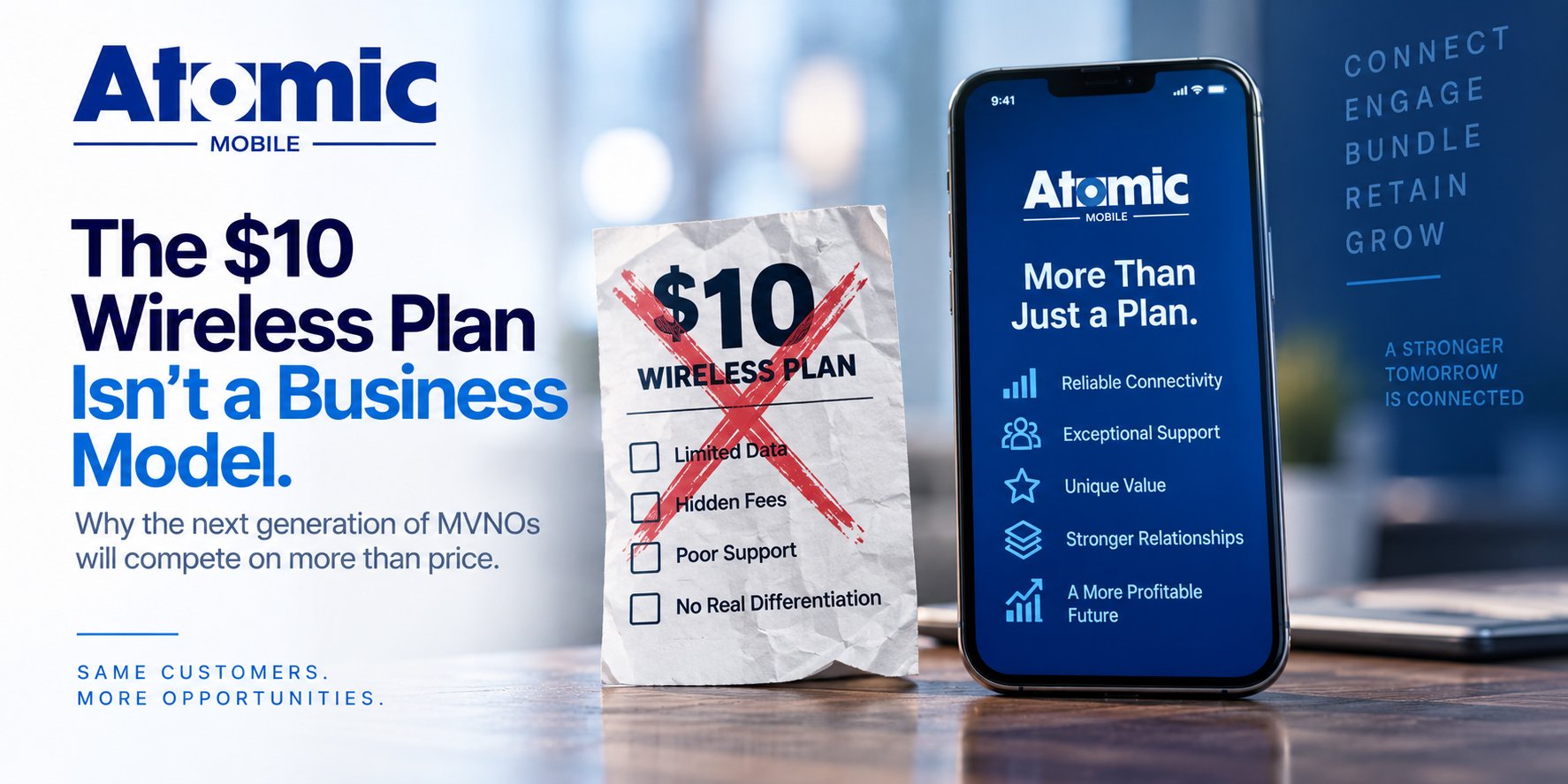
The $10 Wireless Plan Isn’t a Business Model
There will probably always be a $10 wireless plan.
Someone will offer one.
Someone else will offer $9.
Another company will advertise something for $5 with enough fine print to explain why.
That's not the problem.
The problem is building an entire wireless business around the assumption that being cheaper is enough.
It isn't.
For years, one of the easiest ways for an MVNO to explain its value proposition was:
We use the same network. We just cost less.
That message is simple.
It's also becoming increasingly difficult to build a durable business around.
The next generation of successful MVNOs won't necessarily win because they have the cheapest wireless plan.
They'll win because they have a structural reason for customers to choose them.
And increasingly, price will be part of the proposition rather than the entire proposition.
The Race to the Bottom Has a Problem
Imagine an MVNO sells a wireless plan for $20 per month.
Another operator enters at $15.
The first responds with $12.
Someone eventually gets to $10.
From the customer's perspective, this looks great.
From the operator's perspective, something very different is happening.
Every dollar removed from the retail price has to come from somewhere.
Network connectivity still costs money.
Data still costs money.
Billing still costs money.
Customer support still costs money.
Payment processing still costs money.
Taxes and regulatory compliance still exist.
SIMs, eSIMs, number porting, fraud, platforms, marketing and operations don't disappear because the retail price dropped.
Eventually, the operator isn't asking:
"How much value can we create for this customer?"
It's asking:
"What else can we remove and still make the economics work?"
That's not usually where great businesses are built.
Cheap Wireless Isn't Necessarily Profitable Wireless
The basic MVNO business model looks simple:
Retail Revenue - Cost to Serve the Subscriber = Contribution Margin
But as we explained in How Do MVNOs Make Money?, the cost of serving a wireless subscriber extends well beyond the wholesale network rate.
Consider two hypothetical plans.
Plan A
Retail price: $10
Total variable cost: $8
Contribution: $2
Plan B
Retail price: $30
Total variable cost: $20
Contribution: $10
Plan A is dramatically cheaper for the consumer.
But Plan B generates five times the monthly contribution.
That difference affects almost everything else the MVNO can do.
Customer support.
Marketing.
Technology investment.
Product development.
Customer acquisition.
Retention incentives.
And ultimately, profitability.
The cheapest plan isn't necessarily the strongest business.
Subscriber Count Can Hide the Problem
This is where wireless businesses can become deceptive.
Imagine MVNO A has:
100,000 subscribers × $2 monthly contribution = $200,000
MVNO B has:
25,000 subscribers × $10 monthly contribution = $250,000
MVNO B has one-quarter as many subscribers.
Yet it generates more monthly contribution.
That's why we recently explored How Many Subscribers Does an MVNO Need to Be Profitable?.
Subscriber count by itself doesn't tell you whether an MVNO is healthy.
The economics underneath those subscribers do.
Data Makes Ultra-Low Pricing Even Harder
Voice and messaging have become relatively predictable components of mobile service.
Data is different.
Customer data consumption continues to vary enormously.
One subscriber might use 2 GB in a month.
Another might use 50 GB.
Another might use considerably more.
If all three customers pay the same low retail price, their economics may be completely different.
This becomes especially important when an MVNO's underlying wholesale structure exposes it to usage-sensitive data costs.
A $10 plan that works beautifully at 2 GB of average consumption can look very different if actual usage becomes 10 GB.
That's why understanding usage isn't simply an operational requirement.
It's a pricing requirement.
Atomic UsageIQ gives operators near-real-time visibility into data consumption so they can better understand subscriber behavior and protect plan economics.
The less margin a plan has, the less room there is for surprises.
The Major Carriers Are Moving the Other Direction
There's another interesting signal in the market.
Major wireless carriers aren't universally racing toward cheaper plans.
They're increasingly focused on extracting more value from existing customer relationships.
As we discussed in MNO Price Increases Confirm an Atomic Signal, carriers have increased pricing on certain legacy plans, retired older offerings and used additional features and bundles to support higher-value customer relationships.
That doesn't mean MVNOs should simply follow the major carriers and increase prices.
It means the industry is recognizing something important:
Connectivity has to support sustainable economics.
If the largest operators in the country are increasingly focused on monetization, customer value and broader relationships, an MVNO should think carefully before making permanent price compression its primary competitive advantage.
The Better Question: Why Should This MVNO Exist?
This is the question every prospective MVNO should answer before choosing a plan price.
Not:
How cheap can we make wireless?
But:
Why should someone buy wireless from us?
There are many good answers.
Maybe you serve a community the large carriers don't understand particularly well.
Maybe you offer exceptional customer service.
Maybe your customers want a simpler experience.
Maybe wireless integrates with another product.
Maybe your brand already has millions of loyal customers.
Maybe your distribution costs are dramatically lower.
Maybe you serve a particular enterprise workflow.
Maybe connectivity makes another part of your business more valuable.
Those are structural advantages.
Being $3 cheaper isn't.
Someone can always become $4 cheaper.
Existing Brands Have a Different Advantage
This is where I believe one of the largest MVNO opportunities is emerging.
Some of tomorrow's most interesting wireless providers may not begin as wireless companies at all.
They may already be:
Retailers.
Fintech companies.
Banks.
Broadband providers.
Membership organizations.
Travel companies.
Software companies.
Employers.
Consumer brands.
These businesses don't necessarily need wireless itself to be the cheapest product in the market.
Wireless can strengthen something they already have.
We've written separately about why existing customers completely change the economics of adding wireless.
If a company already has 500,000 customers, its advantage may not be wholesale price.
Its advantage may be that it already has 500,000 customers.
It already has distribution.
It already has brand awareness.
It already has billing relationships.
It already communicates with those customers.
It may already have an app, loyalty program, customer support organization and marketing infrastructure.
That's much harder for a competitor to replicate than a cheap rate plan.
Wireless Can Be Worth More Than Its Margin
Suppose a company generates $8 per month in contribution from a wireless subscriber.
Viewed independently:
$8 × 12 months = $96 per year
Useful.
But what if adding wireless also makes that customer less likely to leave the company's primary business?
What if they purchase additional products?
What if they become more engaged with the brand?
What if the company can bundle wireless with another subscription?
What if wireless increases the customer's total lifetime value by $300?
Now the economics look completely different.
The wireless plan doesn't have to maximize standalone margin because wireless is creating value elsewhere in the relationship.
This is a much more defensible strategy than simply trying to undercut another carrier by $5.
Bundling Changes the Price Conversation
Consumers don't always evaluate the price of individual products in isolation.
They evaluate the value of the relationship.
Consider a hypothetical membership that includes:
Wireless service.
Premium customer support.
Device protection.
Travel connectivity.
Discounts.
Loyalty benefits.
Other digital services.
The customer might happily pay $40 for that relationship even if they wouldn't pay $40 for wireless alone.
That creates an important opportunity for MVNOs.
Instead of asking:
"How do we sell wireless for less?"
ask:
"What can we combine with wireless that makes the overall relationship worth more?"
That's a completely different pricing strategy.
And it's one large carriers already understand very well.
Niche Doesn't Have to Mean Cheap
There's also a misconception that niche MVNOs need to offer discount wireless.
They don't.
A niche can actually justify premium pricing if the product solves a specific problem.
Imagine wireless designed specifically for:
International travelers.
Remote workers.
Families.
Senior citizens.
Gig workers.
Truck drivers.
Creators.
Small businesses.
Connected-device fleets.
A particular membership community.
The value proposition doesn't have to be:
"We're cheaper than Verizon, AT&T or T-Mobile."
It can be:
"We built wireless specifically for you."
That is much harder to compare on price alone.
Better Information Creates Better Plans
One reason MVNOs historically relied heavily on simple buckets and broad plan structures was visibility.
If you don't understand exactly how customers use the network, it's difficult to design sophisticated products around them.
Better usage intelligence changes that.
An operator that understands subscriber behavior can ask:
Which customers are profitable?
Which plans are being overused?
Where are margins strongest?
Which customers need more data?
Which customers are paying for capacity they never use?
Which features actually matter?
Could we create plans around behavior rather than arbitrary data buckets?
Could pricing adapt to different customer segments?
That's where platforms such as Atomic UsageIQ become more than operational tools.
They become product-development tools.
Operational Efficiency Matters More When Margins Are Thin
A low-priced plan also creates very little tolerance for operational inefficiency.
Suppose an MVNO earns $3 per subscriber per month.
A billing error costs money.
An unnecessary support call costs money.
A failed activation costs money.
Fraud costs money.
A disconnected system requiring manual intervention costs money.
Each problem consumes a meaningful percentage of the subscriber's contribution.
That's why MVNO profitability isn't only about negotiating the lowest possible wholesale rate.
It's also about building an efficient operating model.
Atomic Fusion is designed to reduce fragmentation across billing, taxation, compliance, support and other operational functions.
And an MVNO in a Box approach can eliminate much of the cost and complexity associated with assembling a wireless operation from multiple disconnected components.
Efficiency creates room for margin.
This Doesn't Mean Cheap Plans Are Going Away
They aren't.
There will continue to be successful low-cost wireless providers.
There will continue to be customers who primarily shop on price.
There will continue to be opportunities for operators with extremely efficient distribution and operating structures to offer inexpensive plans profitably.
The point is different.
Low price needs an economic reason behind it.
Maybe the MVNO has virtually no customer acquisition cost.
Maybe its customers use very little data.
Maybe wireless supports another profitable product.
Maybe distribution is already paid for.
Maybe automation dramatically reduces operating expenses.
Maybe the wholesale model is uniquely advantageous.
Those are legitimate reasons an operator might profitably sell inexpensive wireless.
But:
"We'll charge less than everyone else and make it up with subscribers"
isn't a strategy unless the underlying unit economics support it.
Price Is Easy to Copy. Distribution Isn't.
This may be the most important distinction.
If your competitive advantage is a $15 wireless plan, another company can launch a $14 plan tomorrow.
But competitors can't easily copy:
Your customer base.
Your brand.
Your distribution.
Your community.
Your technology.
Your proprietary data.
Your customer relationships.
Your ecosystem.
Your partnerships.
Your expertise in a specific market.
Those are the assets around which the next generation of MVNOs should be built.
Wireless becomes the connectivity layer that makes those assets more valuable.
Start With the Advantage, Then Build the Plan
When companies approach Atomic Mobile's MVNO platform, the conversation shouldn't begin with:
"What's the cheapest unlimited plan we can sell?"
It should begin with:
Who are the customers?
Why would they buy wireless from this company?
How will we reach them?
What does the existing customer relationship look like?
What should wireless accomplish?
What will acquisition cost?
How much data will customers realistically consume?
What contribution margin does the business need?
What else can be bundled with connectivity?
What happens to customer lifetime value?
Only then should the retail plan be designed.
The business model should determine the price.
The price shouldn't determine the business model.
The Bottom Line
The $10 wireless plan isn't dead.
But the idea that cheap wireless by itself is a durable competitive strategy should be.
The strongest MVNOs won't necessarily be the operators offering the lowest monthly bill.
They'll be the ones with a reason customers choose them beyond price.
Some will have powerful brands.
Some will have built-in distribution.
Some will serve highly specific communities.
Some will embed wireless inside another product.
Some will use connectivity to increase retention and lifetime value.
Some will create customer experiences traditional carriers can't easily replicate.
And some will still offer $10 plans.
But they'll know exactly why $10 works.
That's the difference.
Don't start by asking:
"How cheap can we sell wireless?"
Start by asking:
"What advantage do we have that makes wireless valuable?"
Then build the economics around that advantage.
Atomic Mobile helps companies design, launch and scale wireless businesses using integrated network access, MVNE technology, usage intelligence and managed operational services.
If you're evaluating an MVNO opportunity, talk to Atomic Mobile about the economics behind the business before choosing the price on the plan.
Frequently Asked Questions
Can an MVNO make money with a $10 wireless plan?
Potentially. Profitability depends on the wholesale cost of connectivity, subscriber data usage, customer acquisition cost, operating expenses, churn and other sources of customer value. A $10 plan can work when the underlying economics support it, but the retail price alone doesn't determine profitability.
Why shouldn't an MVNO compete only on price?
Price is easy for competitors to match or beat. Customer relationships, distribution, brand affinity, specialized products and unique customer experiences are generally more defensible competitive advantages.
What determines the right price for an MVNO plan?
An MVNO should consider wholesale network costs, expected data consumption, platform and operational expenses, customer acquisition cost, desired contribution margin, competitive positioning and the broader value wireless creates for the business.
Are low-cost MVNOs still viable?
Yes. Efficient MVNOs with favorable acquisition economics, controlled usage, low operating costs or complementary revenue streams can successfully offer inexpensive wireless plans. The key is having a structural reason the low price is economically sustainable.
Does an MVNO need to be cheaper than the major carriers?
No. MVNOs can compete through specialization, customer service, bundling, community, brand affinity, unique features, embedded connectivity or a better overall customer experience rather than simply offering the lowest price.
How can an MVNO protect margins?
Operators can protect margins by understanding subscriber usage, controlling customer acquisition costs, reducing churn, automating operations, designing plans around actual customer behavior and closely monitoring the complete cost of serving each subscriber.
Brian Latchford
Author