The Invisible Handoff: What It Takes to Make Hybrid Connectivity Actually Work
The Invisible Handoff: What It Takes to Make Hybrid Connectivity Actually Work
Over the last couple of weeks, we've been exploring what I believe is one of the more important changes happening in connectivity.
First, we talked about the **Hybrid Network Era** and why the future isn't fiber vs. wireless vs. satellite.
Then we looked at how eSIM/eUICC, Non-Terrestrial Networks (NTN) and the platform layer could help make that increasingly complex connectivity ecosystem easier to consume.
But those conversations raise another question:
What does it actually take to make all of this feel seamless?
Because giving a device access to multiple connectivity options is one thing.
Making the transition between them invisible to the customer is something entirely different.
And that's where the engineering gets interesting.
The Goal Isn't More Networks
It's tempting to think that hybrid connectivity is primarily about giving a device access to as many networks as possible.
More carriers.
More Wi-Fi.
More satellite coverage.
More options.
But that's not necessarily the goal.
The goal is giving the device access to the right connectivity at the right time while exposing as little of the complexity as possible to the customer.
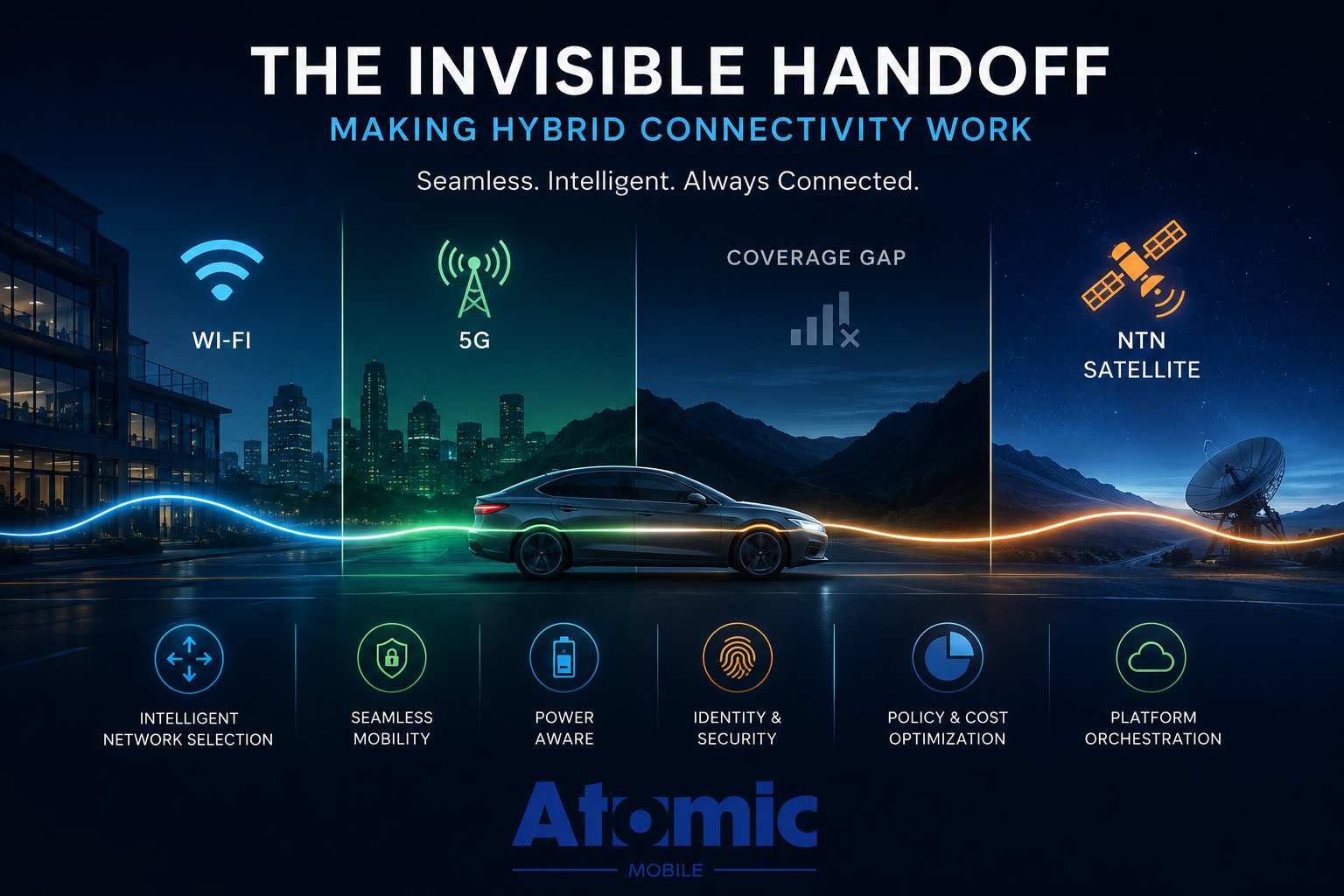
Imagine driving through an area with strong terrestrial 5G coverage.
Your vehicle uses the terrestrial network.
As you enter an area where terrestrial coverage disappears, satellite connectivity becomes available.
Later, the vehicle arrives at a facility with high-capacity Wi-Fi.
Three different access technologies may have been involved.
From the customer's perspective, there should ideally be only one experience:
The application kept working.
That's the promise.
Delivering it is much harder.
A Handoff Is More Than Changing Signals
When we talk about moving between networks, it's easy to imagine a device simply looking around and selecting another signal.
In reality, there is much more happening underneath.
The device and network may need to deal with:
Network discovery.
Authentication.
Network selection and reselection.
Session continuity.
IP connectivity.
Latency changes.
Timing.
Signaling.
Application state.
Security policies.
Billing.
And potentially completely different network architectures.
Add NTN to the equation and several additional challenges become more pronounced.
Satellites move.
Propagation distances are much greater.
Latency characteristics change.
Doppler effects become significant.
Coverage itself may move relative to the device.
The network has to account for all of it.
The customer shouldn't have to.
Satellite Changes the Physics
A terrestrial cell tower and a satellite aren't simply two different versions of the same radio.
The physics are different.
With terrestrial networks, the distance between the device and the radio infrastructure is relatively small.
With NTN, the signal may travel hundreds or even thousands of kilometers.
That creates challenges around propagation delay, timing and synchronization.
Non-geostationary satellites introduce another variable: movement.
A satellite may be moving rapidly relative to a device on Earth, which introduces Doppler shift and changing coverage patterns.
3GPP's NTN standards account for these differences.
For example, NTN-capable devices can use information about satellite position and their own location to compensate for timing and frequency differences when communicating with the network.
That is an extraordinary amount of complexity happening simply so the device can do something the customer considers completely ordinary:
Connect.
Mobility Gets More Complicated When the Network Moves Too
Traditional cellular mobility is already sophisticated.
Your phone can move between cells while you're driving down the highway without requiring you to think about which tower you're using.
Now imagine that the network itself is moving.
That's part of the challenge with Low Earth Orbit satellite systems.
Instead of simply tracking the movement of the device, the system may also need to account for changing satellite coverage.
3GPP has introduced mechanisms specifically designed for NTN mobility, including time-based and location-based handover conditions.
The network can provide satellite orbital information, known as ephemeris, that helps the device understand the availability and movement of NTN coverage.
Release 18 added further enhancements around NTN-to-terrestrial and terrestrial-to-NTN mobility and service continuity.
The objective is straightforward even if the implementation isn't:
Keep the service working while everything underneath it changes.
Then There's Signaling
Every network transition creates communication between devices and networks.
At small scale, that's manageable.
At massive scale, it becomes an architecture problem.
Imagine thousands of IoT devices in an area temporarily losing satellite coverage.
When coverage returns, they could all attempt to reconnect at roughly the same time.
That creates signaling load.
3GPP has specifically addressed scenarios involving many devices simultaneously returning to coverage, including mechanisms intended to reduce signaling overload.
This matters because hybrid cellular/NTN connectivity isn't just about whether one device can switch networks.
It's about whether millions of devices can do it efficiently.
That distinction becomes extremely important in IoT.
Interference Doesn't Disappear Either
More connectivity options also mean more radio environments to manage.
Terrestrial networks already deal with interference through spectrum planning, power control, beamforming and network optimization.
NTN introduces additional considerations.
Satellite systems may use different frequencies, beam patterns, orbital configurations and power characteristics.
Frequency reuse becomes important.
Beam management becomes important.
Coexistence becomes important.
None of those problems are solved by an MVNO platform.
And that's an important distinction.
The radio network, chipset, device, satellite operator and standards ecosystem still have enormous engineering responsibilities underneath the connectivity experience.
The platform layer doesn't replace those systems.
It sits above them.
Battery Life May Be One of the Most Important Constraints
This is particularly important for IoT and wearables.
Connectivity has a cost that doesn't appear on an invoice.
Power.
Searching for networks consumes power.
Measuring networks consumes power.
Transmitting consumes power.
Maintaining signaling relationships consumes power.
Satellite communications can introduce different link-budget and timing considerations than terrestrial connectivity.
For a vehicle connected to a large battery, this may not be a major concern.
For a tiny IoT sensor expected to operate for five or ten years on a battery, it can be critical.
That means the "best available network" isn't necessarily the network with the best coverage or lowest latency.
Sometimes the best network is the one that lets the device go back to sleep fastest.
This is where network intelligence becomes much more nuanced.
The decision may need to consider:
Coverage.
Cost.
Latency.
Reliability.
Battery impact.
Application priority.
Available bandwidth.
Policy.
The correct answer may be different for every device.
Identity Adds Another Layer
There's another part of hybrid connectivity that deserves more attention:
Who is actually connecting?
In traditional cellular, we tend to think about identity through the SIM.
But hybrid connectivity can involve multiple identity models.
A device might have an eSIM identity.
An enterprise may have its own identity and security policies.
An application may authenticate separately.
A Wi-Fi environment may use certificates or enterprise credentials.
Different connectivity environments may therefore involve different authentication mechanisms.
That means orchestration isn't simply about choosing a radio network.
It may also involve understanding:
Who owns the device?
Who is using it?
Which enterprise controls it?
Which services is it authorized to access?
Which connectivity policies apply?
The more networks we combine, the more important identity and policy become.
Not Every Network Has the Same Economics
Then we get to another uncomfortable reality.
Not every connection costs the same.
Some connectivity may be included in an enterprise agreement.
Some may be metered.
Some may be public Wi-Fi.
Some may involve wholesale cellular rates.
Satellite connectivity may have completely different economics.
So network selection can't be based purely on technical performance.
Imagine two networks are available.
Network A has slightly better performance but costs ten times as much.
Network B easily meets the application's requirements at a fraction of the cost.
Which one should the device use?
For a critical emergency message, cost may barely matter.
For a routine software update, it may matter enormously.
This is why hybrid connectivity ultimately becomes both a technical and commercial orchestration problem.
Where Does the MVNO Platform Fit?
This is where we need to be precise.
An MVNO platform isn't going to solve Doppler shift.
It isn't going to synchronize a handset with a satellite.
It isn't going to eliminate radio interference.
And it isn't going to magically extend battery life.
Those responsibilities exist deeper in the device, chipset, radio network and standards layers.
But the platform can play an increasingly important role above them.
It can help manage:
Connectivity policy.
Operator relationships.
eSIM profile lifecycle (including SGP.32 remote provisioning for IoT).
Usage.
Rating.
Billing.
Customer entitlements.
APIs.
Analytics.
Commercial rules.
Application requirements.
And potentially decisions about how different available connectivity options should be consumed.
That is a different type of orchestration.
The network layer makes connectivity technically possible.
The platform layer can help make connectivity commercially and operationally usable.
That's an important distinction.
Maybe We Need to Stop Calling It an MVNO Platform
This raises a bigger question.
If a platform eventually manages cellular connectivity, eSIM profiles, Wi-Fi policies, enterprise identity, IoT devices, satellite services, usage, billing and APIs, is it still simply an MVNO platform?
Maybe not.
The traditional MVNO platform was built around a relatively straightforward relationship:
One customer. One mobile service provider. One underlying MNO.
The connectivity environment we're describing looks very different.
One customer.
Thousands or millions of devices.
Multiple identities.
Multiple access technologies.
Multiple network providers.
Different economics.
Different application requirements.
And one desired customer experience.
That starts looking less like traditional MVNO enablement and more like a connectivity orchestration platform.
I think that distinction will become increasingly important.
The Best Handoff Is the One Nobody Notices
We've spent a lot of time in telecom talking about network performance.
And we should.
But perhaps one of the best measures of the next generation of connectivity will be how little the customer has to think about it.
A vehicle moves from terrestrial coverage to satellite.
A device moves from cellular to Wi-Fi.
An IoT sensor selects a connectivity path based on power and application requirements.
An enterprise changes an operator relationship without physically touching thousands of devices.
Behind the scenes, an enormous amount may be happening.
Authentication.
Signaling.
Synchronization.
Mobility.
Policy.
Billing.
Identity.
Network selection.
Power management.
The customer shouldn't need to understand any of it.
The future of hybrid connectivity isn't simply giving devices access to more networks.
It's making the transition between those networks boring.
Because when connectivity becomes truly seamless, the network disappears from the customer's experience.
And that's probably the point.
The Atomic Perspective
At Atomic Mobile, we believe the connectivity platform of the future will need to understand far more than SIM activation and billing.
As terrestrial networks, eSIM, IoT, Wi-Fi, FWA and NTN continue to converge, complexity underneath the customer experience will increase.
Our industry's job should be to make the experience above it simpler.
The network engineers will solve extraordinarily difficult radio problems.
Device manufacturers will solve extraordinarily difficult hardware and power problems.
Standards organizations will continue defining how these systems interoperate.
And the platform layer will have an increasingly important job:
Turn all of that complexity into something customers can actually use.
Because the most impressive network transition may ultimately be the one the customer never knew happened.
Atomic Mobile: Small actions. Massive results.
Brian Latchford
Author